
Article Summary:
- Batch record delays cost pharmaceutical manufacturers millions in tied-up inventory and missed market opportunities.
- Manual documentation, incomplete data, and sequential review workflows are the primary causes on why batch records delay product release. Each of those bottlenecks traces back to how quality control in pharma manufacturing is structured across documentation, review, and release.
- Quality assurance bottlenecks occur when 100+ page paper records require line-by-line verification before approval.
- Late-stage deviation investigations extend release timelines by days or weeks when issues surface during final review. Those review steps exist because the cGMP manufacturing requirements behind every release demand documented verification before product ships.
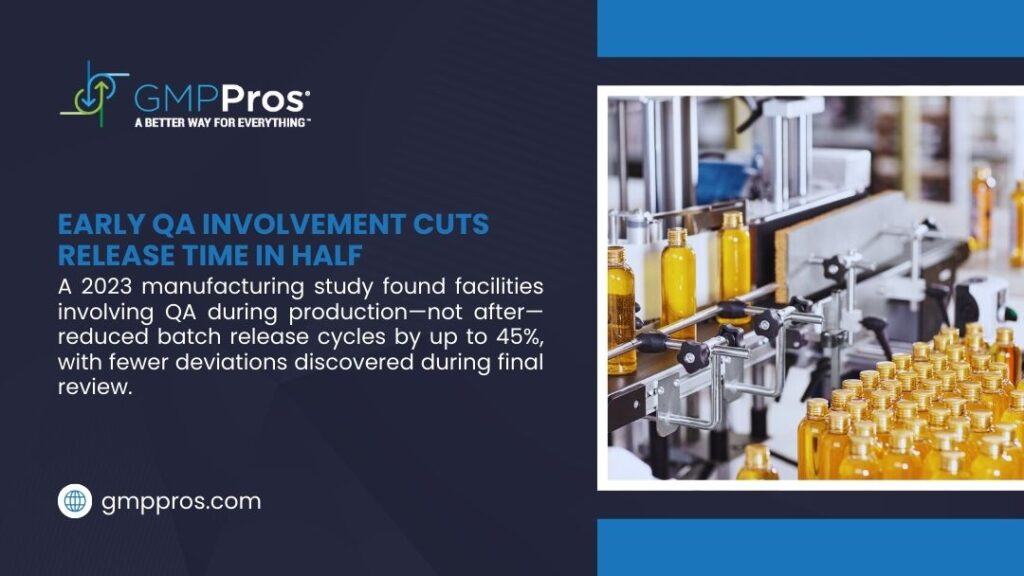
- Electronic batch record systems with parallel workflows reduce release time by 40-50% while maintaining full GMP compliance.
This guide explains the specific reasons why batch records delay product release and shows you practical solutions to accelerate batch release without compromising FDA compliance.
What Batch Records Must Prove Before Release
Under 21 CFR 211.192, the quality control unit must review and approve all batch production records before distribution. This mandatory review verifies that manufacturing followed approved procedures and met all specifications.
Quality teams must confirm several critical elements:
- Documentation Completeness
Every required signature, timestamp, and data entry must appear in the batch record. Missing information stops the review immediately and sends the record back to production.
- Material Traceability
The batch record must show exact lot numbers for every raw material used. Quality verifies these materials had valid release status at the time of use.
- Process Compliance
Each manufacturing step must match the approved master batch record. Any deviation from standard procedures requires formal investigation and quality assessment.
- Test Results
Under Current Good Manufacturing Practice for Finished Pharmaceuticals, laboratory results must confirm the product meets all specifications for identity, strength, purity, and quality. Out-of-specification results trigger extensive investigation.
- Yield Verification
Actual yields must fall within expected ranges based on the formula. Large discrepancies indicate material losses or process problems that need explanation.
This verification protects patient safety but also creates the delays manufacturers experience. Understanding why batch records delay product release starts with recognizing where bottlenecks occur in this required process.
Primary Reasons Why Batch Records Delay Product Release
Several specific factors extend the time between production completion and final quality approval. These delays compound when multiple problems affect the same batch.
- Manual Documentation Takes Days to Complete
Paper batch records require operators to hand-write every measurement, observation, and signature during production. This manual process creates immediate delays.
Operators often complete documentation hours or even days after they finish the actual manufacturing work. Production pressures mean operators focus on making product first and filling out paperwork second.
One mid-size pharmaceutical facility tracked their documentation completion times:
| Production Shift | Average Documentation Delay |
| Day shift | 4-8 hours after production |
| Evening shift | 12-18 hours after production |
| Night shift | 18-24 hours after production |
| Weekend shift | 24-48 hours after production |
These delays mean quality teams cannot start their review until well after the batch physically completes. The clock keeps running while records sit incomplete.
Missing signatures create additional delays. When quality reviewers find unsigned steps, they must track down the operator who performed that work. On different shifts or after several days, finding the right person takes time.
Illegible handwriting forces callbacks to clarify entries. Quality reviewers cannot approve records when they cannot read critical data points. Each callback adds hours or days to the cycle.
- Sequential Review Workflows Create Bottlenecks
Traditional quality processes force each review step to complete before the next one starts. This sequential approach extends timelines unnecessarily.
The typical workflow looks like this:
| Review Stage | Who Performs It | Typical Duration |
| Documentation completion | Production operators | 0.5-2 days |
| First-pass review | Production supervisor | 0.5-1 day |
| Completeness check | QA coordinator | 0.5-1 day |
| Technical review | QA specialist | 1-3 days |
| Deviation assessment | QA manager | 1-2 days |
| Final approval | QA director | 0.5-1 day |
Each handoff adds waiting time. The batch record sits in someone’s queue while they work through their other priorities. High-priority batches wait behind routine reviews with no way to jump the line.
Laboratory results often arrive separately from production records. Quality teams cannot complete their review until all testing finishes and this split timing means reviewers must revisit the same batch record multiple times instead of approving it in one session.
- Deviation Investigations Extend Release Timelines

Any deviation from the master batch record requires formal investigation before quality can approve release. These investigations represent a major reason why batch records delay product release.
Common deviations that trigger investigation:
| Deviation Type | Investigation Time | Common Causes |
| Temperature excursion | 3-7 days | Equipment malfunction, operator error |
| Missing step documentation | 2-5 days | Forgotten signature, unclear procedure |
| Out-of-specification result | 5-15 days | Material variation, test method issue |
| Yield outside limits | 3-10 days | Process loss, calculation error |
| Equipment cleaning verification | 2-4 days | Incomplete documentation, failed test |
Each investigation requires root cause analysis, quality impact assessment, and corrective action decisions. Complex deviations may need input from multiple departments, which extends the timeline further.
Late-stage discovery makes investigations longer. When quality reviewers find a problem days after it occurred, reconstructing what happened becomes difficult. Operators may not remember details clearly, and supporting evidence may not be available.
- Paper Records Limit Reviewer Efficiency
Physical paper batch records create practical limitations that slow the review process. Only one person can look at a paper document at a time, which prevents parallel review activities.
Quality reviewers spend hours manually verifying routine data points:
- Checking that every required field has an entry
- Confirming signatures match authorized operator lists
- Verifying calculations by re-doing the math manually
- Cross-referencing material lot numbers against release records
- Comparing process parameters against specification limits
A 150-page batch record for a complex sterile product might take 6-8 hours of dedicated review time. Reviewers experience fatigue from this repetitive verification work, which increases the chance of missing actual problems.
Paper records also prevent real-time visibility into batch status. Production managers cannot tell which batches are ready for review or stuck in the queue. Quality managers cannot prioritize work based on business urgency because they lack current information.
Understanding the batch record review process helps manufacturers identify where their specific delays occur and target improvements effectively.
- Inadequate System Integration Causes Information Delays
Manufacturing, laboratory, and quality systems often operate independently without data connections. This separation creates delays when information must transfer manually between systems.
Quality reviewers wait for:
| Record Type | Manual Handling Requirement | Cycle Time Impact |
| Laboratory certificates | Printed and physically attached to the batch record | Delays QA review while waiting for lab documentation |
| Equipment logs | Collected by production supervisors from multiple sources | Adds time due to manual gathering and verification |
| Material certifications | Retrieved by purchasing from supplier files | Can place batches on hold while documentation is located |
| Environmental monitoring data | Compiled from separate records by facilities teams | Slows batch closure and final QA approval |
Each piece of missing information stops the review until someone locates and delivers it. A batch record might sit on a quality reviewer’s desk for days while they wait for one laboratory certificate.

How Modern Solutions Reduce Release Delays
Electronic batch record systems address the core problems that cause delays. These validated software platforms change how manufacturers document, review, and release batches.
Immediate Documentation Completion
Electronic systems capture data in real-time during production. Operators enter information directly into tablets or workstations as they perform each step. The documentation completes when production completes, with no lag time.
Required fields prevent operators from skipping steps or leaving blanks. The system enforces completeness automatically, which eliminates the back-and-forth to add missing signatures later.
Parallel Review Workflows
Electronic batch records allow multiple reviewers to access the same record simultaneously from different locations. Quality can begin preliminary verification while production still finishes late-stage activities.
As operators complete each section, that portion becomes available for quality review. By the time the last production step finishes, quality has already verified 70-80% of the record.
Automated Deviation Detection
Modern systems flag deviations immediately when they occur rather than days later during quality review. Automatic alerts notify the right people to start investigation while the event remains fresh.
Built-in workflows guide investigation steps and enforce documentation requirements. This structure speeds resolution and ensures nothing gets missed.
Review-by-Exception
Electronic systems automatically verify routine data points against specifications. Quality reviewers receive exception reports that highlight only items needing human judgment.
A 150-page paper record becomes a 3-page exception report. Reviewers focus their expertise where it matters instead of manually checking every line. This approach is one of the most effective ways to address why batch records delay product release in traditional paper systems.
System Integration
Connected platforms share data automatically between manufacturing execution systems, laboratory information systems, and quality management systems. Information flows in real-time without manual transfer.
Quality reviewers see laboratory results the moment testing completes. Material certifications link automatically to batch records when materials get issued. Equipment data populates directly from process instruments.
| Traditional Paper System | Electronic Integrated System |
| Sequential reviews | Parallel reviews |
| Manual data verification | Automatic verification |
| Single-person access | Multi-user access |
| Delayed deviation detection | Real-time alerts |
| Manual information gathering | Automatic data flow |
| 7-15 day typical cycle time | 2-5 day typical cycle time |
Accelerate Your Batch Release with GMP Pros
GMP Pros embeds production engineers with FDA-regulated manufacturers to eliminate the bottlenecks that cause delays. Our team brings hands-on experience implementing electronic batch record systems, redesigning quality workflows, and integrating manufacturing systems.
We understand why batch records delay product release because our engineers have worked inside pharmaceutical, biologics, and medical device facilities facing these same challenges. Our approach delivers practical improvements that reduce cycle time while maintaining full GMP compliance and FDA readiness.
Contact GMP Pros today to discuss how our production engineering and electronic batch record implementation services can help your facility release products faster.
Frequently Asked Questions (FAQ) On Why Batch Records Delay Product Release
Why do batch records delay product release in pharmaceutical manufacturing?
Batch records delay product release primarily due to manual documentation completion times, sequential review workflows, and late-stage deviation investigations. Paper-based systems require extensive manual verification that takes quality reviewers 6-8 hours per complex batch.
How long should batch record review take?
Target review timelines vary by product complexity. Simple oral solid doses should complete in 3-5 days from production finish to quality approval, sterile injectables typically require 7-10 days and complex biologics may need 10-15 days. Facilities that exceed these timelines without clear justification lose competitive position as customers choose suppliers with faster release.
What causes the longest delays in batch record review?
Deviation investigations cause the longest delays, often adding 5-15 days when out-of-specification results or process deviations occur. Late-stage discovery of problems makes investigations longer because evidence may not be available and operators may not remember details clearly.
How can electronic batch records reduce release delays?
Electronic batch records reduce delays by capturing data in real-time during production, which eliminates documentation completion lag time.
What percentage of batch release time is wasted on manual verification?
Quality reviewers typically spend 60-70% of their review time on routine manual verification tasks when using paper batch records. This includes checking that fields are filled in, verifying signatures, re-doing calculations, and cross-referencing lot numbers.