
Article summary: Batch record errors are a leading, preventable driver of drug recalls. Preventing batch record-related product recalls depends on four controls that most manufacturers already own but underuse: disciplined record review, hard-gated release workflows, electronic batch record (EBR) and MES systems, and data integrity practices that satisfy FDA scrutiny. This playbook connects each control directly to the recalls it stops.
A recall almost never starts on the loading dock. It starts on a page, a field left blank, a signature added a day late, a deviation never explained. The batch manufacturing record is the legal proof that a lot was made correctly, and when that proof is flawed, a nonconforming product can move to distribution before anyone notices. Preventing batch record-related product recalls is a documentation-integrity discipline first and a quality-control activity second.
Why Batch Records Sit at the Center of Product Recalls
The batch manufacturing record (BMR), sometimes called the batch production record (BPR), is the contemporaneous account of how a specific lot was made, tested, and released. Under 21 CFR 211.188 and 211.194, it must capture every significant step, weight, yield, deviation, and laboratory result for the batch. FDA treats the record as the primary evidence that current Good Manufacturing Practice (cGMP) was followed.
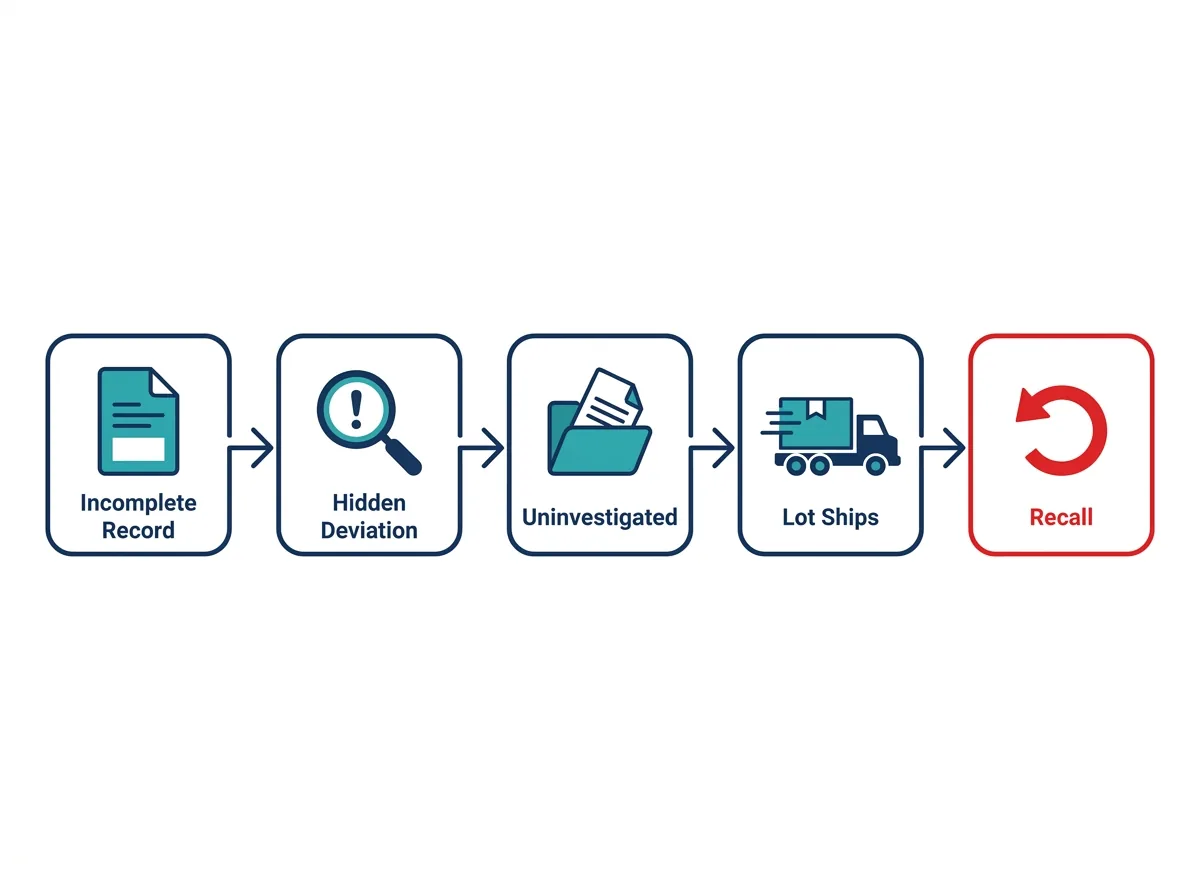
The causal chain to a recall is short. An incomplete or incorrect record hides a deviation. The deviation goes uninvestigated. A nonconforming lot receives disposition and ships. Weeks later, a complaint, a stability failure, or an inspection surfaces the defect, and the firm faces a field action. The record was the checkpoint that should have caught it.
Recall authority itself flows from this logic. FDA’s guidance on how recalls are classified and conducted, set out in its Regulatory Procedures Manual, Chapter 7, ties field action to whether a product violates the law or poses a health risk, conditions a defective record frequently signals long before the product does. Framing the problem this way changes where you spend effort: not on catching bad product at the dock, but on making the record trustworthy at the source.
What Is a Batch Recall?
A batch recall is a manufacturer’s removal or correction of a specific lot (or set of lots) of a marketed product that violates FDA regulations or presents a safety, identity, strength, quality, or purity defect. It can be voluntary or FDA-requested, and it targets the affected batch rather than the entire product line.
FDA sorts recalls into three classes by health risk, a framework detailed in the StatPearls reference on FDA recalls:
- Class I, reasonable probability of serious harm or death (e.g., a sterility or potency failure).
- Class II, temporary or reversible harm, or remote risk of serious harm (e.g., a labeling or reconciliation error).
- Class III, unlikely to cause harm but still in violation (e.g., a minor documentation or GMP lapse).
| Recall class | Health risk | Typical batch-record trigger |
|---|---|---|
| Class I | Serious injury or death | Undocumented sterility assurance failure; potency/OOS result released without investigation |
| Class II | Temporary/reversible harm | Reconciliation or line-clearance error; wrong label version not caught at review |
| Class III | Unlikely harm, still noncompliant | Missing signature, minor transcription error, incomplete cGMP documentation |
The Batch Record Errors That Most Often Lead to Recalls
Most record-driven recalls trace back to a familiar set of defects. Missing or backdated signatures break the chain of accountability. Unexplained deviations leave a known problem uninvestigated. Transcription errors move a wrong number downstream. Failed material or yield reconciliation hides a mix-up. Out-of-specification results that go uninvestigated let a failing lot look passable. Weight and potency calculation errors misstate strength. Incomplete line clearance opens the door to cross-contamination and mislabeling.
Each maps to a recall category regulators see constantly. A retrospective analysis of FDA recalls published in Drug Discovery Today shows how consistently manufacturing and documentation failures cluster behind contamination, out-of-specification potency, and labeling events.
The recall reason on the public notice reads “potency” or “labeling,” but the root cause on the CAPA reads “record.”
For a deeper breakdown of how these defects arise and where controls fail, see this guide to batch record errors in pharma, types, causes, and prevention strategies. The pattern it describes is the raw material every recall-prevention program has to work against.
Building a Batch Record Review Process That Catches Failures First
Core Components of a Review Process That Prevents Batch Record-Related Product Recalls
The review step is the last line of defense in preventing batch record-related product recalls. Designed well, no lot reaches disposition without a documented, independent check that the record is complete and every deviation is resolved. Designed poorly, review becomes a signature ritual that certifies problems instead of catching them.
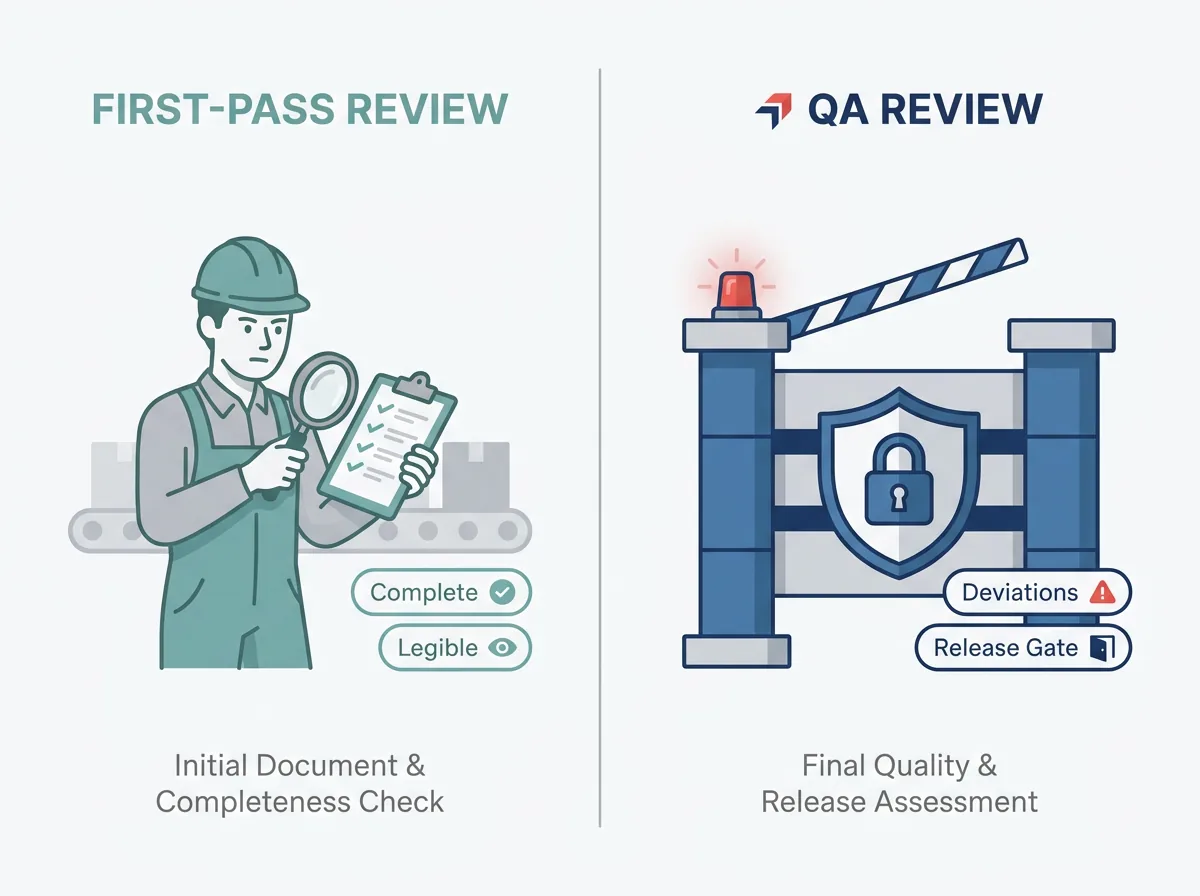
A strong process separates the first-pass review, performed by manufacturing or production, from an independent quality assurance review. The first pass confirms the record is complete and legible while memory of the batch is fresh. The QA review is the gate: it evaluates deviations, verifies calculations, and confirms that every open item is closed before release.
Risk-based review focuses the deepest scrutiny on the steps most likely to cause harm, while review-by-exception, practical mainly in electronic systems, directs reviewers to flagged entries rather than every line. Both depend on a sound deviation impact assessment. For each deviation, personnel evaluate whether it affects the product’s safety, identity, strength, quality, or purity, and document the justification for the disposition that follows.
The design of this step, not merely its existence, determines your recall exposure. A well-structured batch record review process for FDA-regulated manufacturers turns review from a bottleneck into the control that keeps defective lots off the truck.
Designing the Batch Release Workflow: Status Fields That Keep Bad Batches From Shipping
Review only prevents recalls if the workflow around it makes release impossible until review is complete. That is the job of disposition status fields. A compliant pharmaceutical batch release workflow moves a lot through explicit states, Pending QA → Under Review → Approved / Rejected / On Hold, where each state is a hard gate, not a label.
The rule that matters: an unreviewed batch cannot physically reach distribution, because the system will not allow the status to advance without the required approvals. Segregation of duties ensures the person who makes the batch is not the person who releases it. Electronic signatures bind each state change to an identity and a timestamp. And no lot moves to Approved without documented justification for the disposition.
| Release status | Who sets it | System control | Downstream action |
|---|---|---|---|
| Pending QA | Production, at batch close | Record locked from edits | Awaits review assignment |
| Under Review | QA reviewer | Deviations and OOS must be resolved to advance | Review documented |
| Rejected / On Hold | QA | Blocks any move to distribution | Investigation / CAPA |
| Approved | QA authority, e-signature | Requires documented justification | Released to packaging/distribution |
Getting these states, permissions, and controls right is a core theme of sound batch record management best practices, where the workflow itself enforces compliance instead of relying on individual vigilance.
Electronic Batch Records and MES: Engineering the Error Out
What Is an Electronic Batch Record (EBR)?
An electronic batch record (EBR) is a digital version of the batch manufacturing record that captures process steps, data, and signatures in a validated software system rather than on paper. Beyond storage, it enforces how the record is filled out in real time.
That enforcement is where recall risk drops. An EBR can require steps in sequence, block progress until mandatory fields are completed, run limit checks against a value the moment it is entered, and reconcile materials and yields automatically. Whole classes of error, missing entries, out-of-order steps, transcription mistakes, unreconciled quantities, are removed at the source rather than caught days later in review.
A manufacturing execution system (MES) extends this logic across the plant, connecting the shop floor to enterprise systems so that EBR data flows into ERP and LIMS and release decisions lock to verified, system-controlled values. The payoff shows up first at review: reviewers stop hunting for blank fields and spend their time on genuine exceptions.
| Attribute | Paper batch records | Electronic batch records (EBR) |
|---|---|---|
| Error detection timing | Post-execution, at review | Real time, at data entry |
| Reconciliation | Manual, error-prone | Automatic, system-enforced |
| Review effort | Line-by-line, full record | Review-by-exception on flagged items |
| Audit-trail completeness | Depends on operator diligence | Continuous, attributable, time-stamped |
| Recall-risk exposure | Higher, errors escape to disposition | Lower, many error classes blocked at source |
Data Integrity: The ALCOA+ Foundation Regulators Check First
Every record, paper or electronic, rests on data integrity. FDA and international regulators evaluate it against the ALCOA+ principles: data must be Attributable, Legible, Contemporaneous, Original, and Accurate, plus complete, consistent, enduring, and available. When the substrate under the record is sound, the record can be trusted; when it is not, the record is fiction that happens to be signed.
Data-integrity failures are among the most common findings that precede enforcement and recall. Audit trails that are never reviewed, metadata that contradicts the reported result, and shared logins that break attribution all signal that the underlying data cannot be relied upon. A PMC case study on the consequences of drug recalls illustrates how far the downstream damage reaches once trust in a product’s records is lost, into supply shortages, patient impact, and remediation cost.
Data integrity is an engineering problem as much as a quality one. Building systems that guarantee attribution, preserve original data, capture contemporaneous timestamps, and make audit trails reviewable is the work behind a trustworthy record. FDA’s data-integrity expectations are, at bottom, requirements about how data is captured, stored, and controlled.
How to Prevent Product Recalls: A Practical Control Checklist
How do you prevent product recalls? Build layered controls so that no single failure reaches the market. The essentials:
- Written procedures. Current, controlled SOPs for every GMP-critical task, with tracking so revisions and training stay in sync.
- Deviation and CAPA management. A quality event system that captures, investigates, and closes deviations with root-cause rigor, not boilerplate.
- Batch-failure investigation. Real investigation into OOS and batch failures before disposition, never a rushed “invalidate and retest.”
- Supplier and material controls. Verified incoming materials and qualified suppliers, since a contaminated input becomes your recall.
- Process validation. Validated processes and equipment so results are reproducible, not lucky.
- Audit readiness. Records that withstand inspection at any moment, not a scramble before an FDA visit.
- Mock recall drills. Periodic traceability exercises that prove you can identify and retrieve an affected lot fast.
Scrutiny intensifies for reformulated and repurposed products. A drug approved via the 505(b)(2) pathway carries documentation expectations tied to its reference and change history, and gaps there draw regulatory attention quickly. This is where pharmaceutical compliance consulting earns its keep, an outside team can find the control weaknesses an internal group has stopped seeing. Case evidence, such as this study on preventing and managing product recalls, consistently points to proactive traceability and documentation controls as the difference between a contained event and a costly one.
The ROI of Prevention Versus the Cost of a Recall
The economics favor prevention by a wide margin. A recall carries direct costs, retrieval logistics, destruction, replacement production, lost inventory, and indirect ones that dwarf them: regulatory remediation, consent-decree risk, damaged customer relationships, and the management time consumed for months. A single Class I event can eclipse a year of quality-system investment.
Against that, the cost of prevention is modest: sharper review discipline, a hard-gated release workflow, an EBR or MES that blocks errors at the source, and data-integrity controls that hold up under inspection. These are fixed, budgetable investments that also raise throughput and reduce release cycle time. Recalls are variable, unbudgetable, and reputational.
The practical challenge is that root-cause fixes rarely come from a slide deck. They come from embedding engineers in the process, mapping where records actually break, redesigning the review and release workflow, and standing up EBR and MES so the controls hold without heroics. That boots-on-the-ground approach is how GMP Pros helps FDA-regulated manufacturers fix the source of record failures rather than the symptoms.
Frequently asked questions
What is a batch recall?
How do batch record errors cause recalls?
What is an electronic batch record (EBR), and does it reduce recall risk?
What batch release status fields should a compliant workflow include?
How can a manufacturer prove batch record data integrity to the FDA?
The Record Is Where Prevention Lives
Recall prevention is not a downstream inspection problem; it lives in the record. The daily discipline of accurate, contemporaneous documentation, a release workflow with hard status gates, and systems that catch errors before disposition are what keep a defective lot from ever reaching a patient. Manufacturers that treat the batch manufacturing record as the control point, not the paperwork, are the ones who stay out of the recall notices.