How out-of-specification results tie back to the batch record: the two-phase investigation, defensible documentation, batch release logic, and the data integrity practices that keep audits clean.
A batch record related OOS investigation sits at the seam between the laboratory and the manufacturing floor, and that seam is where most compliance programs stumble. An out-of-specification (OOS) result rarely explains itself. The batch manufacturing record, the signed, timestamped account of how a lot was made, is the evidence you read the result against. Handle that connection well and an OOS becomes a controlled, defensible event. Handle it poorly and it becomes a Form 483 observation or a warning letter. This guide covers the procedure regulators expect, the documentation that survives inspection, and the digital practices that shorten every investigation.
What Is an OOS Investigation? (and Where the Batch Record Fits)
An OOS investigation is a documented, structured process that begins when an analytical test result falls outside an established specification, acceptance criterion, or regulatory limit. Its purpose is to determine whether the result reflects a real quality problem or a laboratory error, and to decide what that means for the affected batch and any related batches.
A distinction sits underneath the term. An OOS result breaches a specification. An out-of-trend (OOT) result stays within limits but deviates from the historical pattern. An atypical or aberrant result looks suspicious for a procedural reason. All three warrant scrutiny, but only the OOS carries the immediate regulatory weight of a specification failure. The FDA guidance on investigating out-of-specification test results makes a point that reshapes how teams should think: even when a batch is rejected on an OOS result, the investigation still proceeds, because the finding may point to other batches of the same product.
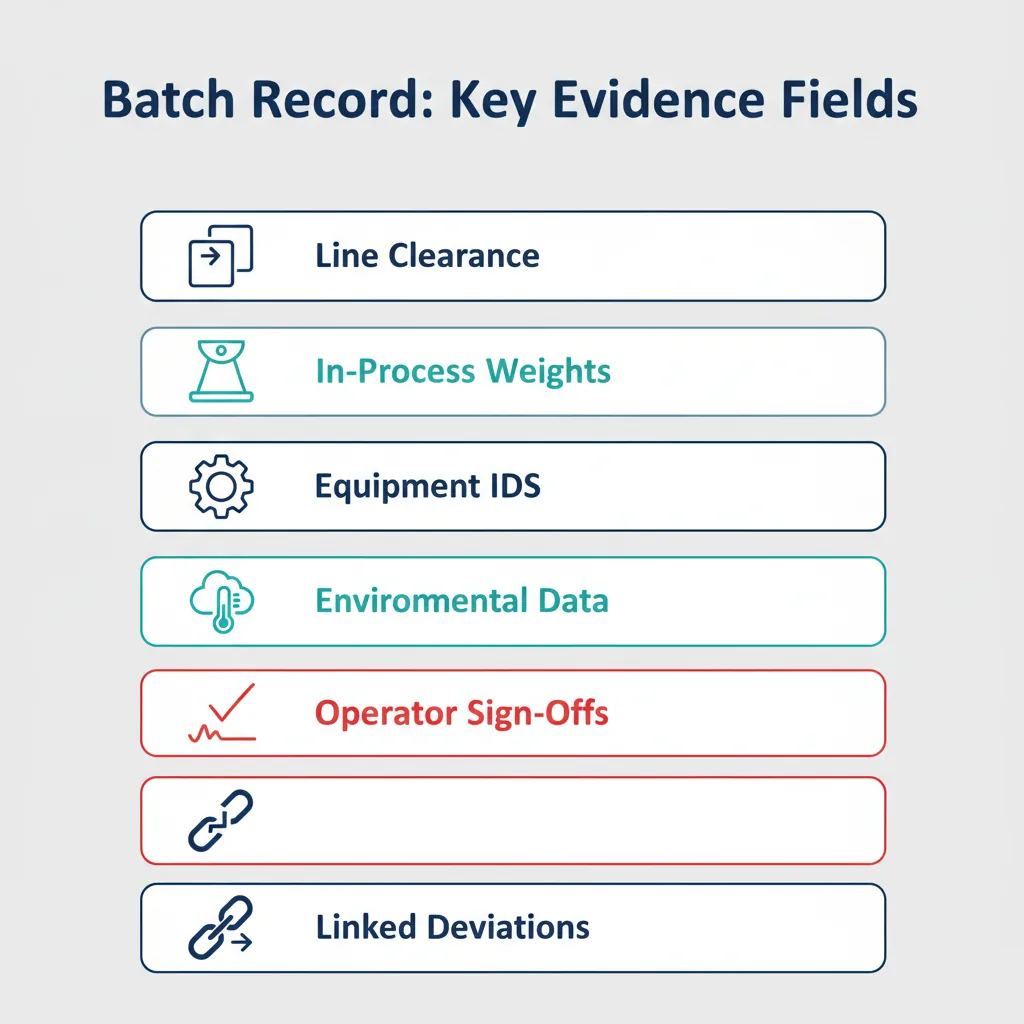
The batch manufacturing record is the document that turns that signal into a conclusion. It records line clearances, dispensed weights, in-process checks, equipment identifiers, environmental conditions, and operator sign-offs. When you later ask whether a failing assay came from the lab bench or from the process, the record holds the answer. For plants moving toward electronic batch records (EBR), more on that below, the same evidence becomes searchable rather than buried in a paper binder.
Why OOS Results Connect Back to the Batch Record
An OOS can originate in two very different places: in the analytical laboratory, or on the production floor. The batch record is the primary tool that lets you tell them apart. Skip it, and any conclusion about assignable cause rests on guesswork.
The regulatory anchor is 21 CFR 211.192, which requires that any unexplained discrepancy or failure of a batch or its components to meet specifications be thoroughly investigated, whether or not the batch has already been distributed. The regulation directs that the investigation extend to other batches and products that may have been associated with the failure. That reach is only possible when the manufacturing record is part of the review from the start.
The Batch Record as Investigation Evidence
When an investigator opens the record during a full-scale review, specific fields carry disproportionate weight:
- Line clearance and setup checks: did a prior product or lot contaminate the run?
- Dispensing and in-process weights: do the numbers reconcile with the yield?
- Equipment IDs and calibration status: was qualified, in-date equipment used?
- Environmental and utility data: temperature, humidity, differential pressure at the relevant step.
- Operator sign-offs and timestamps: was each critical step performed and verified in sequence?
- Linked deviations: was an excursion already documented that could explain the result?
A disciplined batch record review process surfaces these discrepancies before a lot ever reaches release, so an OOS investigation often starts with half its evidence already organized. The National Cancer Institute’s Frederick facility guidance on managing out-of-specification test results reinforces the same principle: the investigation must establish whether the result is associated with other batches of the same product or with other products, and that determination depends on manufacturing records, not lab data alone.
How to Properly Investigate OOS Results: The Two-Phase Process

Regulators expect a two-phase investigation. The structure forces the team to rule out laboratory error before drawing conclusions about product quality, without discarding data or retesting into an acceptable answer.
Phase I: Initial Laboratory Investigation
Phase I is the analyst-and-supervisor review that happens before any retest. The analyst who obtained the result and the laboratory supervisor examine the analytical process for an obvious, assignable laboratory cause:
- Method followed as written, with no deviation in technique.
- Calculations, dilutions, and unit conversions verified.
- Instrument performance, system suitability, and calibration confirmed.
- Reference standards, reagents, and mobile phases within date and correctly prepared.
- Sample integrity and preparation reviewed.
No original data is discarded during Phase I. If a clear, documented laboratory error is found, a transcription mistake, a failed system suitability, a wrongly diluted standard, the result may be invalidated with justification, and a corrected value obtained. If no assignable laboratory cause appears, the result stands and the event escalates.
Phase II: Full-Scale Investigation Including the Batch Record
Phase II is where batch record related OOS investigations earn their name. The scope widens beyond the lab to the manufacturing record, and a cross-functional team of QC, QA, and manufacturing works the problem:
- Manufacturing review of the full batch record for deviations, atypical process data, and equipment issues.
- Root cause analysis to identify an assignable manufacturing cause where one exists.
- Hypothesis testing using a pre-approved plan, not ad hoc retesting.
- Retest and resample rules applied with defined criteria and QA authorization.
- Impact assessment on other batches, other products, and material already released or in distribution.
Two prohibitions define a compliant Phase II. First, results are classified as assignable cause (a documented root cause explains the failure) or non-assignable cause (no cause found, the result cannot simply be dismissed). Second, outlier tests and averaging cannot be used to make a failing result disappear; the FDA’s OOS guidance is explicit that averaging to mask variability, or retesting until a passing value appears, is not acceptable practice. A non-assignable OOS on a final product test generally means the batch fails.
An inspector who cannot follow your reasoning on paper will assume the reasoning was never sound.
Documenting the Investigation Inside the Batch Record
Investigations are won or lost on documentation. A defensible OOS record contains, at minimum:
- A clear problem statement: what result, which test, which batch, which specification.
- Scope: the batches, products, and materials assessed for impact.
- Findings from both Phase I and Phase II, with supporting data.
- A stated root cause, or a documented rationale when none is assignable.
- Corrective and preventive action (CAPA) tied to the root cause.
- QA oversight and approval, with dated sign-offs at each decision point.
The failures that draw citations are predictable: mandatory fields left blank, corrections made without initials, dates, or a reason, and entries added after the fact that break the contemporaneous-record requirement. Many are the same batch record documentation gaps during inspections that turn a routine review into an observation: new operators unsure which fields are mandatory, unclear correction procedures, and missing links between a deviation and the investigation it triggered.
Documentation also governs disposition. Batch release workflows carry status fields, Approved, Rejected, Pending QA, On Hold, and an open OOS investigation blocks the transition to Approved. Until QA closes the investigation and records the rationale, the batch cannot move forward, and the record must show why.
The Batch Release Decision: Approve, Reject, or Hold
The OOS investigation feeds directly into the batch release decision, and this is where many generic OOS resources go quiet. QA disposition is not a formality applied after testing; it is a controlled judgment that reads the completed investigation against every result on the record.
The rule is firm: a batch cannot be released with an unresolved OOS result. While the investigation is ongoing, the lot sits in a hold or pending state. Where a non-assignable OOS stands on a release specification, the batch is rejected. Conditional states exist for narrow, well-documented circumstances, but they never substitute for a closed investigation.
| Status | Trigger | Required Documentation | Who Signs |
|---|---|---|---|
| Pending QA | Testing complete, review not yet closed | Batch record, test results, open items list | QA reviewer |
| On Hold | Open OOS or deviation under investigation | Investigation report in progress, impact scope | QA / Investigation lead |
| Approved | All results in spec, investigations closed | Completed record, closed CAPAs, QA release statement | QA / Qualified Person |
| Rejected | Non-assignable OOS or unresolved critical deviation | Full investigation, root cause rationale, disposition memo | QA management |
The last gate is a final review of all results before release. It confirms that nothing in late-stage testing reopens a question the investigation was meant to close. When something does, the lot returns to hold rather than proceeding on momentum.
Data Integrity and Electronic Batch Records in OOS Investigations
The speed and credibility of an investigation depend heavily on how the underlying data is captured. Paper records slow root cause analysis and expose the process to data integrity gaps. Electronic systems change the equation.
What Is an EBR and Why It Speeds OOS Investigations
An electronic batch record (EBR) is a validated digital version of the manufacturing record that captures process steps, checks, and sign-offs in real time. Its value in an OOS event comes from built-in ALCOA+ data integrity: records that are attributable, legible, contemporaneous, original, and accurate, plus complete, consistent, enduring, and available. Every entry carries an audit trail, no sign-off is lost, and trend queries that take hours on paper take seconds. The FDA treats data integrity as a cornerstone of CGMP, and an EBR that enforces it removes a whole category of investigation-slowing ambiguity.
| Factor | Paper Batch Record | Electronic Batch Record (EBR) |
|---|---|---|
| Traceability | Manual search across binders | Indexed, queryable by field |
| Audit trail | Reconstructed from initials/dates | Automatic, timestamped, tamper-evident |
| Time to root cause | Hours to days | Minutes to hours |
| Data integrity risk | Higher: gaps, illegibility, late entries | Lower: enforced ALCOA+ controls |
| Trend detection | Difficult, retrospective | Real-time across batches |
Beyond the record itself, a manufacturing execution system (MES) pulls process data into a single investigation-ready view. Structured, validated, retrievable data is what lets an investigator ask “did this deviation touch any other lot?” and get a trustworthy answer the same day. That capability is the difference between an investigation that contains a problem and one that lets it spread.
Common FDA Pitfalls in Batch Record Related OOS Investigations
Inspection history shows the same errors repeat across facilities. Each maps to a specific CGMP expectation, and each is avoidable:
- Invalidating results without justification: discarding an OOS because it is inconvenient rather than because a documented laboratory error explains it.
- Inadequate scope: closing the investigation without checking other batches or products the failure could touch.
- Weak root cause: settling for a symptom (“analyst error”) instead of a verified cause.
- Retesting into compliance: repeating tests until a passing value appears, then releasing on it.
- Poor documentation: missing fields, uninitialed corrections, non-contemporaneous entries.
- Missing or disconnected CAPA: corrective actions that do not trace to the identified root cause.
- Delayed timelines: investigations that drift past defined closure targets, leaving lots and product families in limbo.
Most of these are quality-system problems as much as technical ones, which is where an outside review earns its keep: a fresh set of eyes often catches the scope gap or the weak root cause before an inspector does.
Related readingBatch Record Errors in Pharma: Causes & PreventionRead the guide →How GMP Pros Supports OOS and Batch Record Compliance
GMP Pros works inside FDA-regulated plants rather than from a distance, and for teams strengthening OOS and batch record practices that embedded model shows up in three areas. EBR implementation puts investigation-ready records and enforced audit trails in place, so Phase II reviews start with organized evidence. Data analytics turns batch data into trend and impact answers that manual review cannot reach quickly. And engineers on the floor help align MES workflows, deviation handling, and release decisions so an OOS moves through a defined path instead of an improvised one, with documentation that reads cleanly under inspection.
Frequently asked questions
What is a batch record related OOS investigation?
How do you properly investigate OOS results?
Can a batch be released with an open OOS result?
What is the difference between Phase I and Phase II OOS investigation?
How do electronic batch records help OOS investigations?
Batch record related OOS investigations are decided in the record itself. A disciplined two-phase procedure, contemporaneous documentation, enforced data integrity, and clear approve-reject-hold logic are what keep a specification failure contained, and what keep an inspection uneventful.