
An MES decision outlives the project team that sponsored it and constrains every site rollout that follows, so it deserves more rigor than a feature checklist. This guide covers how to choose an MES vendor for pharma, from requirements definition through GMP and data integrity gates, validation burden, integration architecture, total cost of ownership, and support models.
What an MES Actually Does on a GMP Floor
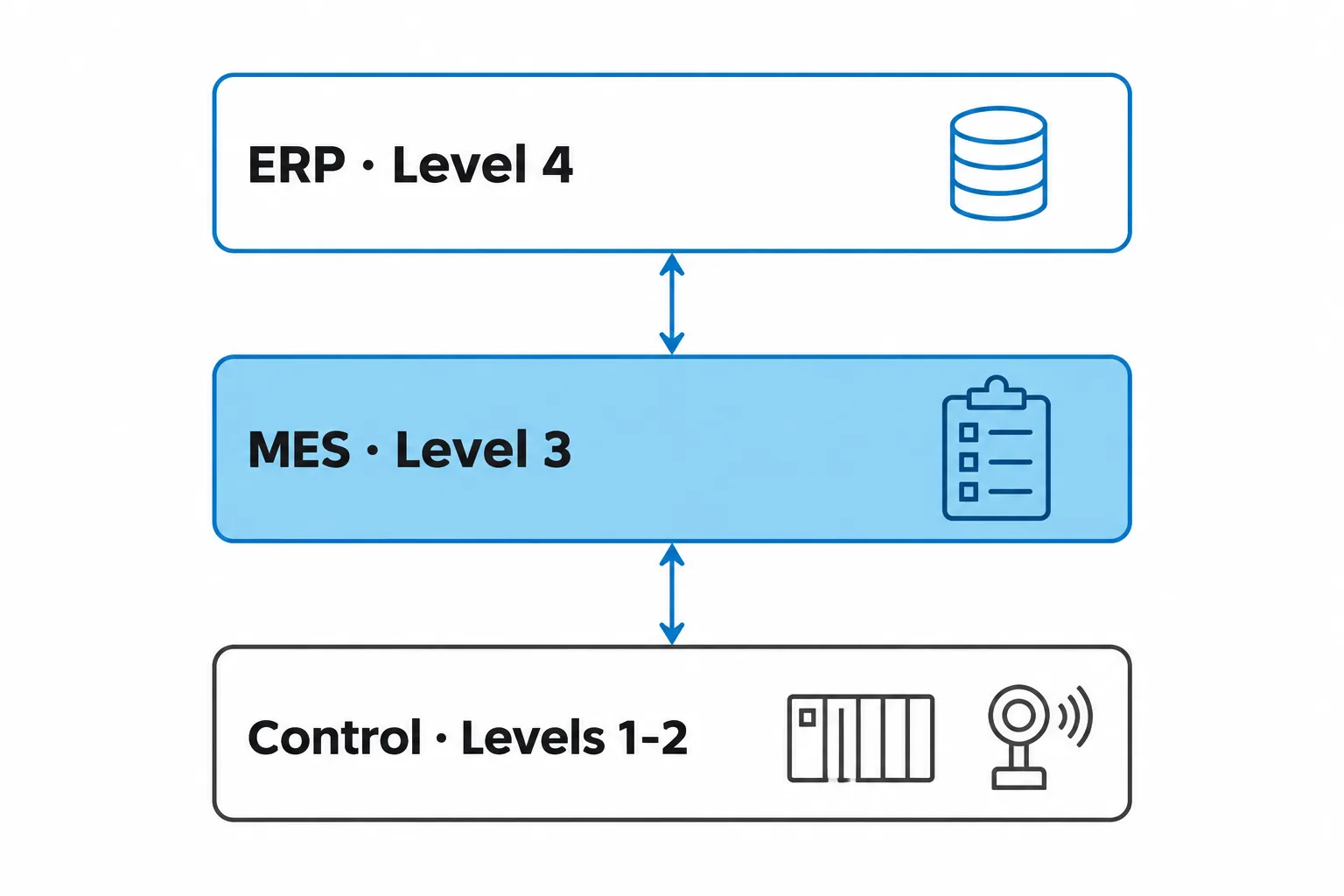
An MES executes and records the batch manufacturing record electronically. It enforces step sequence, material genealogy, equipment status, and operator qualification in real time, then hands a reviewable record to QA.
Core functions span detail scheduling, dispatch of production units, document control, data collection, product tracking and genealogy, and performance analysis.
MES versus MRP comes down to scope. MRP and ERP plan demand, materials, and orders. MES runs the order on the floor and produces the GMP record of what happened.
The ISA-95 model formalizes the split: MES sits at Level 3, between process control at Levels 1-2 and business planning systems such as ERP at Level 4 (ISA-95 enterprise-control system integration standard).
Types divide by architecture rather than brand: platform-native MES suites, ERP-coupled MES modules, low-code manufacturing operations platforms, and EBR-first (paper-on-glass) systems. Two terms recur below. The MBR is the approved master batch record. The EBR is the executed instance for a single batch.
Requirements work precedes platform choice, which is why MES implementation in pharma treats requirements and vendor selection as one phase.
Write Requirements Before You Take a Single Demo
Map the current process first: batch flow, weigh and dispense, in-process checks, sample points, equipment interfaces, and review-by-exception targets.
Translate that map into a URS with traceable, testable requirement IDs, split into GMP-critical and business-desirable.
Specify the data model, not just the screens. Deviation and OOS workflow fields, batch release status with approval and rejection states, and the meaning bound to each electronic signature all belong in the URS.
Name the decision team early: manufacturing, QA, automation, IT/OT, validation, plus a business owner with budget authority.
One caution. A vendor-supplied requirements template quietly becomes a scorecard for that vendor’s feature set. Write your own.
MES selection is one of the highest-consequence, lowest-information decisions in pharma manufacturing. You are committing to a platform for ten to fifteen …Read on LinkedIn ↗
How to Choose an MES Vendor for Pharma: Core Criteria

Build a weighted scorecard and set the weights by risk profile. Sterile fill-finish, solid dose, biologics, and animal health do not share priorities. Score against scripted scenarios you wrote, not against vendor feature lists, and require every claimed capability to be shown in the shipped product.
Related readingLegacy MES Integration with Electronic Batch RecordsRead the guide →| Evaluation criterion | What to test during the demo | Evidence to request |
|---|---|---|
| GMP compliance | Corrected entries, audit trail review, and electronic signatures | Audit trail examples and Part 11 control documentation |
| Batch record management | Build and revise a master batch record | Version history, effective dating, and change-control workflow |
| Integration | Exchange batch status, material data, and test results with connected systems | Reference architecture, interface specifications, and test evidence |
| Validation | Trace requirements through configuration and testing | Supplier quality package, test documentation, and traceability examples |
| Upgrade management | Assess the impact of a planned software release | Release notes, regression-testing guidance, and support policy |
| Technical support | Escalate a simulated production-critical issue | Written response commitments, escalation paths, and reference contacts |
Force each answer into one of three buckets: in the product today, configurable, or custom development.
GMP compliance and data integrity capability
Part 11 controls are testable during evaluation. 21 CFR 11.10 requires secure, computer-generated, time-stamped audit trails that independently record the date and time of operator entries and actions that create, modify, or delete electronic records (21 CFR 11.10, controls for closed systems). Verify that behavior hands-on, not on a slide.
Then push on ALCOA+ behavior under stress: network loss mid-step, equipment timeout, a corrected entry. Ask how audit trail review works in practice, because a trail nobody can filter fails to meet inspection expectations. Confirm inspection-ready reports and e-record export for FDA audit readiness.
Batch record changes after go-live
Ask who changes an MBR once the system is live: your QA and engineering staff through configuration, or the vendor through a change order at cost.
Probe recipe reuse across products and sites, phase libraries, parameter-driven scale, version control, effective dating, and what happens to in-flight batches during an MBR revision. The best test is concrete. Hand each vendor one redacted MBR section and watch them build it.
Integration architecture and the OT/IT boundary
Interfaces to scope: ERP for orders, material movements, and batch status; LIMS for samples and results; historian, SCADA, and PLC; WMS; scales and labelers; QMS for deviations.
Mechanics matter more than the count. Standards-based APIs, point-to-point middleware, and file drops carry very different validation loads, and someone has to own that work. Ask for a reference architecture, not a logo slide.
The order of MES implementation steps usually reveals which interfaces carry the heaviest qualification weight. Contextualized data on the way out is what makes manufacturing analytics feasible later.
Validation burden and upgrade path
Request the supplier quality package: development lifecycle evidence, test documentation, audit report availability, and supplier audit rights.
GAMP 5 Second Edition encourages regulated companies to maximize supplier involvement and draw on supplier knowledge, experience, and documentation where possible (GAMP 5 Guide, 2nd Edition). That only pays off when the documentation survives your review.
Quantify regression effort per minor and major release, the vendor’s release cadence, and the version support window. A heavily customized deployment carries revalidation cost for its whole life, so weight configuration-first platforms accordingly.
For hosted deployments, pin down the responsibility split on qualified infrastructure, change notification, and data residency.
Support model, references, and vendor viability
Get written response commitments for a line-down event, coverage that matches your shift pattern, and an escalation path into product engineering. Check named-resource availability in your region and the size of the trained consultant pool beyond the vendor’s own bench.
Run reference calls with comparable sites (same dose form, similar scale, ideally post-inspection) and ask for one reference that had a hard go-live. Review ownership changes, roadmap continuity, and installed base in pharma specifically rather than discrete manufacturing generally.
Total Cost of Ownership Beyond the License Line
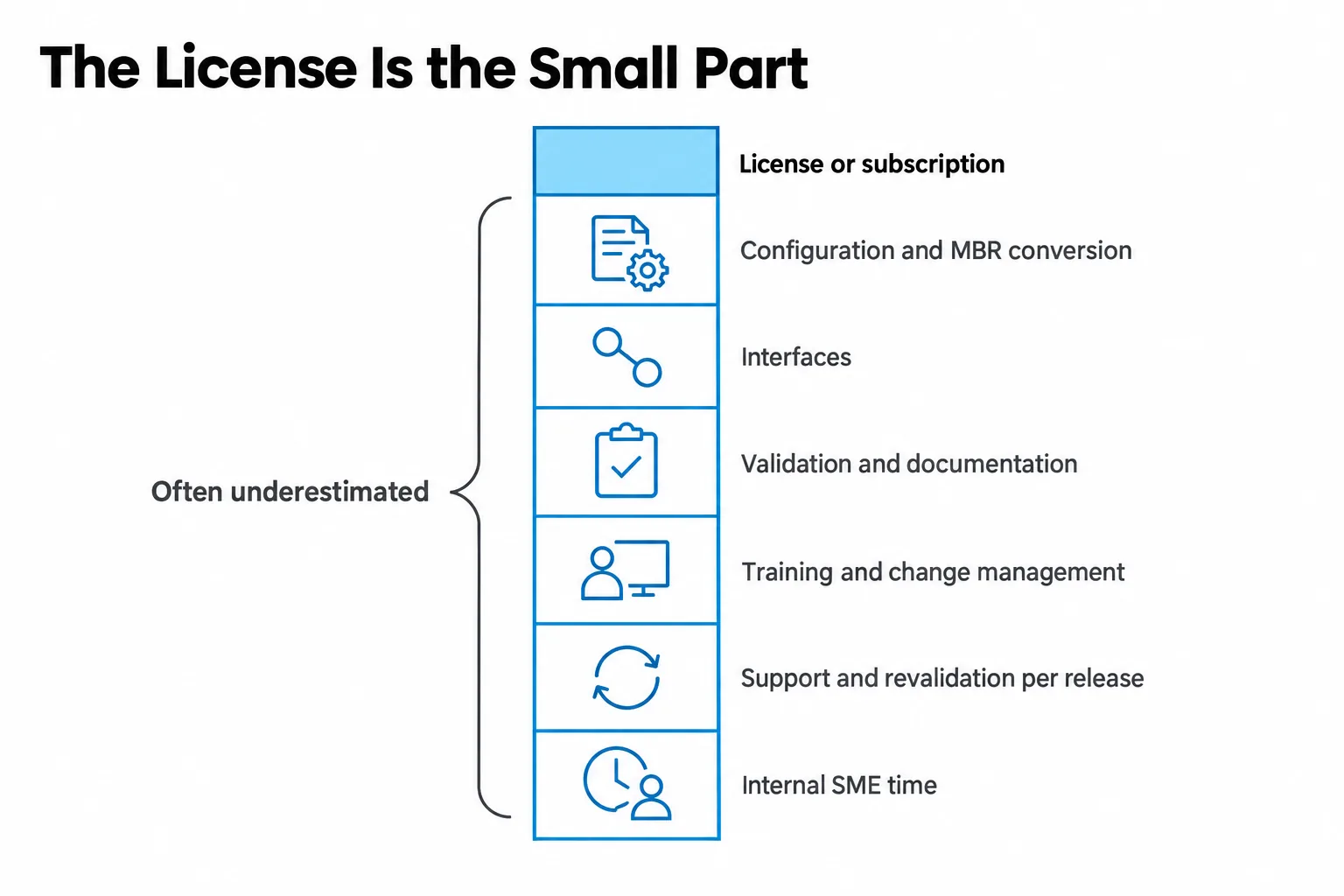
| Cost element | Typical owner | Where buyers underestimate |
|---|---|---|
| Licenses or subscription | Vendor | How price scales per user, line, and site at rollout |
| Configuration and MBR conversion | Internal or partner | Recipe count, SME hours, QA review cycles |
| Interfaces | Partner with IT/OT | Interface validation, not just the build |
| Validation and documentation | QA and validation | Test script authorship and execution hours |
| Training and change management | Internal | Shift coverage and retraining after each release |
| Annual support and upgrades | Vendor | Revalidation per release, uncapped support uplift |
| Internal staff time | Internal | SMEs pulled off production for months |
Multi-site math changes the answer. A global template with local fit produces a very different per-site cost than site-by-site builds, and only some platforms support the template model cleanly.
Price is not a proxy for fit. A cheaper platform that needs custom code for GMP-critical behavior often costs more over five years.
Measure returns where they actually appear: review-by-exception cycle time, right-first-time rate, deviation volume, and batch release lead time. Baseline those metrics before selection so the business case has a reference point.
Run a Selection Process That Tests Reality
Structure the RFP for comparable answers: traceable requirement IDs, forced response codes, priced options, and a mandatory assumptions section.
Write the demo script yourself. One complex batch, one deviation, one OOS result, one batch release including the rejection path. Vendor-led demos show the happy path only.
Time-box a proof of concept or sandbox on your own data before contract signature, with acceptance criteria agreed up front.
In negotiation, make validation deliverables contractual artifacts. Secure data extraction rights, exit terms, a cap on support uplift, and acceptance milestones tied to qualification.
Red flags when choosing an MES vendor for pharma
No pharma references. MBR changes only through the vendor. An audit trail with no review tooling. Roadmap answers to GMP-critical requirements. Refusal of a supplier audit. Any one of those justifies a walk-away.
Implementation Partner Choice Is Part of the Vendor Decision
Software fit and delivery capability are separate evaluations. A strong platform still fails with an unqualified integrator, which is why SAP MES implementation projects weight partner selection as heavily as product selection.
Evaluate partners on regulated-manufacturing delivery history, validation capability, floor-level presence through commissioning and hypercare, and knowledge transfer so your own team owns the system afterward.
GMP Pros has worked in FDA-regulated manufacturing since 2013, with engineers embedded on-site for electronic batch record implementation, production engineering, and data science and analytics.
Independent MES implementation consultancy for pharmaceutical manufacturers helps most in three places: neutral requirements, vendor-agnostic scoring, and validation strategy set before contract signature.
Frequently asked questions
How Do You Choose an MES Vendor for Pharma?
What are the most popular MES systems?
Should we buy MES from our ERP vendor?
Do we need MES if we already have electronic batch records?
How long does MES vendor selection take?
What documentation should we require from a vendor to support validation?
Closing Takeaway
The decision logic stays simple even when the scorecard is not. Requirements come first. GMP compliance and data integrity act as gates, not scored line items. Validation and integration costs break ties between platforms that look similar on features.
References and support are your insurance for the next decade.