
Article Summary:
- Batch record cycle time directly affects product release speed and inventory costs in pharmaceutical manufacturing.
- According to a mid-size pharma firm case highlighted by ComplianceQuest, transitioning to digital batch record systems led to a 45% reduction in batch closure time
- Manual processes, late-stage QA bottlenecks, and poor system integration extend cycle times unnecessarily.
- Real-time data capture eliminates transcription delays that add days to the process.
This guide shows you practical steps on how to reduce batch record cycle time while maintaining full FDA compliance.
What Is Batch Record Cycle Time?
Batch record cycle time measures the total time from when a batch completes production until Quality Assurance approves it for release. Batch record cycle time measures the total time from when a batch completes production until Quality Assurance finishes its production record review and approves the batch for release. This timeline includes documentation completion, data verification, deviation resolution, and final quality review.
For FDA-regulated manufacturers, understanding how to reduce batch record cycle time matters because it controls how fast you can ship products to customers.
Long cycle times tie up inventory, increase storage costs, and delay revenue. Short cycle times improve cash flow and customer satisfaction.
The cycle time breaks down into distinct phases:
| Phase | Activity | Typical Duration |
| Phase 1 | Production team completes batch record documentation | 1–2 days |
| Phase 2 | Production supervisor reviews batch record for completeness | 0.5–1 day |
| Phase 3 | QA performs detailed compliance review | 2–7 days (depending on complexity) |
| Phase 4 | Deviation and OOS investigations (if required) | Variable (can add weeks) |
| Phase 5 | Final QA approval and product release decision | 0.5–1 day |
Most delays happen in phases 3 and 4. Quality teams spend excessive time on manual verification while deviation investigations drag on without clear timelines.
What Drives Long Batch Record Cycle Times
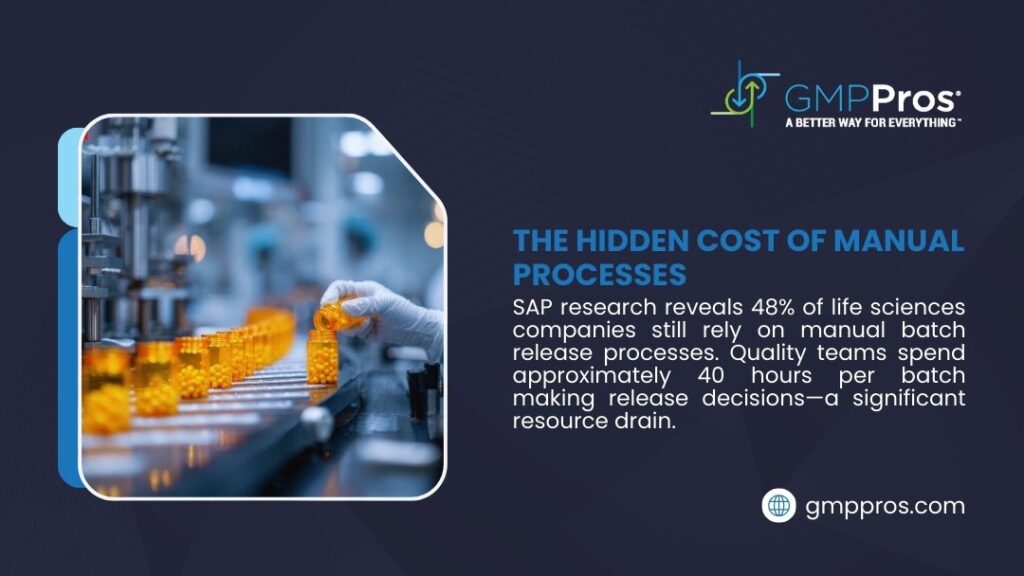
Several factors contribute to slow batch release, and identifying them is the foundation of how to reduce batch record cycle time effectively.
- Manual Documentation Creates Delays
Paper batch production and control records require operators to hand-write every data point, signature, and timestamp, making it difficult for manufacturers focused on how to reduce batch record cycle time to achieve consistent results.
This manual process introduces multiple delay points:
- Operators complete records hours or days after production ends
- Illegible handwriting forces callbacks to clarify entries
- Missing signatures send records back to production floor
- Physical documents move slowly between departments
- Only one person can review a paper record at a time
- Siloed Department Workflows
Traditional manufacturing separates production, quality, and laboratory functions. Each department works in sequence rather than parallel:
- Production finishes → Records go to production supervisor → Then to QA → Lab results arrive separately → QA combines everything
This sequential handoff adds days to the process. QA cannot start their review until production completes all documentation. Lab results arrive late because the testing request did not go out promptly.
Understanding why batch records delay product release helps manufacturers identify which silos cause the most problems.
- Late-Stage QA Bottlenecks
Most facilities push all quality verification to the end of the process, which is a common barrier for teams trying to understand how to reduce batch record cycle time without adding QA resources.
This creates several problems:
- QA workload concentrates at the end
- Errors found late require extensive rework
- Reviewer fatigue increases with 100+ page documents
- High-priority batches wait in queue behind routine reviews
One large biologics manufacturer found their QA team spent 6-8 hours per batch on manual verification of routine data points that machines had already captured accurately.
- Lack of Real-Time Visibility
Paper systems provide zero visibility into batch status until the physical document arrives. Production managers cannot tell if batches are on schedule or delayed. QA cannot prioritize reviews based on business urgency.
Key Metrics to Track Before You Improve
Measure current performance before you change processes. Any initiative on how to reduce batch record cycle time should start with clear baseline metrics.
Track these four key metrics:
- Cycle Time Per Batch (End-to-End)
Measure from production completion timestamp to final QA approval date. Calculate average cycle time across all batches for each product type.
| Product Type | Current Average | Industry Target |
| Oral solid dose | 8.5 days | 3-5 days |
| Sterile injectable | 12.3 days | 7-10 days |
| Biologics | 18.7 days | 10-15 days |
| Topical cream | 6.2 days | 3-5 days |
- Review Time vs Execution Time
Separate the time spent on actual production from the time spent on documentation and review. Many facilities discover they spend more time on paperwork than on making products.
- Calculate: (Total cycle time – Production time) = Documentation + Review time
- Error/Exception Rate in Records
Count how many batches have errors that require correction or investigation. High error rates extend cycle time because fixing mistakes takes extra days.
| Error Type | Frequency Impact on Cycle Time |
| Missing signatures | Adds 1–2 days to locate operators and obtain approvals |
| Calculation errors | Adds 2–4 days for verification and correction |
| Incomplete data fields | Adds 1–3 days for additional data collection |
| Unexplained deviations | Adds 5–15 days due to formal investigation requirements |
- QA Backlog Duration
Measure how long batches wait in the QA queue before review starts. Long backlogs signal resource constraints or inefficient review processes.
- Calculate: Date QA received record – Date QA started review = Queue time
One facility found batches waited an average of 4.2 days in queue before anyone looked at them. Simply prioritizing urgent batches reduced their cycle time by 3 days without any system changes.
Proven Ways to Reduce Batch Record Cycle Time
Multiple strategies work together to compress cycle time. Focus on high-impact changes first.
- Implement Electronic Batch Records (EBRs)
Electronic batch records eliminate the slowest parts of paper documentation. Operators enter data directly into validated software that performs automatic checks.
EBR systems provide immediate benefits:
- Real-time data collection prevents lost paperwork and reduces completion delays from hours to minutes.
- Automatic calculations eliminate math errors that require investigation.
- System-enforced workflows prevent operators from skipping critical steps. Those controls do more than shorten cycle time, because preventing recalls tied to batch record errors depends on catching the same mistakes at the point of entry rather than after release.
- Multiple reviewers can access the same record simultaneously from different locations.
- Built-in audit trails track every change without separate logbooks.
Industry data confirms that facilities switching from paper batch records to electronic systems see 50% or more reduction in total cycle time.
GlaxoSmithKline, a global pharmaceutical leader, significantly sped up their batch release process using Manufacturing Execution System (MES) technology and Electronic Batch Records (EBR)
The compliance benefits matter just as much as speed. Electronic systems ensure data integrity through automatic validation and complete audit trails that satisfy 21 CFR Part 11 requirements.

- Automate Review by Exception
Review-by-exception changes how quality teams work. Instead of manually verifying every data point, reviewers focus only on exceptions and critical parameters.
The system automatically verifies:
- Temperatures, pressures, and times fall within specifications
- All required signatures and timestamps exist
- Calculations match validated formulas
- Material lot numbers trace to approved sources
- In-process test results meet acceptance criteria
Quality reviewers receive a summary report that highlights only items needing attention. A 150-page batch record becomes a 3-page exception report.
This approach requires validated electronic systems that reliably detect all exceptions. The batch record review process still requires QA approval, but reviewers spend their expertise on meaningful problems instead of routine verification.
One sterile manufacturing facility cut review time from 8 hours per batch to 90 minutes using review-by-exception. Their QA team could handle 3x more batches without adding staff.
- Integrate Systems Across Departments
Connected systems eliminate delays from department handoffs. When production, quality, and laboratory systems share data automatically, information flows in real-time.
Key integration points include:
| System Integration | How It Connects to EBR | Cycle Time Impact |
| MES → EBR | Production schedules and work orders flow directly into electronic batch records. Operators access current instructions without waiting for paper documents. | Eliminates delays caused by manual document distribution |
| Process Equipment → EBR | Temperature probes, scales, and process instruments transmit data automatically to the batch record, removing the need for manual transcription. | Prevents data entry delays and transcription errors |
| LIMS → EBR | Laboratory test results populate the batch record automatically upon completion, giving QA immediate visibility instead of waiting for paper certificates. | Accelerates QA review and release decisions |
| ERP → EBR | Material lot numbers, inventory status, and traceability data integrate seamlessly, verifying material status at the point of use. | Avoids holds caused by missing or incorrect material documentation |
These connections eliminate the multi-day delays that occur when information moves on paper between systems.
- Lean Batch Record Design & Error Prevention
Overcomplicated batch records slow down both execution and review. Simplify templates to capture only required information.
Apply these design principles:
| Best Practice | Description |
| Remove redundant data fields | Eliminate fields that serve no clear purpose and consolidate duplicate information into a single, traceable location. |
| Align batch records with actual process flow | Ensure record steps match real production activities to prevent operator confusion and rework. |
| Use clear, simple language | Write instructions at appropriate reading levels and avoid unnecessary technical jargon. |
| Build in error-prevention controls | Use pick lists, drop-down menus, and range checks to prevent invalid or impossible entries. |
| Pre-populate known data | Automatically enter known details such as product code, batch size, and equipment assignment before production starts. |
- Parallel Processing
Traditional sequential workflows force each step to complete before the next one starts. Parallel processing allows multiple activities to happen simultaneously.
QA can begin preliminary review while production still finishes late-stage activities. As operators complete each section of the electronic batch record, that section becomes available for quality verification. By the time production ends, QA has already verified 70-80% of the record.
Cross-functional checkpoints catch problems early. Brief reviews at critical process points identify issues while correction remains simple. Waiting until the end means extensive rework when problems surface.
One approach structures reviews into phases:
| Phase | Activity | Timeline |
| Phase 1 | QA verifies material documentation | During production setup |
| Phase 2 | QA checks in-process data | As each manufacturing step completes |
| Phase 3 | QA reviews equipment logs | During final production stages |
| Phase 4 | QA evaluates deviations | Concurrent with investigation |
| Phase 5 | QA performs final approval | Immediately after lab results arrive |
This parallel structure reduces total cycle time by 40-50% compared to sequential review.
Compliance & FDA Expectations
Speed cannot compromise compliance. FDA expects manufacturers to maintain complete documentation regardless of how fast they release batches.
Maintain GMP Data Integrity
Electronic systems must ensure data integrity through the complete lifecycle. The FDA’s data integrity guidance emphasizes ALCOA+ principles:
- Attributable: Clear identification of who performed each action
- Legible: Data readable and permanent throughout retention period
- Contemporaneous: Records created at time of activity
- Original: First capture of data in durable format
- Accurate: Data complete, correct, and verified
- Complete: All data available for review
- Consistent: Timestamps follow standard chronology
- Enduring: Records preserved for required retention period
- Available: Ready access during entire retention period
Faster cycle times work when systems enforce these principles automatically. Shortcuts that skip verification or allow data manipulation create compliance risks that outweigh any speed benefits.
21 CFR Part 11 Considerations
Electronic batch record systems must comply with FDA’s electronic records and signatures rule. Key requirements include:
| Compliance Requirement | Description |
| System validation | Demonstrates accurate, reliable, and consistent system performance for its intended use |
| Audit trails | Capture all record changes with secure, computer-generated time stamps |
| Electronic signatures | Meet identification and authentication requirements for signers |
| System access controls | Restrict system functions and data access to authorized users only |
| Periodic record reviews | Ensure regular review of electronic records and audit trail access |
Properly validated EBR systems satisfy these requirements while also reducing cycle time. The same controls that ensure compliance also prevent errors and speed reviews.
Audit Readiness While Shortening Cycle Time
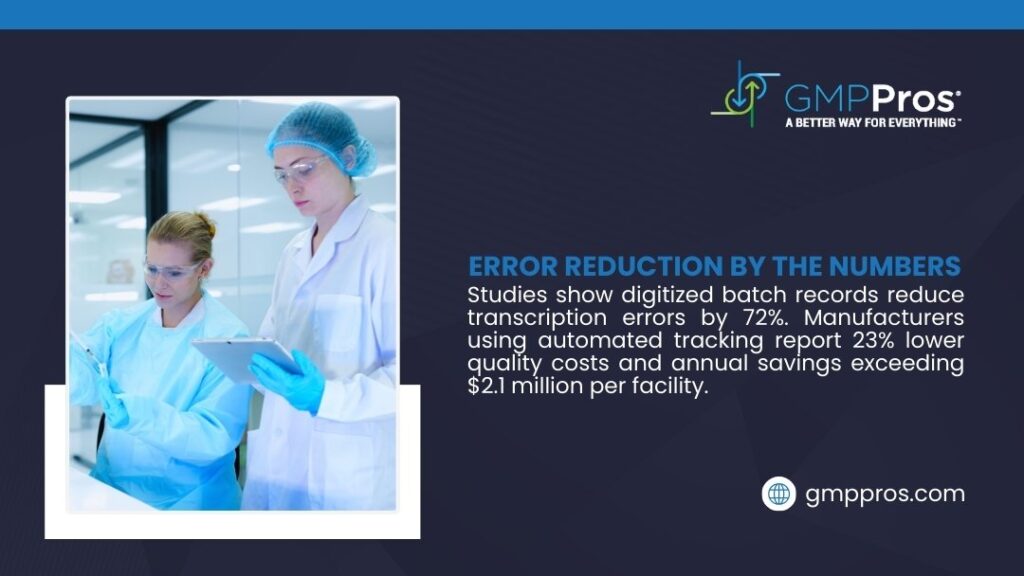
FDA inspectors focus on whether you can demonstrate process control and data integrity. Fast batch release raises questions only if documentation quality suffers.
Prepare to show inspectors:
- Validation protocols that prove your electronic systems work correctly.
- Standard procedures that define your accelerated review process.
- Training records that confirm reviewers understand abbreviated workflows.
- Metrics that demonstrate consistent cycle times without increasing errors.
- Audit trail reports that show complete traceability despite faster timelines.
From GMP Pros experience working with FDA-regulated facilities, inspectors accept review-by-exception and parallel processing when you can demonstrate these approaches maintain data integrity and quality oversight.
Case Examples & Benchmarks
Real-world implementations prove that significant cycle time reduction is achievable while maintaining compliance.
Success from Pharma and Biologics
GlaxoSmithKline documented their batch release optimization journey at multiple sites. One facility reduced preparation and review from 10 days to 36 hours through:
- Electronic batch record implementation
- Integrated laboratory systems
- Parallel review workflows
- Review-by-exception for routine batches
A large biologics manufacturer achieved similar results. Their complex cell culture batches previously required 18-22 days from harvest to release. After system integration and workflow redesign, they release 85% of batches within 12 days.
Another contract manufacturing organization specializing in clinical trial materials cut cycle time from 14 days to 6 days. Speed matters critically for clinical supply where production delays can pause entire studies.
Industry Benchmarks
Competitive manufacturers achieve these cycle time targets:
| Product Category | Competitive Cycle Time | Best-in-Class Cycle Time |
| Simple oral solids | 3-5 days | Under 3 days |
| Complex oral formulations | 5-7 days | 3-5 days |
| Sterile injectables | 7-10 days | 4-7 days |
| Biologics (cell culture) | 10-15 days | 7-10 days |
| Topical products | 3-5 days | 2-3 days |
Facilities that exceed these timelines without clear justification lose competitive position. Customers choose suppliers who can deliver products faster while maintaining quality standards.
Transform Your Batch Release Speed with Expert GMP Support
GMP Pros embeds experienced production engineers with FDA-regulated manufacturers to optimize quality systems and reduce batch record cycle time.
Our hands-on approach delivers practical improvements that combine electronic batch record implementation, workflow redesign, and system integration.
We have engineers bring validated electronic batch record expertise, process optimization methods, and regulatory knowledge that ensures your improvements satisfy FDA expectations.
Contact GMP Pros today to discuss how our production engineering services can help your facility release products faster while maintaining complete GMP compliance.