
Article Summary:
- Manual transcription errors in batch records are a direct threat to GMP compliance and data integrity
- FDA investigators treat documentation failures as potential quality system breakdowns
- ALCOA+ principles are violated when transcription errors go undetected or uncorrected
- Electronic batch records eliminate most transcription risk through automated data capture
- Correct correction procedures, not concealment, are the required response when errors surface
This article covers what are manual transcription errors in batch records, how they connect to data integrity, and what practical steps reduce the risk across both paper and digital documentation environments.
What Are Manual Transcription Errors in Batch Records?
A manual transcription error occurs when a value, identifier, or observation recorded by an operator does not match the actual data from the source.
In a GMP context, this means the batch record contains information that does not accurately reflect what took place during manufacture.
Transcription errors are distinct from falsification. A transcription error is unintentional, a result of human limitation rather than deliberate alteration.
Falsification involves intent to deceive. Regulators treat both seriously, but the investigation path and corrective action differ between them.
Batch records are sensitive documents because they serve as the legal and scientific evidence that a product was manufactured according to its validated process. Any inaccuracy in that record is an inaccuracy in the evidence.
| Type of Transcription Error | Example | Potential Risk |
| Decimal misplacement | 10.0 g recorded as 100 g | Out-of-spec formulation |
| Wrong unit entry | mg recorded instead of mL | Dosage calculation error |
| Incorrect lot number | Adjacent row number copied | Traceability failure |
| Omitted step | Operator skips a line during transfer | Incomplete batch history |
| Incorrect timestamp | Time recorded post-completion | ALCOA+ violation |
Common error locations include paper production logs, manual data transfer from instruments to records, spreadsheet-based batch documentation, and handwritten operator entries at shift transitions.
A review of batch record errors in pharma provides useful context for understanding how documentation failures are classified and investigated before any compliance assessment.
Why Manual Transcription Errors Are a Serious GMP Concern
FDA regulations under 21 CFR Part 211 require batch records to be accurate, complete, and attributable. When manual transcription errors enter a batch record, they create a direct conflict with those requirements and with the quality system built around them.
The concern extends beyond a simple documentation fix. An inaccurate value in a batch record can mean the product was not manufactured exactly as documented, with no way to confirm compliance without a formal investigation. Understanding how OOS investigations tied to batch record errors are scoped and documented helps QA decide when a transcription discrepancy escalates into a full out-of-specification review.
| Minor Documentation Error | Critical Transcription Error |
| Administrative correction with single-line strikethrough | Incorrect value affecting product quality assessment |
| No formal deviation required | Triggers deviation and root cause investigation |
| Closed at supervisor review | May require batch rejection or quarantine |
| Low audit visibility | High audit visibility |
Batch release decisions depend on the accuracy of batch record data. An error that affects a critical process parameter, such as temperature, concentration, or time, cannot be dismissed as clerical.
The relationship between documentation quality and product quality is not theoretical. It is the foundation of the GMP framework.
Data integrity issues in pharmaceutical batch records examines how documentation failures escalate from record-level errors to systemic quality concerns.
Common Causes of Manual Transcription Errors
No single factor drives most transcription errors. Root causes are typically a combination of environmental, procedural, and systemic conditions found across the production floor.
The most frequent contributors identified in GMP facilities include:
- Operator fatigue during extended shifts or high-volume production runs
- Shift handover gaps where records are updated from memory rather than direct observation
- Time pressure that causes operators to defer data entry until after task completion
- Manual copy-transfer of instrument readouts into paper or spreadsheet records
- Illegible handwriting that leads to misreads during data transfer or review
- Absent double-check systems with no second operator verification before batch sign-off
- Inadequate GMP training on data integrity and correct documentation practice
- Legacy paper systems with no structural controls to prevent incorrect entry
| Cause | Example | Risk Level |
| Fatigue | Wrong value recorded at end of night shift | High |
| Shift change | Time recorded by next operator from verbal handover | Medium to High |
| Manual instrument transfer | Lab result re-entered with transposed digits | High |
| No double-check system | Single operator records and approves data | High |
| Poor template design | Ambiguous fields lead to inconsistent entries | Medium |
Regulatory and Compliance Implications
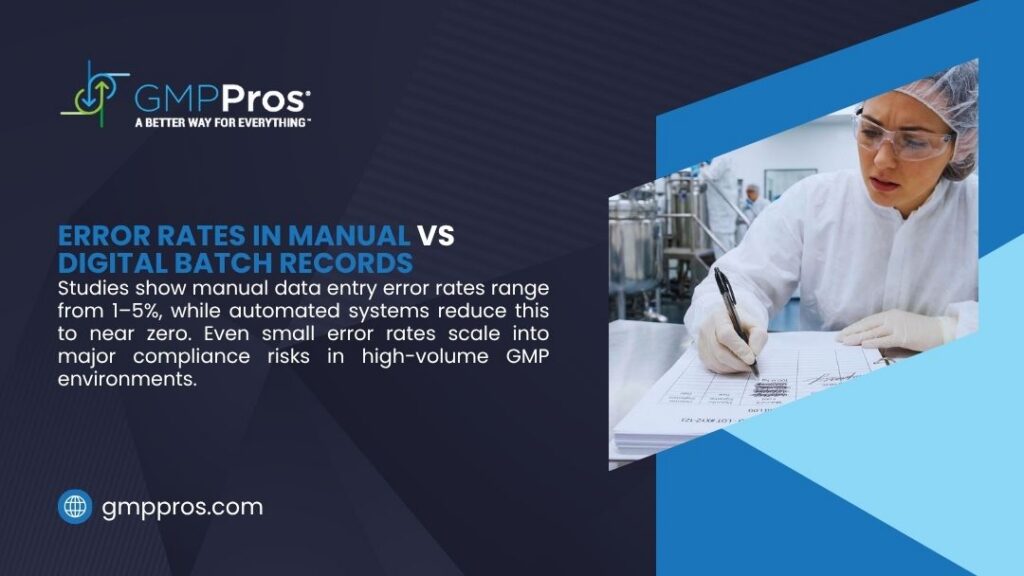
FDA investigators examine batch records closely during facility inspections. Patterns of manual transcription errors in batch records, even when corrected, signal a broader data integrity weakness that draws deeper regulatory scrutiny.
A single uncorrected transcription error in a released batch record can become the basis for a Form 483 observation. Repeated patterns across multiple records elevate the concern toward warning letter territory.
The regulatory impact follows a consistent sequence:
Error >> Detection >> Deviation Report >> Root Cause Investigation >> Corrective Action >> Audit Review
| Stage | Regulatory Implication |
| Error undetected at release | Potential market recall risk |
| Error detected at audit | Formal observation, possible repeat finding |
| Pattern of errors identified | Data integrity investigation |
| Inadequate CAPA response | Warning letter risk |
Batch rejection is also a direct outcome when a transcription error affects a critical quality attribute and the investigation cannot confirm the actual value. This represents both a compliance event and a financial loss.
How Manual Transcription Errors Affect Data Integrity
Data integrity is not a separate concern from transcription accuracy. It is the same concern. When a batch record contains an incorrect value, even an unintentional one, the record no longer satisfies ALCOA+ requirements.
ALCOA+ is the FDA’s framework for evaluating data quality: Attributable, Legible, Contemporaneous, Original, Accurate, plus Complete, Consistent, Enduring, and Available.
| ALCOA+ Principle | How Transcription Errors Violate It |
| Attributable | Error source cannot always be traced to a specific person or event |
| Contemporaneous | Post-event data entry breaks the time-record link |
| Original | Copied data is not the original source record |
| Accurate | Incorrect values directly violate this principle |
| Complete | Omitted steps or values leave the record incomplete |
Loss of traceability is one of the most serious downstream effects. When a lot number or equipment ID is recorded incorrectly, the ability to trace that batch through its full production history is compromised.
Paper batch records vs electronic outlines how the structural difference between documentation formats affects data integrity risk at the record level.
Real-World Examples of Transcription Errors in Batch Records
The scenarios below reflect the types of errors that appear in GMP investigation reports and FDA observation records.
| Scenario | What Went Wrong | Consequence |
| Decimal point error | 0.5 kg recorded as 5.0 kg for active ingredient | Out-of-spec batch, full investigation required |
| Incorrect batch number | Adjacent lot number copied from prior record | Traceability failure, full records review required |
| Wrong equipment ID | Operator copied previous shift’s equipment reference | Validation status of equipment could not be confirmed |
| Transposed digits | 1260 recorded as 1620 for process time | Critical parameter outside validated range |
| Missing signature | Operator completed step without contemporaneous sign-off | Regulatory observation at audit |
| Incorrect timestamp | Time of completion recorded rather than time of action | ALCOA+ violation, contemporaneous record requirement breached |
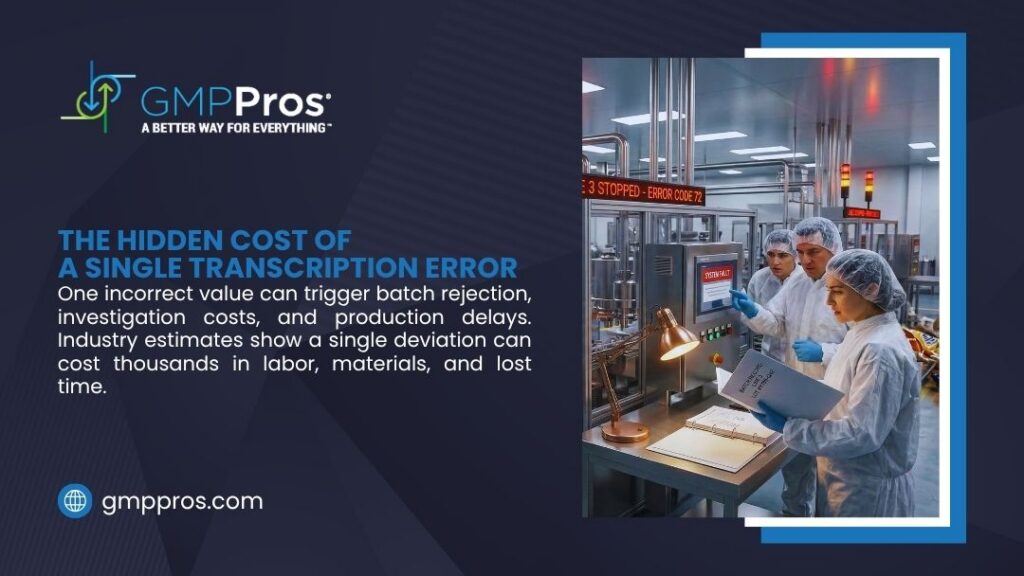
Each of these scenarios is preventable. The risk does not come from complexity. It comes from the absence of structural controls around how data is captured and verified.
Best Practices to Prevent Manual Transcription Errors
The most effective approach to reducing manual transcription errors in batch records combines procedural controls with structural changes to the documentation environment.
- Implement Double-Check Systems
Independent verification before batch sign-off is one of the most direct controls available in a paper environment. A second operator reviews all critical values against source data before the record is closed.
This is not a duplicate task. It is a formal quality control step. Facilities that treat second verification as optional tend to see higher error rates at batch review and release.
- Train Operators on Data Integrity Principles
GMP training that covers only procedural steps is insufficient. Operators need to understand why data integrity matters, what happens when a record is inaccurate, how errors are investigated, and what correct documentation looks like at each production step.
Refresher sessions tied to actual deviation examples from the facility’s own records carry more impact than generic compliance modules.
- Design Error-Resistant Batch Templates
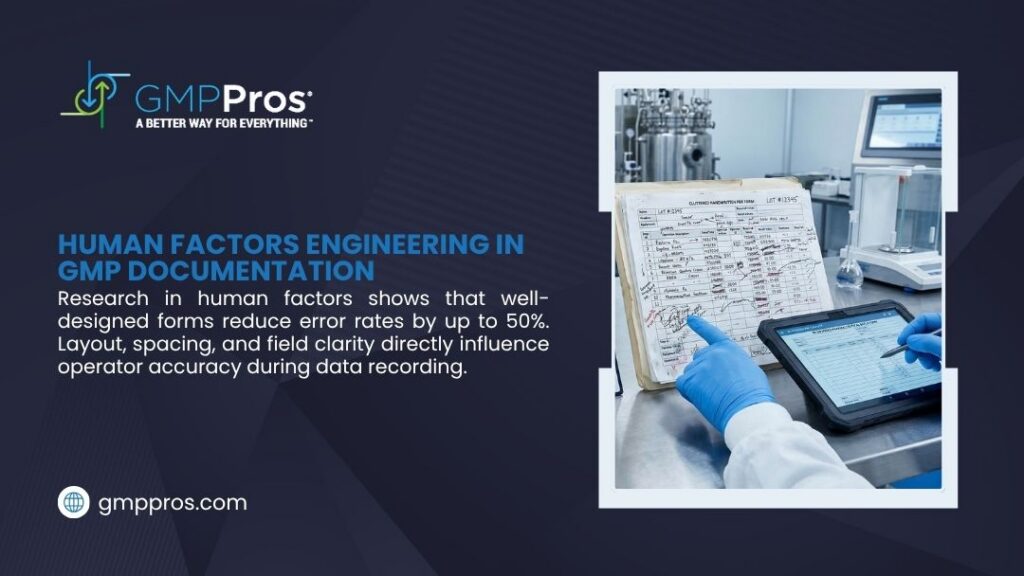
Structured documentation formats reduce transcription risk before the operator reaches the record. Clear field labels, defined units next to each entry, pre-printed lot number fields, and logical step sequences reduce the opportunity for error at the source.
Template design is an engineering problem, not just a documentation task. A well-structured template removes ambiguity at the point of entry.
| Strategy | Manual Environment | Digital Environment |
| Double-check | Second operator sign-off | System-enforced reviewer workflow |
| Data entry | Operator transcription from source | Direct instrument integration |
| Timestamp | Manual entry by operator | Automatic system-generated timestamp |
| Template control | Pre-printed structured forms | Locked field formats with validation rules |
How Electronic Systems Reduce Transcription Risk
Electronic Batch Record systems address the structural root cause of most transcription errors: the manual transfer of data from its source into the batch record.
When data flows directly from instruments, sensors, and production systems into the electronic record, the opportunity for transcription error is removed at that step. The operator does not re-enter values. The system captures them at the source.
Role of Audit Trails
Electronic systems maintain a complete, time-stamped audit trail for every data entry, edit, and approval action. This audit trail is not optional. It is a requirement under 21 CFR Part 11 for electronic records used in FDA-regulated environments.
The audit trail does not prevent errors outright, but it makes every change visible, attributable, and reviewable. That alone transforms how data integrity investigations are conducted at the facility level.
Integration With Production Equipment
Direct integration between electronic batch record systems and production equipment, including scales, bioreactors, environmental monitors, and filling lines, removes manual copy-transfer entirely for those data points.
From an engineering standpoint, instrument integration is the single highest-impact intervention for transcription error reduction. The data travels from the source directly to the record without a human transfer step in between.
| Feature | Manual Batch Record | Electronic Batch Record |
| Data entry | Operator transcription | Automated or direct capture |
| Timestamp | Manual, operator-assigned | System-generated, tamper-evident |
| Audit trail | Paper correction history only | Full electronic history with user ID |
| Error detection | Review-dependent | Real-time validation alerts |
| Regulatory reference | 21 CFR Part 211 | 21 CFR Part 11 |
The transition from paper to electronic documentation is covered in detail through [EBR implementation pharma], which outlines the validation, change control, and staff readiness steps that make the transition sustainable.
What To Do If a Transcription Error Is Discovered
The correct response to a discovered transcription error follows a defined sequence. Concealment is never the right action. In a regulated environment, it converts an unintentional error into a potential falsification event.
The correction workflow:
- Document the error immediately with a single-line strikethrough, correct value, date, and operator initials
- Assess whether the error affects a critical process parameter or quality attribute
- Initiate a deviation if the error carries potential quality or compliance impact
- Investigate root cause, whether an isolated event or a systemic gap
- Implement corrective action through the facility’s CAPA system
- Prevent recurrence through template redesign, targeted training, or procedural control updates
| Stage | Required Action |
| Error detected | Document with correction notation, do not erase |
| Impact assessment | Determine if a critical parameter is affected |
| Deviation threshold | Initiate formal deviation if quality impact is possible |
| Root cause analysis | Identify systemic or individual contributing cause |
| CAPA closure | Verify corrective action effectiveness before close |
Speed of detection matters. An error caught at in-process review is far easier to resolve than one found during batch release review or during an external audit.
Frequently Asked Questions About Manual Transcription Errors in Batch Records
What are manual transcription errors in batch records?
They are unintentional data entry mistakes where values, identifiers, or timestamps recorded in a batch record do not match the actual source data from the production process.
Why are transcription errors considered a GMP issue?
Batch records are the formal evidence that a product was manufactured according to its validated process. An inaccurate record means that evidence is unreliable, which directly conflicts with FDA documentation requirements under 21 CFR Part 211.
How do transcription errors affect data integrity?
They violate one or more ALCOA+ principles, most often Accurate, Contemporaneous, or Original, which are the FDA’s criteria for evaluating whether data can be trusted as a reliable record of manufacture.
Are transcription errors always considered deviations?
Minor errors with no quality impact may be corrected through standard documentation procedures. Errors that affect critical process parameters or quality attributes require a formal deviation and root cause investigation.
How can manual transcription errors be prevented?
A combination of double-check systems, structured batch templates, operator data integrity training, and transition to electronic data capture addresses the most significant risk vectors.
What is the difference between a transcription error and falsification?
A transcription error is unintentional, a result of human limitation under real production conditions. Falsification is the deliberate alteration or fabrication of data. Both are serious in a GMP context, but they carry different regulatory and legal implications.
Strengthen Your Batch Record Accuracy Before the Next Audit
Manual transcription errors in batch records are not isolated documentation events. Each one carries the potential to affect batch release decisions, trigger regulatory observations, and undermine the data integrity framework the entire quality system depends on.
Facilities that rely on paper-based documentation face structural risk that procedural controls alone cannot fully address.
The shift toward electronic batch records, with direct instrument integration, audit trails, and real-time validation, removes the human transfer step where most transcription errors originate.
For FDA-regulated manufacturers ready to assess current batch documentation practices, strengthen data integrity controls, or build a transition roadmap toward electronic systems, GMP Pros provides embedded engineering support at the facility level.
The team works on-site, within your production environment, to close the gap between current documentation risk and the compliance standard your facility requires.
Contact GMP Pros today to discuss your batch record challenges and explore what a practical path forward looks like for your operation.