
- Data integrity issues in pharmaceutical batch records represent one of the most cited FDA violations in regulated manufacturing.
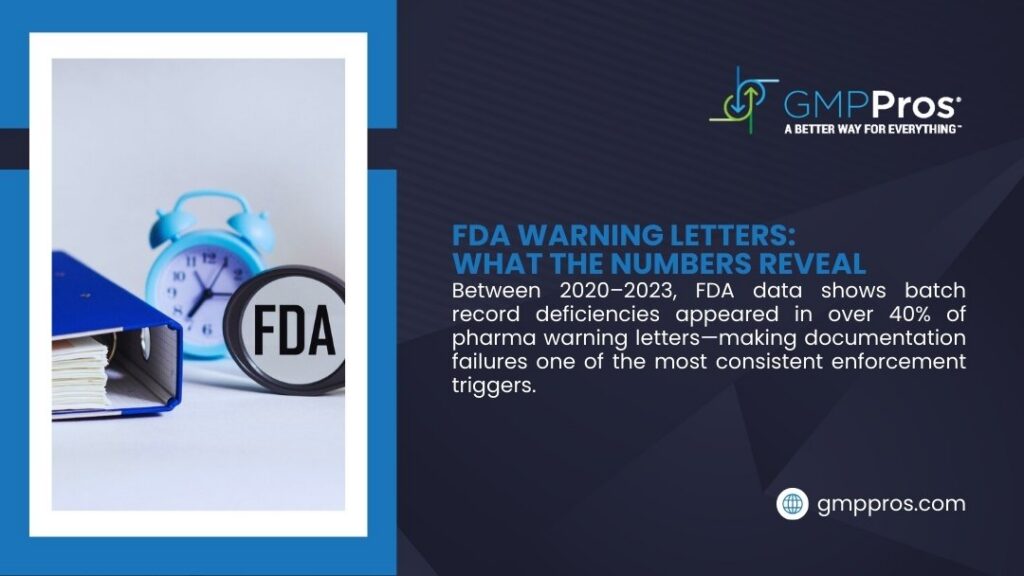
- Between 2020-2023, FDA warning letters referenced batch record deficiencies in 42% of pharmaceutical facility inspections.
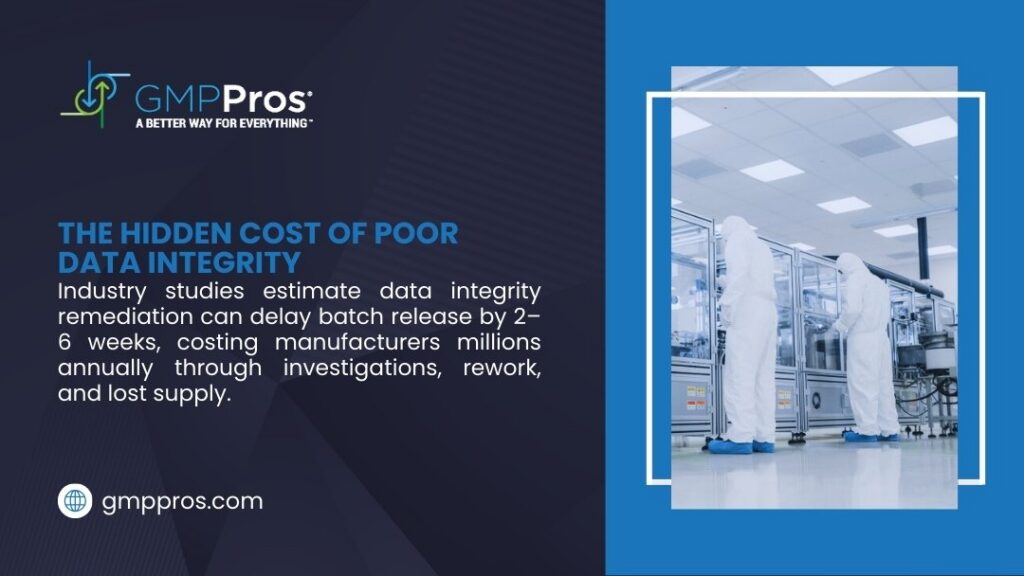
- These failures cost manufacturers millions through delayed product releases, investigation expenses, and regulatory remediation.
- Facilities that address root causes systematically reduce audit findings, accelerate batch release cycles, and build stronger quality cultures.
This technical guide examines common data integrity failures, regulatory expectations, prevention strategies for both paper and electronic systems, and audit preparation methods that work in real-world manufacturing environments.
Understanding Data Integrity in Batch Records
Batch records serve as the legal proof that manufacturers followed approved procedures. Every entry, signature, and measurement documents process control.
As FDA explicitly states in its Data Integrity and Compliance guidance:
“Ensuring data integrity is an important component of industry’s responsibility to ensure the safety, efficacy, and quality of drugs, and of FDA’s ability to protect the public health.”
When data integrity fails, regulators question whether the product was actually made according to specifications. FDA cannot verify safety or efficacy without trustworthy documentation.
What ALCOA+ Principles Mean for Batch Documentation
FDA expects batch records to meet ALCOA+ criteria. These principles define acceptable data practices in GMP environments.
| ALCOA+ Element | Definition | Batch Record Application |
| Attributable | Data traces to specific person | Operator signatures link entries to individuals |
| Legible | Information remains readable | Clear handwriting or electronic fonts prevent misinterpretation |
| Contemporaneous | Records created in real-time | Operators document during manufacturing, not hours later |
| Original | First capture of data | Primary measurements recorded directly, not transcribed |
| Accurate | Data reflects actual events | Test results match what instruments measured |
| Complete | All required information present | No blank fields or missing signatures |
| Consistent | Data makes chronological sense | Timestamps follow logical sequence |
| Enduring | Records survive retention period | Storage methods prevent degradation |
| Available | Records accessible for review | Retrieval systems allow quick access during audits |
Electronic batch record systems enforce several ALCOA+ elements automatically. Timestamps become contemporaneous by default. Audit trails make attribution permanent. Data cannot be altered without detection.
Paper systems require more procedural controls to achieve the same level of data integrity. Operators must self-enforce real-time documentation. Supervisors verify completeness through manual review.
Key Regulatory Requirements for Data Integrity
FDA regulation 21 CFR 211.188 requires batch production records to include complete information. This means dates, signatures, actual yields, equipment identification, and in-process control results.
21 CFR Part 11 governs electronic records and electronic signatures. Systems must validate before use, generate accurate copies, protect records with access controls, and create audit trails for all changes.
| Regulation | Core Requirement | Data Integrity Impact | Batch Record Example |
| 21 CFR 211.188 | Complete batch documentation | All manufacturing steps documented | Missing temperature reading creates incomplete record |
| 21 CFR 211.192 | QC review before release | Quality unit verifies record accuracy | Reviewer catches calculation error before distribution |
| 21 CFR Part 11 | Electronic record controls | Audit trails track all changes | System logs who modified lot number entry and when |
| 21 CFR 211.186 | Master record requirements | Templates must be detailed and unambiguous | Vague instruction “mix well” fails to specify time or speed |
FDA Form 483 observations frequently cite missing signatures, incomplete test results, and unexplained data modifications. These violations directly trace to weak data integrity controls.
Common Types of Data Integrity Failures
Manufacturers face distinct categories of batch record problems. Some stem from human mistakes. Others result from system design flaws. A few represent deliberate manipulation.
| Failure Type | Typical Cause | Potential Regulatory Impact | Prevention Strategy |
| Missing signatures | Operator forgot to initial step | 483 observation, delayed batch release | Electronic prompts that prevent progression without signature |
| Blank data fields | Rushed documentation, unclear requirements | Warning letter citation for incomplete records | Required field validation in EBR systems |
| Backdated entries | Operator recorded hours after event | Data integrity violation, truthfulness questions | Real-time documentation requirements with supervisor spot checks |
| Unauthorized changes | Correction procedure not followed | 483 observation for unapproved alterations | Change control workflow with approval routing |
| Out-of-sequence timestamps | Time entry errors or manipulation | Investigation for possible data fabrication | Automated timestamp capture from system clock |
| Transcription errors | Manual data transfer from instruments | Product quality risk if specifications affected | Direct instrument integration eliminates manual copying |
| Erased or whited-out entries | Improper correction method | Severe data integrity violation | Training on single-line strikethrough correction procedure |
The distinction between unintentional error and deliberate falsification matters during investigations. FDA treats intentional manipulation far more seriously than honest mistakes that were promptly corrected.
Causes of Data Integrity Issues in Pharmaceutical Batch Records
Root causes extend beyond individual operator actions. Process design, technology limitations, and organizational culture all contribute to data integrity problems.
- Human Factors
Operators work under production pressure with tight timelines. Documentation becomes secondary when the focus stays on output rather than quality.
Insufficient training leaves staff unsure about proper procedures. When operators do not understand why each entry matters, they make shortcuts that seem harmless but create compliance gaps.
Operators rushing to complete documentation before shift end created patterns of incomplete entries and missing verifications.
| Human Factor | How It Creates Problems | Practical Solution |
| Production schedule pressure | Operators skip steps to meet deadlines | Realistic timelines that account for documentation time |
| Inadequate initial training | Staff do not know proper procedures | Competency-based training with documentation exercises |
| Lack of ongoing refreshers | Bad habits develop over time | Quarterly documentation reviews with error trend analysis |
| Unclear accountability | Nobody owns record quality | Assign specific roles for record verification at each step |
| Fatigue during long shifts | Tired operators make careless mistakes | Break schedules and workload distribution that prevent exhaustion |
Facilities that treat documentation as part of the manufacturing process rather than administrative burden see fewer human-factor errors.
- System and Technology Factors
Legacy manufacturing execution systems often lack proper validation. When software was never qualified for GMP use, the electronic records failed to meet 21 CFR Part 11 requirements.
Poor system integration creates gaps where data must transfer manually between platforms. Each manual step introduces transcription risk.
| System Failure Type | Risk Impact | Recommended Mitigation |
| Unvalidated software | Records legally questionable | Complete IQ/OQ/PQ validation per Part 11 |
| Missing audit trails | Cannot detect unauthorized changes | Implement system with comprehensive change logging |
| Inadequate access controls | Unauthorized users can modify data | Role-based permissions with individual user accounts |
| System downtime procedures | Paper backup records create dual systems | Validated contingency procedures with clear switchover protocols |
| Instrument integration failures | Automatic data capture stops working | Redundant capture methods with error alerts |
One contract manufacturer implemented an electronic batch record platform without proper validation. During an FDA inspection, investigators questioned whether the system could be trusted. The facility faced a warning letter and spent six months completing retrospective validation.
- Organizational and Cultural Factors
Companies that tolerate documentation shortcuts create environments where data integrity erodes gradually. Small violations accumulate until an audit exposes systemic problems.
Unclear standard operating procedures leave operators guessing about correct methods. When ten different people complete batch records ten different ways, consistency becomes impossible.
Poor communication between production, quality, and engineering means process improvements never reach the master batch record. Operators then follow unofficial procedures while documentation reflects outdated methods.
| Cultural Factor | Compliance Consequence | Leadership Action Required |
| “Production first” mentality | Quality viewed as obstacle rather than partner | Executive messaging that quality enables business success |
| Blame culture after errors | Staff hide mistakes instead of reporting | Non-punitive error reporting for honest mistakes |
| Weak cross-functional collaboration | Silos prevent process improvement | Regular quality/production/engineering review meetings |
| SOPs written by people who don’t do the work | Procedures disconnected from reality | Operator involvement in SOP development and updates |
GMP Pros consultants embed with client teams specifically to bridge these organizational gaps. External perspective combined with hands-on manufacturing experience helps identify cultural issues that internal staff might overlook.
Prevention Strategies for Data Integrity Issues
Systematic prevention proves far more effective than reactive investigation. Well-designed processes make errors difficult to commit in the first place.
| Prevention Strategy | Description | Tools and SOPs | Expected Outcome |
| Master record design review | Templates evaluated for clarity and completeness | Cross-functional review checklist, operator usability testing | 70% reduction in execution errors |
| Real-time documentation enforcement | Rules require contemporaneous entries | Supervisor spot checks, electronic timestamps | Elimination of backdating issues |
| Tiered verification approach | Critical steps get independent confirmation | Dual-signature requirements, automated alerts | 85% fewer material addition errors |
| Automated data capture | Instruments feed data directly to batch records | MES integration, validated interfaces | 95% reduction in transcription mistakes |
| Regular system audits | Periodic review of data integrity controls | Self-assessment tools, trending metrics | Early detection of control degradation |
Best Practices for Paper Batch Records
Paper documentation still dominates many manufacturing operations. These systems can achieve strong data integrity when proper controls exist.
Legibility standards must be defined and enforced. Some facilities require a printed name next to each signature. Others mandate specific ink colors for different roles.
Contemporaneous documentation means operators carry batch records with them during production. Records stay at the manufacturing line, not in an office where they get completed from memory later.
Controlled revisions prevent outdated templates from entering production. Master records should have version numbers, effective dates, and document control procedures that ensure only current versions reach the floor.
Pre-printed units eliminate confusion between kilograms and grams or minutes and hours. When operators only enter numbers, not units, calculation errors decrease substantially.
Best Practices for Electronic Batch Records
Electronic systems offer advantages that paper cannot match, but only when implementation follows GMP principles.
System validation must occur before production use. Installation qualification verifies hardware and software configuration. Operational qualification confirms all functions work correctly. Performance qualification demonstrates the system performs reliably under actual manufacturing conditions.
Audit trails should capture who made entries, when they occurred, and what changed. Complete change history allows investigation of any suspicious patterns.
Access controls prevent unauthorized modifications. Role-based permissions ensure operators cannot approve their own work or access records outside their responsibility.
Automated alerts flag missing data, out-of-specification results, or incomplete steps before batch records reach quality review. These real-time notifications prevent issues from reaching final review.
| Control Aspect | Paper Records | Electronic Batch Records | Compliance Advantage |
| Signature verification | Manual comparison to signature log | Electronic authentication with password | Electronic signatures cannot be forged or repudiated |
| Timestamp accuracy | Written by operator, subject to error | System-generated from validated clock | Precise contemporaneous documentation proof |
| Data modification tracking | Single-line strikethrough with initials | Complete audit trail with before/after values | Full traceability of all changes |
| Calculation accuracy | Manual math with independent verification | Automated formulas with error checking | Elimination of arithmetic mistakes |
| Template version control | Physical distribution of updated forms | Automatic deployment of current version | Impossible to use obsolete templates |
Facilities considering the transition from paper batch records vs electronic approaches should pilot on simple products first. Success with straightforward formulations builds confidence before tackling complex processes.
Preparing for Audits and Inspections
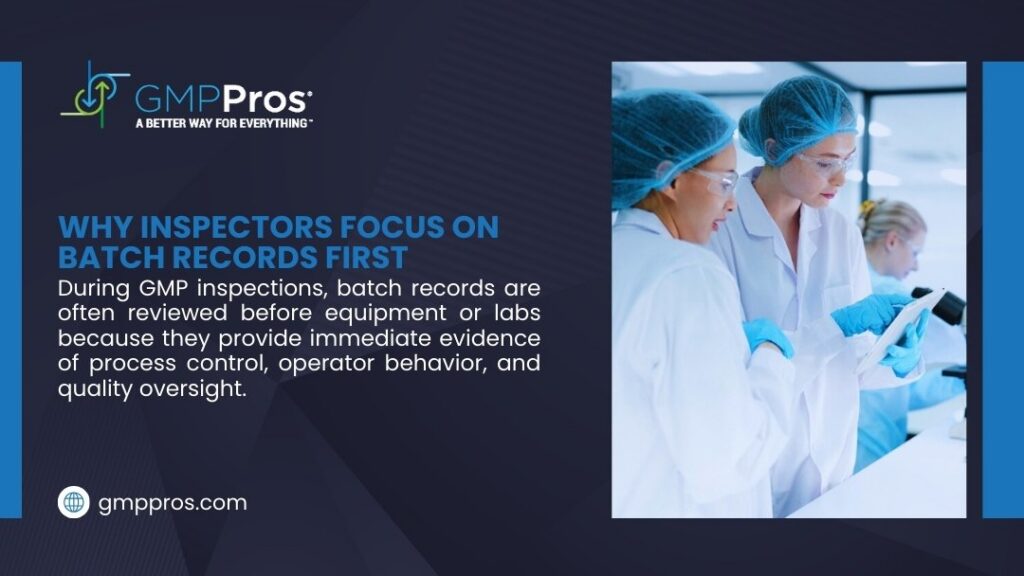
FDA investigators evaluate batch records for completeness, accuracy, and compliance with approved procedures. Facilities must demonstrate control over their documentation systems.
Audit preparation begins long before inspection notices arrive. Continuous readiness means batch records always meet standards, not just during inspection periods.
Documentation packages should include batch production records, laboratory test results, deviation reports with investigations, and change control history affecting the batch.
Retrieval systems must locate specific batches within minutes. Inspectors expect immediate access to requested documentation. Delays raise suspicions about missing or problematic records.
Common auditor questions include:
- How do you ensure operators document in real-time?
- What controls prevent unauthorized record modifications?
- How do you verify calculation accuracy?
- What happens when electronic systems fail?
- How do you train new operators on documentation requirements?
| Audit Preparation Element | Responsible Role | Evidence Type | Verification Method |
| Record completeness check | Production supervisor | Signed checklist confirming all fields filled | Weekly supervisor review before QC |
| Calculation verification | Quality reviewer | Independent recalculation of yields and batches | 100% review before batch release |
| Signature authenticity | Quality assurance | Comparison to authorized signature log | Random sampling during internal audits |
| Deviation documentation | Quality unit | Investigation reports with CAPA linkage | Monthly trending analysis |
| Training records current | Training coordinator | Individual training files with competency assessments | Annual verification of completion |
| System validation status | IT/validation team | Current validation protocols and summary reports | Periodic revalidation per schedule |
Mock inspections conducted by internal auditors reveal gaps before external scrutiny occurs. These practice runs should use the same intensity and scrutiny FDA investigators apply.
Batch record review process standardization prevents inspector findings about inconsistent practices. When all reviewers apply identical criteria, facility responses to audit questions become straightforward.
Risk Assessment and Continuous Improvement
Proactive identification of vulnerabilities prevents future compliance failures. Risk-based approaches focus resources where they deliver maximum protection.
Self-assessment models evaluate current batch record practices against regulatory expectations and industry benchmarks. Scoring systems assign numerical values to control effectiveness, allowing objective comparison.
| Risk Factor | Severity (1-5) | Likelihood (1-5) | Risk Score | Mitigation Plan |
| Missing operator signatures | 4 | 3 | 12 | Implement electronic prompts requiring signature before step progression |
| Calculation errors in yield | 5 | 2 | 10 | Add automated yield calculation with variance alerts |
| Backdated entries | 5 | 2 | 10 | Supervisor spot checks with timestamp verification |
| Incomplete deviation documentation | 4 | 3 | 12 | Deviation template with required fields that cannot be bypassed |
| Out-of-calibration instrument data | 5 | 1 | 5 | Automated calibration status verification before data acceptance |
Continuous monitoring through key performance indicators reveals trends before they become audit findings. Metrics worth tracking include:
- Percentage of batch records requiring correction before release
- Average time from batch completion to quality approval
- Number of deviations per batch
- Training effectiveness scores from competency assessments
- System uptime for electronic batch record platforms
Corrective action loops should close within defined timeframes. Open CAPAs related to batch record errors represent ongoing compliance risks.
Frequently Asked Questions
What are the most common data integrity issues in batch records?
Missing signatures create compliance risks because they eliminate proof that qualified personnel performed and verified critical manufacturing steps. Incomplete data fields similarly undermine batch integrity by leaving gaps in the documented manufacturing history. FDA frequently cites both issues during inspections, particularly under 21 CFR 211.188 requirements for complete batch documentation.
How do electronic batch records improve compliance compared to paper systems?
Electronic batch records provide automated audit trails that track every entry and modification. Access controls prevent unauthorized changes. System timestamps ensure contemporaneous documentation. Required field validation eliminates blank entries.
Are paper records safer than electronic batch records for data integrity?
Neither system is inherently safer. Both require proper controls, training, and oversight. Paper records offer simplicity but depend entirely on operator discipline. Electronic systems provide stronger technical controls but require validation and maintenance.
FDA accepts both approaches when they meet ALCOA+ principles and regulatory requirements.
What steps should facilities take to remediate data integrity issues?
Begin with thorough root cause analysis that goes beyond blaming individuals. Examine process design, training adequacy, procedure clarity, and system capabilities. Implement corrective actions that address systemic weaknesses.
Retrain affected staff on proper procedures and data integrity principles.
Verify effectiveness through follow-up audits. Document all investigation and remediation activities for regulatory review.
Building Sustainable Data Integrity Programs
GMP Pros helps FDA-regulated manufacturers build robust data integrity programs through embedded engineering expertise.
Our consultants work alongside your production and quality teams to assess current practices, design improvements that fit your workflows, validate systems to regulatory standards, and train staff on both technical operation and compliance principles.
Whether you need EBR implementation pharma expertise, systematic improvement of existing paper systems, or comprehensive data integrity program development, GMP Pros brings hands-on experience from pharmaceutical, biologics, food, and animal health facilities.
Contact GMP Pros today to discuss how our embedded approach transforms batch record management from compliance challenge into competitive advantage through measurable improvements in audit readiness, batch release speed, and quality culture.