
Incomplete batch records causing lot release delays rank among the most disruptive problems in FDA-regulated plants, because a lot can meet every specification and still sit in quarantine. QA does not release on test results alone.
It releases on documented proof that the lot followed the approved process, step by step, signature by signature. One blank field, one unsigned verification, or one open deviation stops disposition cold.
What a Batch Record Must Prove Before QA Releases a Lot
The executed batch record is the legal evidence that a specific lot was made per the approved master formula and a validated process. Under 21 CFR 211.188, batch production and control records must be prepared for each batch of drug product and must include complete information relating to the production and control of that batch.
Before disposition, QA confirms:
- Material identity, weights, and lot traceability for every component
- In-process control results inside approved limits, documented at the time of the check
- Equipment identification, line clearance, and cleaning status
- Theoretical versus actual yield, with justification for any variance
- A complete signature and second-person verification chain
- Closure of every deviation and OOS investigation tied to the lot
The disposition test is blunt:
If a check cannot be proven from the record, from a compliance standpoint it never happened.
That is why in-process control documentation failures hold so many lots. A missing pH reading or an unrecorded fill weight check removes QA’s ability to confirm a critical control point ever ran.
Master Batch Record vs Executed Batch Record
| Master Batch Record (MPCR) | Executed Batch Record (BPCR) | |
|---|---|---|
| Governed by | 21 CFR 211.186 | 21 CFR 211.188 |
| What it is | The approved, unexecuted template, the recipe | The completed, signed record of what happened for one specific lot |
| Created | Once per product and batch size, before any lot runs | Once per lot, filled in as production happens |
| Signed by | One person, then independently checked, dated, and signed by a second | Each operator and reviewer, step by step, as the work occurs |
| A defect means | The flaw replicates across every future lot made from this template | The flaw blocks only the single lot in front of QA |
The master batch record (master production and control record) is the approved, unexecuted template that defines formula, process steps, specifications, and controls. 21 CFR 211.186 requires such a record for each drug product and each batch size, prepared, dated, and signed by one person, then independently checked, dated, and signed by a second.
The executed batch record is the completed, signed copy of what actually occurred during one lot. The compliance difference matters: a master record defect replicates across every future lot, while an executed record defect blocks the single lot in front of QA.
The Mechanism Behind Incomplete Batch Records Causing Lot Release Delays
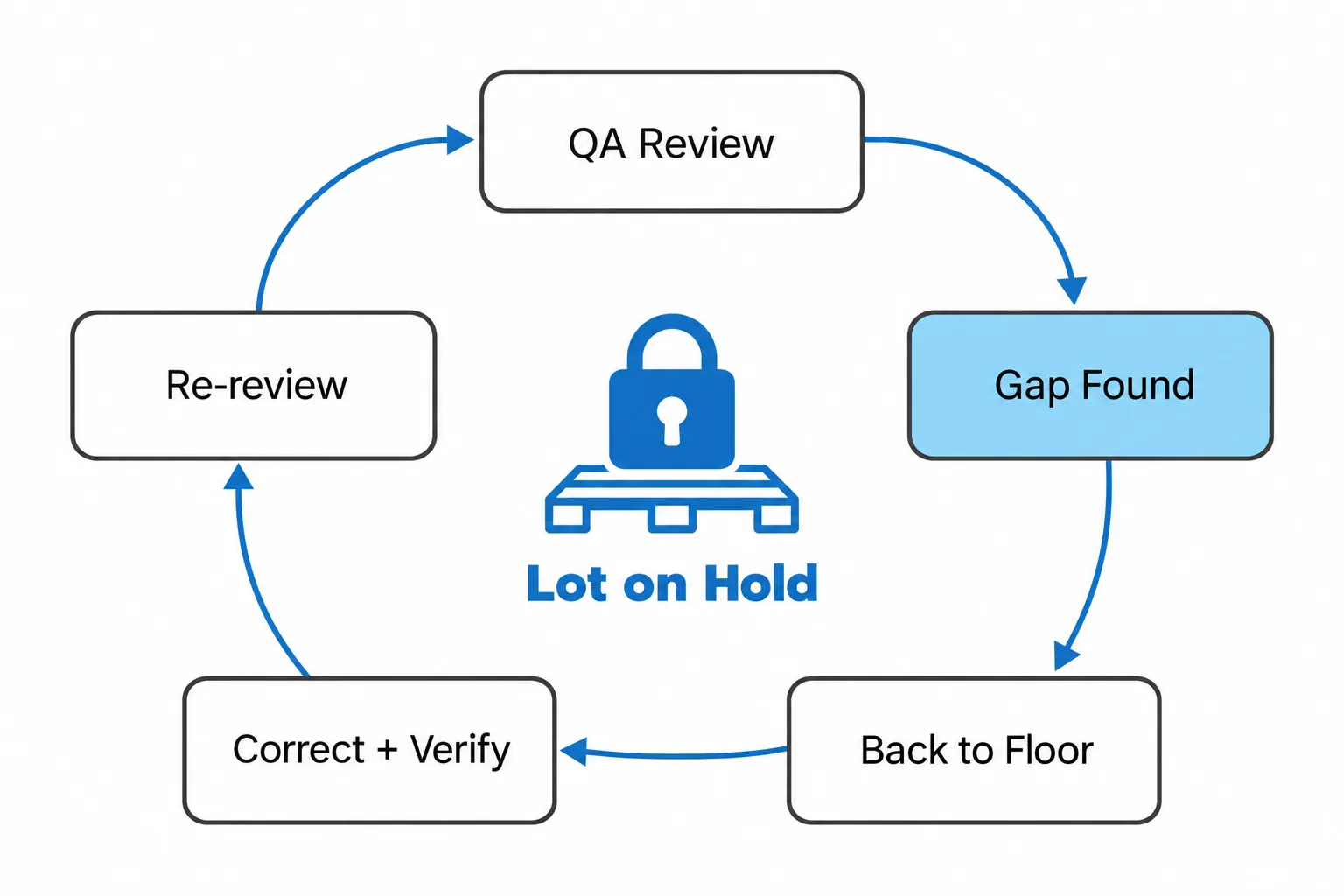
QA cannot approve a record that still holds an open question. 21 CFR 211.192 requires review and approval of all production and control records by the quality control unit before a batch is released, plus thorough investigation of any unexplained discrepancy or specification failure. Review halts, the lot stays on quarantine hold, and the query routes back to the floor.
Each round trip costs days, not minutes. The operator who owns the entry has rotated off shift. The supervisor who must verify the correction needs the original context. GMP-compliant error correction and re-verification then follow.
Corrections also attract scrutiny. A late entry or an unexplained change invites a data integrity review against ALCOA+ expectations (attributable, legible, contemporaneous, original, accurate), which converts a small documentation gap into an investigation.
Volume compounds the effect: several minor gaps in one record extend cycle time non-linearly, and a backlog of held lots consumes the same reviewers needed to clear it. The broader pattern behind batch record-driven release delays usually traces to this queue behavior rather than to reviewer speed.
Root Causes on the Manufacturing Floor
- Paper execution. Illegible entries, skipped fields, absent initials and dates, plus physical routing of the packet between production, warehouse, lab, and QA.
- Manual transcription. Weights, yields, and calculations copied from equipment printouts and logbooks, where a transposed digit survives until final review.
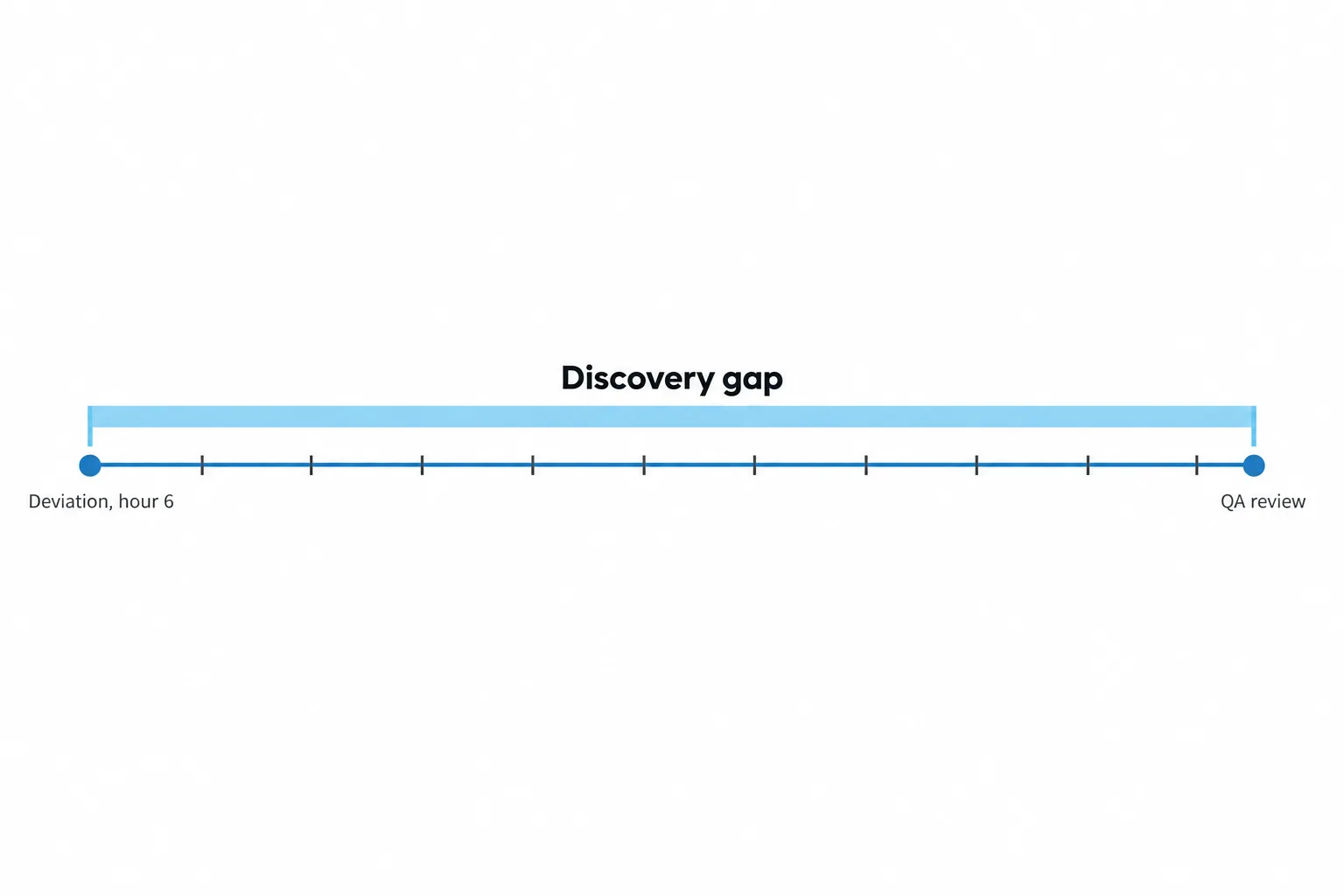
- Late deviation and OOS discovery. The event occurs at hour six of the run and reaches QA weeks later, so the investigation clock starts at the worst possible moment.
- Sequential review. One static document, one reviewer at a time, with no concurrent access for microbiology, analytical, and production specialists.
- Ambiguous master record design. Unclear step instructions, unlabeled fields, and no defined convention for “not applicable” outcomes. Poor masters manufacture their own downstream gaps, a root cause most vendor commentary skips.
- Turnover and training gaps. New operators unfamiliar with contemporaneous documentation practice and second-person verification rules.
Regulatory and Financial Impact
Documentation gaps read as quality system weaknesses, not clerical slips. Incomplete batch production and control records map directly to 21 CFR 211.188, unresolved discrepancies map to 211.192, and both surface as Form 483 observations. Data integrity findings escalate faster still, because they question the reliability of every record the site produces.
The financial drag runs parallel. Working capital sits in quarantined finished goods, warehouse space stays occupied, supply commitments and distribution windows slip, and shelf life burns down while the lot waits. QA reviewer hours go to rework instead of forward disposition, and repeated gaps invite a wider inspection scope on the next visit.
Paper vs Electronic Batch Records: Where the Delay Goes
Related readingBatch Record Errors in Pharma: Causes & PreventionRead the guide →| Dimension | Paper batch record | Electronic batch record (MES) |
|---|---|---|
| Data capture | Handwritten at the line, transcribed from printouts | Entered or acquired directly, with forced units and formats |
| Error detection point | After execution, at QA review | At entry, before the step closes |
| Review model | Sequential, one reviewer at a time | Parallel access for QA, analytical, and production |
| Deviation visibility | Surfaces days or weeks later | Flagged in real time, routed the day of the event |
| Audit trail | Reconstructed manually from initials and dates | System-generated and time-stamped |
| Inspection response | Physical retrieval from archive | Immediate query and display |
Audit trail expectations for those systems come from 21 CFR Part 11, which calls for secure, computer-generated, time-stamped audit trails that independently record the date and time of operator entries and actions that create, modify, or delete electronic records.
One caveat: an EBR does not repair a weak process or a confusing master record. It enforces whatever design gets configured, at speed.
How to Fix Incomplete Batch Records Causing Lot Release Delays
1. Field-level validation. Mandatory entries, range and limit checks, forced units, calculated fields, and no forward progress until the prior step closes. 2. Documentation at the point of execution. Contemporaneous entry beats end-of-shift reconstruction and removes the memory gap that drives correction cycles. 3. Automated deviation detection. Real-time flags and routes, so an investigation opens on the day of the event. 4. Parallel review workflows. Concurrent reviewer access to one electronic record instead of a serial queue. 5. Review by exception. Reviewers examine flagged exceptions rather than every compliant line. 6. Master record redesign before digitization. Simplify steps, delete redundant entries, define N/A conventions, and standardize across sites. 7. Metrics that expose the problem. Right-first-time record rate, QA queries per record, days from production completion to disposition, and deviation cycle time.
Sites that treat this as an engineering problem rather than a staffing problem tend to move fastest. GMP Pros embeds engineers inside client operations for EBR and MES implementation, master record simplification, and production engineering support, work covered further on our guide about incomplete batch records and lot release delays.
Frequently asked questions
Why do companies use only three batches for process validation?
What is the main difference between a batch record and a master batch record?
What is an executed batch record?
What is the purpose of pharmaceutical batch records?
Does an EBR system guarantee faster release?
Closing Takeaway
Release speed is a documentation design outcome. Prevention at the point of entry beats detection at review, because a query that never opens costs nothing to close. Manufacturers who redesign the record first and digitize second get both compliance and cycle time.