
Article Summary: This guide explains why are incomplete batch records causing lot release delays in FDA-regulated manufacturing, which documentation errors most commonly block QA release, how record gaps affect operations beyond the quality team, and what practical steps reduce repeat issues and improve release readiness.
Why Are Incomplete Batch Records Causing Lot Release Delays
Incomplete batch records causing lot release delays is one of the most frequent and operationally disruptive problems in FDA-regulated manufacturing, yet the same errors appear in facilities that otherwise have strong production systems.
The regulatory foundation is direct. Under 21 CFR 211.192, the quality unit must review and approve all batch production records before any lot goes to distribution.
That review requires evidence that every significant step was performed, that the right person confirmed it, and that any deviation was caught and addressed. Release stalls even longer once an out-of-specification result enters the picture, which is why batch record related OOS investigations demand a documented, phased approach before the lot can move forward.
Between 2020 and 2023, FDA warning letters referenced batch record deficiencies in 42% of pharmaceutical facility inspections, costing manufacturers millions through delayed product releases and regulatory remediation.
The batch record review process is the final checkpoint before a lot reaches the market, and incomplete documentation at that checkpoint stops release, regardless of product quality.
| Manufacturing Status | Documentation Status | Release Outcome |
| Production complete; tests passed | All fields complete, signed, traceable | Release proceeds |
| Production complete; tests passed | Blank field on critical step | QA hold; clarification required |
| Production complete; tests passed | Absent signature on verification step | Investigation initiated |
| Production complete; tests passed | Late entry without attribution | Data integrity review opened |
| Production complete; tests passed | Correction fluid over original entry | Release blocked; record deficient |
What QA Must Confirm Before Releasing a Lot
Before a quality unit authorizes release, the batch record must show that every significant step has a completed entry, an identified operator, a confirmed timestamp, and a result within approved master batch record limits.
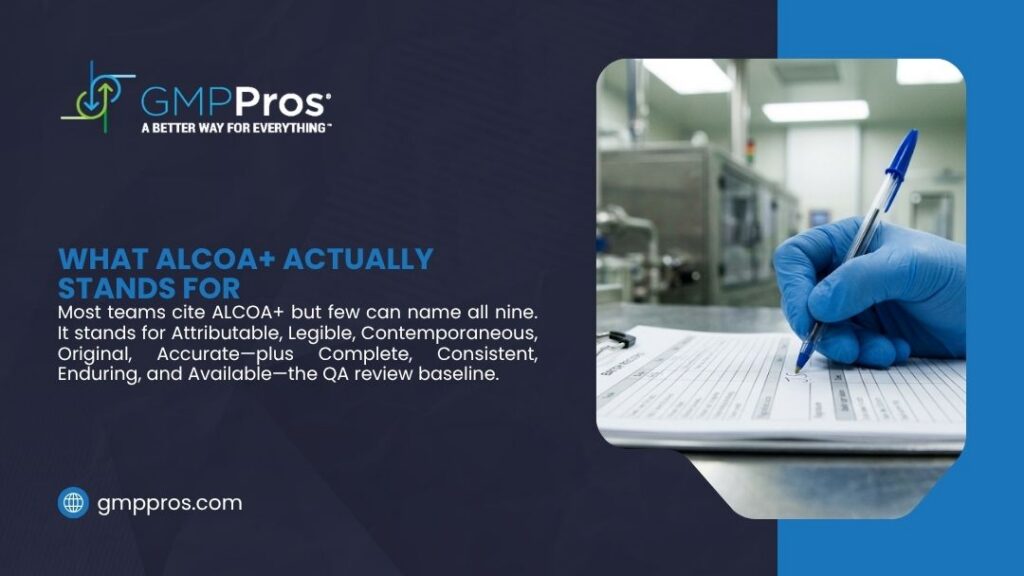
QA also needs to confirm that any deviation has a documented investigation reference and that corrections follow ALCOA+ principles.
The lot release process requires a complete evidentiary chain. A single link broken by a blank field, an absent initial, or an unexplained correction is enough to send the record back to production before review can continue.
Why Absent Information Creates Compliance Risk
A blank field is not a minor paperwork issue. Under GMP documentation requirements, it represents a gap in proof that the process ran as approved.
FDA investigators do not assume a step was completed because the product seems acceptable. They look at the record, and if it cannot confirm control, the inspection finding follows.
CDER warning letters jumped 50% in fiscal year 2025, with more than a third citing GMP violations tied directly to documentation failures, including absent contemporaneous entries and incomplete batch records.
The Most Common Batch Record Errors That Delay Release
Most release delays trace back to a small set of repeat documentation problems. In 2024, over 70 Form 483s cited failures in batch documentation, from absent signatures to incomplete data capture during production.
| Error Type | Typical Cause | Potential Release Impact |
| Absent operator signature | Step completed; form not returned to | QA hold; operator confirmation required |
| Blank process parameter field | Operator skipped or rushed entry | Investigation before release |
| Non-compliant correction | Correction fluid; no initials or reason | Data integrity question; record deficient |
| Outdated form version | Form pulled without version check | Document control failure |
| Deviation with no investigation link | Deviation noted; CAPA not opened | Release blocked under 21 CFR 211.192 |
| Absent calibration reference | Supporting document not attached | QA cannot confirm equipment state |
Absent Signatures, Initials, or Dates
Signatures confirm that a specific person performed or verified a specific step at a specific time. When an operator signature is absent from a critical process step, QA has no evidence the step happened.
That absence alone can stop lot release until the operator confirms the action and a compliant late-entry notation is added.
Absent date entries create a related problem. Without a date, QA cannot verify the entry was contemporaneous, which directly implicates ALCOA+ compliance and can broaden the review from a single field to a full data integrity assessment.
Incomplete Process Documentation
A batch record without complete process parameters does not meet GMP documentation requirements under 21 CFR 211.188. Blank yield fields, unrecorded equipment IDs, and absent material quantity entries all prevent QA from verifying the batch ran within approved limits.
These gaps are common in high-volume production runs where operators track multiple steps simultaneously. When a parameter is not recorded at the time of the step, accurate reconstruction later is rarely possible.
Documentation Corrections That Raise Questions
Corrections are a routine part of batch record documentation. The problem arises when corrections obscure the original entry. A correction that uses correction fluid, heavy overwriting, or a retroactive addition without a reason or initials no longer meets GMP correction standards.
Batch record documentation errors tied to corrections are among the most direct triggers for data integrity questions during an inspection. FDA’s 2024 enforcement summary showed more than 60% of warning letters cited human factor failures in documentation and quality processes.
Absent Supporting Records
A batch record references other documentation: calibration certificates, cleaning verification logs, environmental control records, and incoming material data. When any of these are absent, not referenced, or expired at the time of production, QA cannot complete its release review.
Absent supporting records are a common oversight in facilities with paper-based systems where documents are stored across multiple physical locations. One absent attachment can delay release by days while production tracks down the source document.
How Incomplete Batch Records Affect Operations Beyond QA Review
The business impact of incomplete batch records causing lot release delays extends well past the quality department. Inventory cannot ship, production capacity is consumed by investigation work, and supply commitments to customers get pushed back.
Manual batch record review costs mid-size pharmaceutical manufacturers an estimated $500,000 to $2 million per year in avoidable release delays.
For facilities still on paper, manual data entry causes 30 to 40% of all batch record deviations, making delays predictable rather than exceptional.
When batch record errors in pharma accumulate across multiple lots or shifts, the investigation workload can exceed the QA team’s capacity, creating a backlog that further delays release across the product portfolio.
| Area Affected | Immediate Impact | Long-Term Consequence |
| Inventory | Finished lots held; warehouse space consumed | Cash tied up in unreleased product |
| Production planning | Next run blocked by hold on preceding lot | Schedule disruption; capacity loss |
| Customer supply | Shipment late; delivery commitment broken | Relationship damage; contract risk |
| QA resources | Investigators diverted to documentation review | Review backlog grows; further delays |
| Regulatory standing | Repeat findings create systemic compliance risk | Warning letter or import alert exposure |
Inventory and Supply Chain Delays
A lot that cannot be released is inventory that cannot move. In high-throughput facilities, a two-day documentation hold on a single batch can disrupt the entire downstream schedule, particularly for products with short shelf lives or just-in-time supply commitments.
A 2024 FDA 483 issued to a contract drug manufacturer cited incomplete batch manufacturing record entries, absent signatures, and unrecorded deviations.
The batch was rejected at a $2 million loss, a direct consequence of documentation failures that existed before the product reached QA.
Increased Deviation and Investigation Workloads
Every documentation gap that reaches QA review without a clear resolution path generates an investigation. That investigation consumes QA time, pulls production personnel back into the process, and may require a formal CAPA.
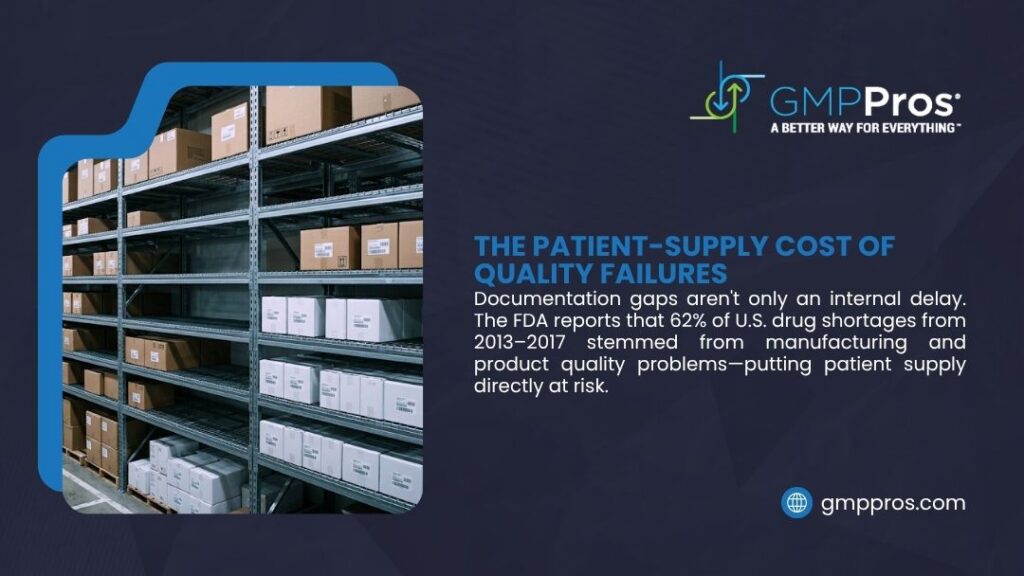
FDA drug quality assurance inspections reached 972 in FY2024, up from 766 in FY2023. Facilities with repeat documentation failures operate in a higher-scrutiny environment where each new hold compounds the regulatory exposure from prior observations.
Inspection and Audit Readiness Risks
Between 2022 and 2024, Form 483 citations linked to batch release failures remained consistently high, with over 48 inspection reports issued and 8 escalating to warning letters.
A facility with recurring documentation gaps is not an isolated compliance risk. Regulators treat it as evidence of a quality unit problem.
Root Causes of Incomplete Batch Records Causing Lot Release Delays
Documentation problems almost always originate upstream from QA review. They begin on the production floor, during shift handoffs, or in the form design itself.
Addressing batch record documentation errors at the source requires a root cause view, not a correction-after-the-fact approach.
| Root Cause Category | Typical Examples | Preventive Actions |
| Training gaps | Operators unsure which fields require dual verification | Role-specific training on critical field requirements |
| Poor form design | Required fields unclear; no visual prompts | Redesign templates with explicit labels and step sequences |
| Paper-based workflows | Manual transcription; no real-time prompts | Phased EBR adoption or hybrid interim controls |
| Late review detection | Errors found at final QA review, not during production | Production-level review before QA submission |
| Unclear accountability | Both operator and QA assume the other completed verification | Defined responsibility matrix per step type |
Inadequate Training and Documentation Practices
Generic GMP training teaches the regulation. It rarely teaches the specific mistakes operators make on specific forms for specific products. When training is not built around real failure modes from internal audit data, the same errors repeat.
Human errors account for approximately 50% of all batch record discrepancies in pharmaceutical manufacturing. 80% of process deviations trace back to human error, according to Dr. Ginette Collazo, CEO of Human Error Solutions.
Collazo has also pointed to a gap in how the industry responds to that reality. As she noted at Interphex:
“Training is used 80% of the time when a problem is traced to human error. Unfortunately, it only cures 5% to 10% of human errors.”
That gap explains why the same documentation failures repeat even after retraining cycles. The fix is almost always in the system, not the individual.
Complex or Poorly Designed Batch Record Templates
A batch record form that is difficult to complete correctly will produce errors. Templates with unclear field labels, ambiguous required sections, or no logical step sequence create conditions for omissions even when operators are attentive and experienced.
Form design is a process control tool. When a template is reviewed against actual production flow and updated to reflect real completion patterns, the right-first-time rate on that record improves without any additional headcount or oversight.
Paper-Based Processes and Manual Review Challenges
A typical paper batch record for a solid oral dosage form runs 50 to 150 pages. The QA review process alone consumes 5 to 15 hours per batch for reviewers. Every hour of that review covers entries that a validated electronic system could confirm automatically.
Siegfried Schmitt, PhD, Vice President Technical at Parexel, frames the dynamic plainly in Pharmaceutical Technology:
“It is human nature to follow the path of least resistance. There is a real likelihood that staff may not want to bother with onerous procedures, particularly when there is a high workload and pressure to meet deadlines.”
A batch record form that adds friction at the moment of highest production pressure is one that will produce blank fields at review.
The data integrity issues in pharmaceutical batch records that develop into formal findings often start with a paper process that was never designed for the production volume it now handles.
Manual transcription, sequential review workflows, and physical document retrieval all introduce error points that electronic systems eliminate.
Lack of Real-Time Review During Production
When documentation review is deferred to after production is complete, errors that could have been corrected on the floor become investigation events at the QA stage. A blank signature field caught during production takes seconds to address.
The same absent signature found during final review can take hours and may generate a formal deviation.
Production-level review, built into batch execution rather than added at the end, catches most common errors before they reach QA.
How to Prevent Incomplete Batch Records and Improve Release Readiness
Prevention is a system design question, not a discipline question. That same design thinking carries a higher stake than delayed release, since batch record gaps that lead to product recalls follow the same failure paths, only discovered after distribution. The facilities with the best release readiness build quality assurance batch review requirements into the production workflow, not just into the post-production review process.
Facilities that follow best practices in batch record documentation reduce audit findings by 60 to 75% and cut batch release times by 40%. Knowing how to reduce batch record cycle time starts with identifying where errors enter the process, not where they are discovered.
| Improvement Initiative | How It Works | Potential Benefit |
| Standardized templates with required fields | Fields cannot be skipped; sequence is fixed | Fewer blank entries; consistent completeness |
| Production-level pre-submission review | Supervisor checks record before QA submission | Errors caught before they become investigations |
| EBR with field-level enforcement | Mandatory fields prompt at point of execution | Near-elimination of blank field errors |
| Parallel QA review workflows | Multiple reviewers work simultaneously | 40-60% reduction in review cycle time |
| Trend tracking by shift and product | Repeat errors identified by line and operator | CAPA targeted at actual failure patterns |
Standardize Documentation Requirements
Consistency across operators, shifts, and facilities starts with a template that leaves no ambiguity about what is required at each step.
Required fields, defined check sequences, clear attribution prompts, and version control tied to a controlled document repository give every operator the same framework before the batch starts.
Standardization does not mean rigidity. It means every required entry has a designated place, and every operator knows what that place is.
Introduce Review Before QA Submission
Production supervisors who review batch records before submission to QA catch errors at the source.
A quick scan for blank fields, absent signatures, and correction compliance takes minutes at the production level. The same scan takes hours at the QA level when it generates a return, a question, and a wait cycle.
This first-pass review does not replace QA. It gives QA a record worth reviewing.
Use Electronic Batch Records and Validation Controls
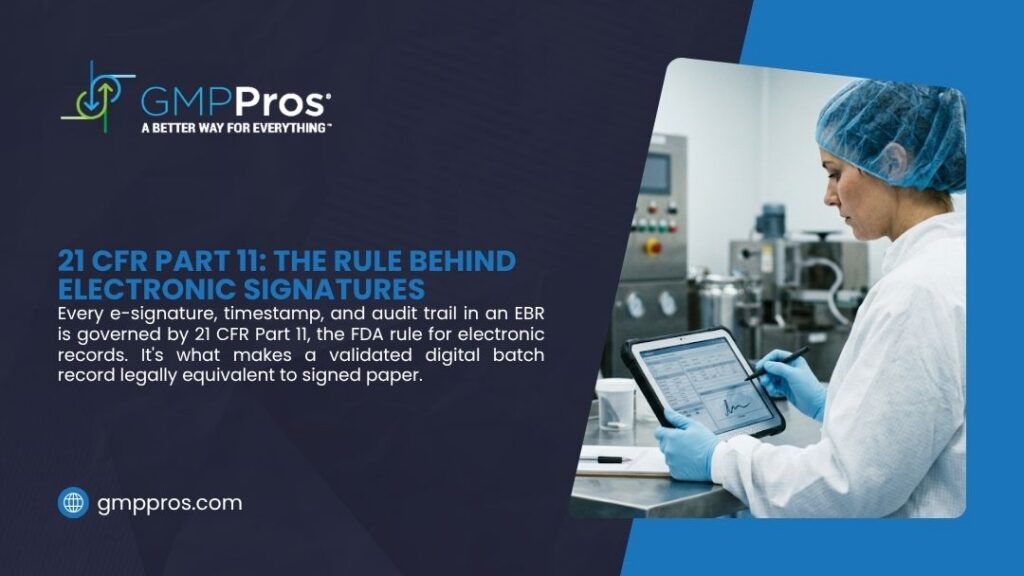
Electronic batch record systems address the most common paper failure modes directly. The list below summarizes the controls EBR provides that paper workflows cannot replicate:
- Mandatory field completion at every step; blank entries are blocked
- System-generated, tamper-proof timestamps at the point of execution
- Electronic signatures that cannot be added retroactively
- Real-time out-of-range alerts for process parameters
- Automatic audit trail with before-and-after values for every entry
Investments in pharmaceutical manufacturing digitalisation are projected to grow from $3.4 billion in 2025 to over $5.5 billion by 2030.
The direction of regulated manufacturing is toward systems that enforce GMP documentation requirements at the point of execution, not at the point of review.
Track Documentation Error Trends
Right-first-time rates by shift, line, and product family reveal where manufacturing record completeness breaks down. A facility-wide right-first-time rate of 90% can mask a specific shift or product line at 70%, and that gap will not be visible without segmented tracking.
Deviation trend data and repeat audit finding patterns give QA teams the visibility to act before errors surface during an inspection. The metric is not the goal. It is the signal.
Incomplete Batch Records Causing Lot Release Delays: When Does an Error Become a Release Blocker?
Not all documentation gaps carry the same risk. QA teams that can quickly distinguish a correctable omission from a release-blocking deficiency spend less time on unnecessary investigation and move product faster.
| Issue Type | Typical Risk Level | Likelihood of Release Delay |
| Single blank non-critical field; operator confirmation available | Low | Minor; resolvable with compliant late entry |
| Absent signature on non-critical step | Low to moderate | Resolvable with operator confirmation and notation |
| Blank field on critical process step | High | Hold required; investigation may be needed |
| Absent signature on critical verification step | High | Investigation initiated; release blocked |
| Non-compliant correction on critical parameter | High | Data integrity review; batch may be rejected |
| Deviation referenced but no investigation record | High | Release blocked under 21 CFR 211.192 |
Minor Documentation Gaps
A minor gap is one where the underlying event can be verified and the correction can be made without altering the original record’s meaning.
A single blank field on a non-critical step, confirmed by the operator and corrected with a compliant late-entry notation, may proceed through review without a formal deviation.
The key question is not the size of the gap. It is whether the control can be verified through primary or secondary evidence.
Major Documentation Deficiencies
A major deficiency is one where the underlying control step is in question.
If a critical process parameter was never entered and equipment data is not available to support it, the batch record cannot confirm the process ran within approved limits.
That situation requires a formal investigation before QA can make a disposition decision.
Patterns of the same deficiency across multiple batches or shifts trigger a systemic response: CAPA, root cause analysis, and a review of the training and form design that contributed to the repeat failure.
Can a Batch Be Released If the Record Is Incomplete?
The answer depends on three factors: the criticality of the step with the gap, the ability to verify what actually occurred through secondary evidence, and the outcome of QA review.
A non-critical gap with strong secondary evidence may be resolvable without formal deviation. A critical step with no supporting data cannot proceed to release until an investigation is complete and QA has made a formal disposition decision.
Frequently Asked Questions About Incomplete Batch Records Causing Lot Release Delays
What documentation errors most commonly delay lot release?
Absent operator signatures, blank process parameter fields, non-compliant corrections, outdated form versions, and deviations without investigation links are the errors most likely to stop QA release.
Why does QA reject incomplete batch records?
Under 21 CFR 211.192, QA must confirm that every significant production step was performed as approved and that any error was investigated. An incomplete record cannot satisfy that requirement.
Can incomplete records create FDA compliance concerns?
Yes, batch record deficiencies appeared in 42% of pharmaceutical facility inspections from 2020 to 2023 and remain among the most cited findings in Form 483s and warning letters.
How do electronic batch records reduce release delays?
EBR systems enforce mandatory field completion at the point of execution, eliminate manual transcription, generate automatic timestamps, and support parallel QA review. Facilities that adopt EBR with review-by-exception report 40 to 60% reductions in release cycle time.
What is the difference between a documentation correction and a deviation?
A correction addresses an entry error where the underlying event can be verified and the original meaning is preserved. A deviation is required when the underlying step is in question or when the process runs outside approved limits.
Build a Release-Ready Documentation System
Incomplete batch records causing lot release delays are not random failures. They are the predictable output of a process that places documentation at the end of production rather than at the center of it.
GMP Pros engineers embed directly within FDA-regulated manufacturing facilities to help QA and production teams redesign that process. From batch record template redesign and production-level review frameworks to full EBR implementation and validation support, the work happens on the production floor alongside the teams who execute it every day.
If your facility has recent documentation-related holds, a paper system that is slowing QA review, or repeat findings tied to record completeness, connect with the GMP Pros team today.