
Article summary:
| Decision Factor | Staff Augmentation | Consulting |
|---|---|---|
| Primary purpose | Add capacity to execute an existing plan | Deliver a defined outcome or solve a specific problem |
| Day-to-day direction | Client manages the work | Consulting firm manages delivery under its methodology |
| Quality system and SOPs | Works within the client’s quality system | Must follow applicable client requirements and agreed procedures |
| Accountability | Client oversees execution and work records | Firm is accountable for contracted deliverables |
| Best fit | You know what needs to be done but need more people | You need specialist expertise, a defined solution, or an outcome |
| GMP record ownership | Defined by the client’s procedures and applicable agreements | Defined by the client’s procedures, contract, and applicable requirements |
Three variables decide most of these engagements. How mature the scope definition is today. How much internal subject-matter expert bandwidth exists to direct outside people. How much regulatory exposure the deliverable carries once it becomes a validated system or a GMP record. Generic comparisons stop at the first two. Regulated manufacturers cannot.
What Staff Augmentation Looks Like Inside a GMP Facility

Staff augmentation places contracted individuals inside your operation under your direction. They follow your procedures, sit in your tier meetings, report to your project manager, and work the priorities your site sets that morning. The vendor supplies qualified people. You supply the plan.
Common pharma applications are easy to recognize: validation surge during a tech transfer, temporary QA document reviewer coverage, an automation engineer backfill during a leave, or batch record remediation ahead of an inspection. In each case, approved protocols or an existing backlog already define the work.
Ramp speed is the real advantage. Resumes arrive in days, and site onboarding runs in weeks rather than months. Pricing is hourly time-and-materials against a published rate card, which procurement teams find simple to model.
The failure mode is equally predictable. Thin scope definition turns an hourly contract into open-ended billing with no finish line. A three-month augmentation that keeps renewing costs more than a scoped project would have.
Direction, Supervision, and Who Carries the SOP
Augmented staff execute against your pharmaceutical quality system, not the vendor’s. Your QA group approves their training curriculum, your IT group grants system access, and your deviation process handles anything they get wrong.
Badge color does not change the qualification standard: 21 CFR 211.25 requires each person engaged in the manufacture, processing, packing, or holding of a drug product to have the education, training, and experience needed to perform assigned functions.
Supervision is a real line item. A site whose lead validation engineer already works sixty hours a week will not extract value from four contractors who need daily direction. Count those supervision hours before you sign.
Co-employment and worker-classification questions surface under this model too, which is why HR and procurement often gate it with tenure limits and badge policies.
What a Consulting Engagement Delivers in Regulated Manufacturing
A consulting engagement transfers control of method and sequence to the firm. The firm selects the staffing mix, runs the work plan, and commits to a defined deliverable at a defined date.
Typical pharma scope includes electronic batch record implementation, MES selection and deployment, deviation and OOS workflow redesign, data integrity gap assessments, and capital project engineering. These share a trait: the answer is not known at kickoff.
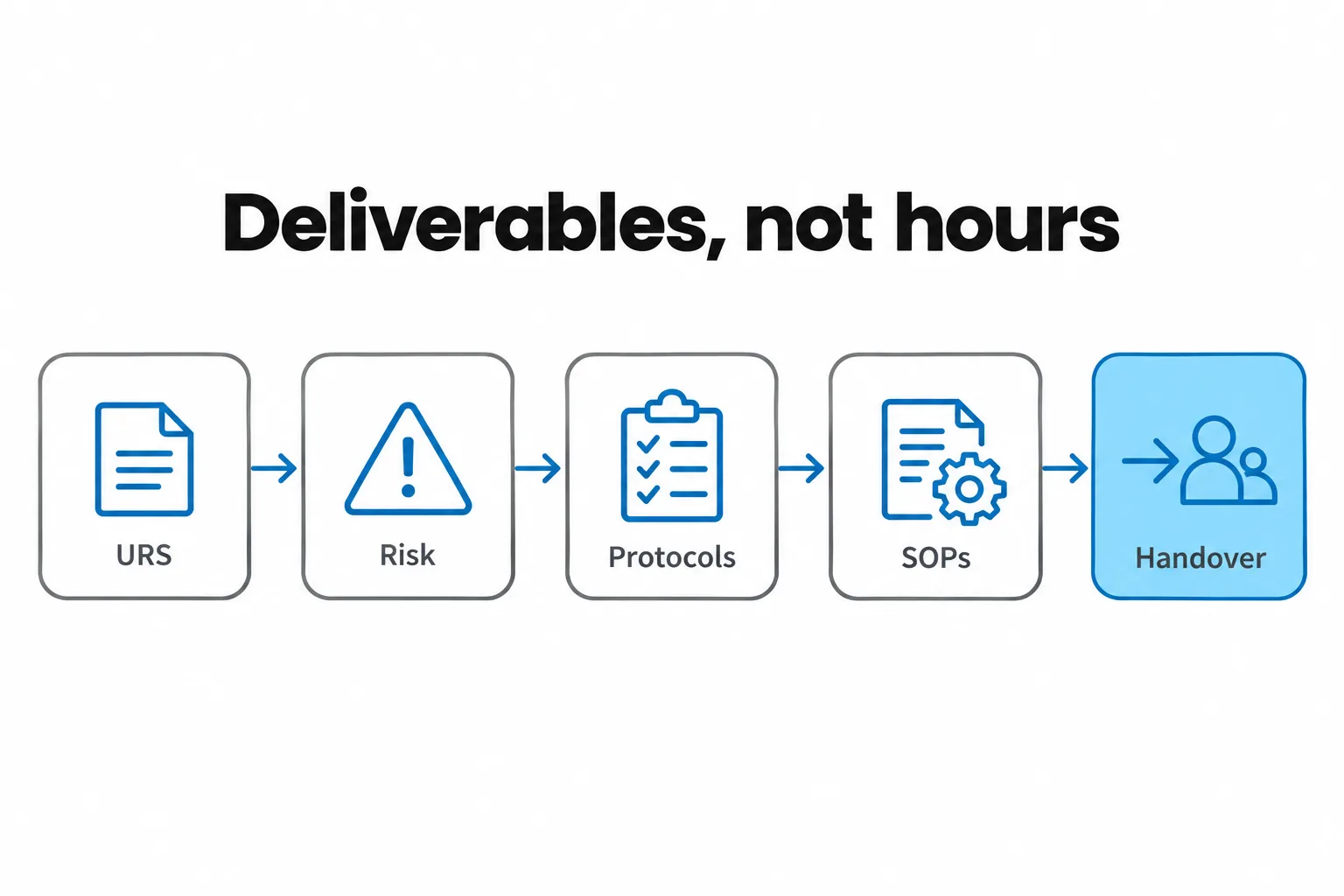
Deliverables are artifacts rather than hours. A user requirements specification, a risk assessment, validation protocols and summary reports, revised SOPs, training packages, and a benefits case that finance will accept. When scope is fixed, the firm absorbs rework and schedule risk.
The other advantage is pattern recognition. A firm that has configured batch release workflow status fields and approval routing at a dozen sites brings design decisions that a single-site team would rediscover the hard way.
The failure mode: the recommendations land, the adoption does not, because nobody stayed long enough to operationalize them.
Methodology, Deliverables, and Outcome Accountability
According to Janet Woodcock and Michael Kopcha in their article on modernizing drug quality programs:
> Quality metrics are used in a variety of industries to monitor the quality control systems and processes that ensure standards are met, and to identify opportunities for manufacturing improvements. For the pharmaceutical industry, the use of quality metrics offers potential benefits to patients, manufacturers, and the FDA – including the potential to better combat drug shortages.
Strong consulting engagements in regulated environments carry visible governance: a steering committee, stage gates, and formal change control on scope. Acceptance criteria get written before kickoff and tie to validated-state evidence, not hours burned.
Knowledge transfer matters more in pharma than in most sectors. Your site will own that MES or electronic batch record system for a decade or longer. A handover clause with named recipients and demonstrated competence belongs in the contract.
One boundary never moves. Approval authority over GMP records stays with the manufacturer regardless of engagement model.
Staff Augmentation vs Consulting for Pharma Projects: Side-by-Side Comparison
| Factor | Staff Augmentation | Consulting Engagement |
|---|---|---|
| Work direction | Client sets daily priorities | Firm runs the work plan |
| Deliverable definition | Hours and tasks | Contracted artifacts and outcomes |
| Pricing model | Hourly time-and-materials | Fixed scope, milestone, or blended rate |
| Ramp time | Days to weeks | Weeks, after discovery and scoping |
| Schedule risk owner | Client | Firm, when scope is fixed |
| QA oversight burden | High, sits with client QA | Shared, firm brings its own review layer |
| GMP training obligation | Client assigns and tracks curriculum | Firm pre-qualifies staff, site SOP training still required |
| System access and audit trail identity | Unique client-issued accounts per person | Unique client-issued accounts per person |
| Quality expectations in writing | Vendor qualification and access control | Written quality expectations for GMP deliverables |
| Knowledge retention | Leaves with the contractor | Depends on the handover clause |
| Exit condition | End of contract term | Acceptance of deliverables |
| Best fit | Defined scope, capacity shortfall | Undefined scope, capability gap |
Three Variables That Settle Staff Augmentation vs Consulting for Pharma Projects
First, scope maturity. Approved protocols that wait for execution point to augmentation. A problem statement without a design points to consulting.
Second, SME bandwidth. If no internal expert can give ten hours a week to direction and review, augmentation will underperform no matter how strong the individuals are.
Third, regulatory exposure. A deliverable that becomes a validated system, a batch manufacturing record template, or an inspection artifact deserves methodology and accountability, not just hands.
Regulatory Factors Generic Comparisons Leave Out
Most comparisons treat this as an IT staffing question. In FDA-regulated manufacturing, four compliance factors reshape the math.
GMP Training and Personnel Qualification Apply to Contractors Too
CGMP personnel requirements reach every person who touches the product or the record, contractors included. Under augmentation, curriculum assignment, training records, and requalification land on client QA as new workload. Under a consulting model, the firm usually pre-qualifies its people, though site-specific SOP training remains mandatory either way.
Practical planning point: build training and onboarding time into every contractor ramp plan. Treat it as overhead that starts on day one, or the schedule slips before any real work begins.
| Training and Qualification Task | Staff Augmentation | Consulting Engagement |
|---|---|---|
| Initial personnel qualification | Client verifies qualifications and assigns required training | Firm pre-qualifies personnel; client verifies suitability |
| Site-specific SOP training | Client assigns and documents training | Client still requires site-specific training |
| Training records | Client tracks completion under its procedures | Responsibilities should be defined in the engagement agreement |
| Retraining after procedure changes | Client coordinates retraining for assigned contractors | Client and consulting firm coordinate applicable retraining |
| Readiness before GMP work | Confirm training and authorization before access | Confirm training and authorization before access |
Both engagement models must support cGMP manufacturing requirements, including applicable documentation, training, and quality procedures.
Data Integrity, Audit Trails, and Attributable Actions
Anyone who touches electronic batch records, LIMS, or MES needs a unique identity. Shared or generic logins break attribution, and the control requirement is explicit: 21 CFR 11.10 requires closed systems to limit access to authorized individuals and to use secure, computer-generated, time-stamped audit trails that record operator entries and actions.
Contractor turnover turns this into a governance problem with a long tail. Three years later, an investigator asks who made an entry, and account-lifecycle records need to answer. Any pharmaceutical data engineering work that touches regulated records should put account provisioning and deprovisioning in the project plan, not in an afterthought ticket.
Quality Agreements, Vendor Oversight, and Ultimate Responsibility
Outsourced activity stays inside your pharmaceutical quality system. The manufacturer retains responsibility for product quality no matter which model funds the work.
In practice, consulting engagements that produce GMP deliverables benefit from documented quality expectations: which party authors, which reviews, which approves, and how defects get handled. Staff augmentation rarely triggers that paperwork, but it always triggers vendor qualification, background and training verification, and disciplined access control.
Validation Deliverables and Who Can Author, Review, and Approve
The common split works well: the contractor or consultant authors protocols; client QA reviews and approves them. Independence of review carries weight for computerized system validation deliverables, where common practice keeps the author out of the sole-approver role.
Settle approval authority in the contract. Disagreement discovered during protocol execution costs weeks.
Cost and Procurement: Time-and-Materials vs Fixed-Scope
| Cost Factor | Staff Augmentation | Consulting Engagement |
|---|---|---|
| Direct labor | Hourly or time-based charges | Project fee, milestones, or blended rates |
| Internal supervision | Often higher because the client directs daily work | Often lower for day-to-day direction, though client governance remains necessary |
| Project management | Usually provided internally | Often included in the engagement scope |
| Scope changes | Additional hours can extend total spend | May trigger formal change orders |
| Rework | Client may absorb more coordination and rework costs | Responsibility depends on contract terms and acceptance criteria |
| Knowledge transfer | May require internal documentation and handover time | Should be defined as a deliverable in the contract |
| Schedule delays | Extended staffing can increase labor costs | Cost impact depends on scope, terms, and responsibility for delays |
Augmentation reads as headcount spend. Consulting reads as project spend, and capitalization treatment depends on your finance policy and the nature of the deliverable.
Blended consulting rates look higher per hour because they include project management, internal QA review, and methodology overhead. Under augmentation you still pay for those functions, just through internal salaries and calendar time.
Compare total cost of ownership instead of rate cards: supervision hours, rework risk, cost of a two-month schedule slip, and the revalidation cost if a design decision proves wrong after go-live.
For projects involving tech transfer pharma, teams should clarify responsibilities for transferring process knowledge, documenting requirements, and confirming readiness at the receiving site.
One procurement safeguard applies to both models. Require a documented scope baseline and a written change-control mechanism. Augmentation contracts without one drift. Consulting contracts without one generate change orders nobody planned for.
Match the Model to the Project: Six Common Pharma Scenarios
Multi-site electronic batch record implementation. Consulting. Cross-site standardization and master data design drive the outcome, and those need design authority that spans sites.
MES deployment for pharmaceutical manufacturers. Consulting or hybrid. Selection, configuration design, and validation strategy call for an MES implementation consultancy with prior deployments. Post-go-live hypercare suits augmentation.
Deviation and OOS workflow redesign. Consulting. The data fields, status logic, and escalation rules in a batch deviation investigation workflow need cross-functional design authority across QA, manufacturing, and IT.
Validation surge before a facility startup. Augmentation. Approved protocols already define the scope. You need qualified execution capacity.
Batch release workflow status and approval routing configuration. Hybrid. A consultant designs the approval and rejection states; embedded engineers configure, test, and train.
Manufacturing analytics and data engineering buildout. It depends on the data model. If it exists and is governed, augment. If nobody can name the source of truth for batch genealogy yet, scope a design engagement first.
The Hybrid Model Most Multi-Site Manufacturers Actually Use
The practical answer for large programs is rarely pure. Scoped consulting covers design and governance. Embedded engineers handle execution and adoption inside the plant.
That structure closes the gap pure advisory work leaves open. Engineers who sit on the floor, run the shift handover conversation, and troubleshoot a batch record exception at 2 a.m. produce adoption that a recommendation deck cannot.
GMP Pros built its practice around that model. Founded in 2013 and based in Omaha, Nebraska, the firm embeds engineers inside client operations across electronic batch record implementation, production engineering, capital project engineering, and data science and analytics, acting as an extension of the client team rather than an outside advisory layer.
Apply one sustainability test to any hybrid structure: can the site run the system without the vendor ninety days after handover? If the honest answer is no, the knowledge transfer plan needs work before the engagement ends.
A Practical Decision Checklist
Score each item before your next procurement meeting. Mostly left column: augment. Mostly right: scope a project.
- Can you write acceptance criteria today, or does the work need discovery first?
- Does an internal SME have ten or more hours a week to direct and review the work?
- Does the deliverable become a GMP record or a validated system?
- Who absorbs the cost if the timeline slips two months?
- Is the gap capacity (you know what to do) or capability (you do not)?
- What happens to the knowledge when the engagement ends?
Frequently asked questions
What are the key differences between consulting and staff augmentation?
What is the difference between staffing and consulting?
What is the rule of 3 in consulting?
Is it better to hire an employee or a consultant for pharma work?
Can contractors sign GMP documents?
Closing Takeaway
Buy capacity when the plan already exists. Buy outcomes when it does not. That single line resolves most of the staff augmentation vs consulting for pharma projects debate before procurement gets involved.
Regulated manufacturers carry one additional test. Ask who can stand behind the record, the protocol, and the configuration decision in front of an inspector three years from now. If the answer is nobody who will still be there, revisit the model.