
Approximately 60% of pharmaceutical manufacturers identify legacy system integration as their primary technical challenge in digital transformation.
Legacy MES integration with electronic batch records sits at the technical center of that gap. These projects stall not because the goal is unclear, but because the architecture is complex, validation requirements are strict, and the cost of disruption in a GMP environment is high.
This article breaks down what makes these integrations difficult, which architecture models work in practice, and how to approach the integrate-versus-replace decision with data rather than assumption.
Topics covered:
- How MES and EBR systems interact in a real plant environment
- Architecture options for legacy MES integration with electronic batch records
- Validation and FDA compliance requirements
- Common failure points and how to avoid them
- A practical decision framework for integration, replacement, or hybrid deployment
For teams at the early planning stage, a functional review of what an electronic batch record system covers provides useful context before any integration architecture is evaluated.
Why Legacy MES Integration with Electronic Batch Records Is So Complex
Most legacy MES platforms were not built for the data exchange model that modern EBR systems require. They were designed for execution control, not structured record generation.
The result is an architecture mismatch that goes deeper than a software configuration problem.
| Source of Complexity | Description | Integration Impact |
| Legacy customization | Decades of site-specific configuration | Custom logic blocks standard API connections |
| Data fragmentation | Process, quality, and equipment data in separate silos | EBR cannot access complete batch context |
| Validation constraints | Existing MES is in a validated state | Changes trigger revalidation requirements |
| System dependencies | MES connected to SCADA, ERP, LIMS, PCS | Any interface change affects the full chain |
| Documentation gaps | Original system specs often incomplete or outdated | Integration design starts with limited visibility |
Organizations often allocate up to 75% of their IT budgets to the maintenance of outdated legacy systems, leaving limited capital for the integration work these modernization projects require.
Pharmaceutical manufacturers that define comprehensive data standards before the integration design phase experience 40% fewer integration issues during system deployment, according to research published in the WJARR, 2025.
For teams at the mes implementation steps stage, that data standard definition is one of the highest-leverage actions available before a single line of interface code is written.
MES and EBR Roles in Modern Manufacturing Architecture
Before any integration architecture can be designed, both systems need to be understood on their own terms. Confusion about where MES responsibility ends and EBR responsibility begins is one of the most common sources of scope creep in these projects.
| Function | MES Responsibility | EBR Responsibility |
| Production execution | Yes — work order dispatch, sequencing | No |
| Real-time equipment control | Yes — via PLC/SCADA connection | No |
| Batch record generation | Partial — data capture | Yes — structured record creation |
| Electronic signatures | No | Yes — 21 CFR Part 11 compliant |
| Audit trail for records | No | Yes — tamper-evident, time-stamped |
| Deviation capture | Partial | Yes — with formal QA workflow |
| Regulatory record retention | No | Yes |
Where MES Ends and EBR Begins in a Real Plant Environment
In a correctly architected facility, MES handles the execution layer. It controls work order dispatch, material issuance, and real-time equipment status. EBR handles the record layer. It captures what happened, who authorized it, and whether it conforms to the master batch record.
The two systems share data at defined points, but their functions are distinct. MES produces the production events. EBR documents them in a format the FDA can audit.
Why Legacy MES Systems Blur This Boundary
Legacy MES platforms built in the 1990s and early 2000s often absorbed record-keeping functions that modern EBR systems now own separately. Those embedded workflows become obstacles when an EBR is introduced.
A system that has performed both jobs for 20 years does not yield cleanly to a new division of responsibility. The custom logic that handled record generation in the legacy MES must be identified, mapped, and either replaced or preserved through the integration architecture.
Common Integration Architectures for Legacy MES and EBR Systems
There is no single correct architecture for legacy MES integration with electronic batch records. The right model depends on system age, customization level, data volume, and the validation risk the organization can absorb.
| Architecture | Speed | Cost | Validation Risk | Scalability |
| API-based direct integration | Fast | Low-Medium | Medium | Moderate |
| Middleware orchestration layer | Medium | Medium-High | Lower (abstracted) | High |
| Event-driven architecture | Medium | High | Low (decoupled) | Very High |
| Hybrid coexistence model | Slow | High | Highest (two systems) | Low initially |
API-Based Integration (Direct System Communication)
API connections between MES and EBR work well when the legacy system has documented, accessible interfaces. Many older platforms do not.
Undocumented APIs, proprietary data formats, and locked vendor configurations make direct API work unreliable in legacy environments.
Where feasible, API integration delivers the fastest time-to-value and the lowest per-connection cost. The limitation is tight coupling, a change in either system requires revalidation of the interface.
Middleware and Orchestration Layer
In enterprise pharmaceutical environments, a middleware layer between MES and EBR is the most common architectural choice. The middleware receives events from the MES, transforms them to the format the EBR expects, and passes them through.
This abstraction reduces the direct dependency between systems. When either platform is updated, only the middleware interface requires revalidation — not the full integration stack.
For organizations with multiple systems that feed into a single EBR, middleware also simplifies the overall architecture considerably.
Event-Driven Architecture for Real-Time Batch Data Sync
Event-driven integration treats every production action as a published event. The EBR subscribes to relevant events and processes them asynchronously. This model avoids the tight coupling of API integration and handles high data volumes without latency issues.
The complexity lies in event schema design. Each event must carry enough context for the EBR to create an accurate record without a callback to the MES. That design work requires close collaboration between MES, EBR, and QA teams from day one.
Hybrid Coexistence Model for Legacy MES Systems
When a legacy MES is too deeply customized to integrate cleanly, a hybrid model runs both systems in parallel for a defined period. The legacy MES continues to handle execution. The EBR captures records through a combination of automated feeds and structured manual entry.
This is not an ideal long-term state, but it is a controlled approach for organizations that cannot absorb a full system cutover. The key is a defined sunset plan for the legacy system. Hybrid coexistence without an exit timeline tends to become a permanent operating condition.
Data Flow Challenges Between Legacy MES and Electronic Batch Records
Integration can be architecturally sound and still produce inaccurate records. Data flow failures are often silent — the system appears to function, but the records it generates do not hold up under audit.
| Data Challenge | Root Cause | EBR Record Impact |
| Timestamp mismatch | MES and EBR clocks not synchronized | Audit trail breaks ALCOA+ requirements |
| Event mapping gaps | MES events do not correspond to EBR fields | Incomplete records at batch closure |
| Lot number format conflict | Different numbering schemas across systems | Batch genealogy gaps |
| Missing process parameters | MES stores aggregate values, not step-level data | Record lacks required granularity |
| Duplicate event records | Retry logic in middleware creates multiple entries | False deviations in EBR |
Facilities that achieve full MES integration with LIMS and ERP platforms report 22% higher overall equipment effectiveness compared to those with partial or fragmented integration, according to 2025 pharmaceutical research data.
Data flow quality directly affects both compliance outcomes and production performance.
Detailed analysis of how these vulnerabilities appear at the record level is covered in our resource on data integrity issues in pharmaceutical batch records, which outlines the most common causes and their downstream regulatory consequences.
Validation and Regulatory Considerations (FDA / GMP Context)
From an engineering standpoint, process validation begins well before the EBR system goes live. Every interface in a legacy MES integration with electronic batch records must be validated independently before production data flows through it.
| Regulation / Guidance | Core Requirement | Integration Implication |
| 21 CFR Part 11 | Electronic records and signature controls | All data transfers must maintain audit trail integrity |
| 21 CFR 211.188 | Complete batch documentation | Integration gaps create Form 483 exposure |
| GAMP 5 | Risk-based software validation | Integration layer requires its own validation package |
| ALCOA+ | Attributable, contemporaneous, accurate data | Timestamp synchronization and access control are critical |
| EU Annex 11 | Computerized systems in GMP environments | Global operations must reconcile both frameworks |
The FDA enforcement environment makes validation gaps increasingly costly. FDA issued 327 warning letters between July and December 2025 (a 73% increase over the same period in 2024) with data integrity and incomplete production records among the most frequently cited violations.
In February 2026, EMA and PIC/S launched a joint public consultation on revised data management requirements, further tightening global expectations.
A practical overview of what these requirements mean for production teams is available through our resource on pharma regulatory compliance for FDA-regulated manufacturing environments.
Audit Trail Integrity Across Integrated Systems
An integrated system must produce a single, unbroken audit trail across both the MES and EBR layers.
If a production event is recorded in MES at one timestamp and captured in EBR at a different one, that gap creates an attribution problem the FDA can cite as a data integrity violation.
A compliant audit trail must show, for every record:
- Who created or modified the entry
- When the action occurred (system-generated, not manual)
- What the original value was before any change
- What the revised value is and the documented reason for that change
How GAMP 5 Impacts Integration Design Decisions
According to ISPE’s GAMP 5 Second Edition:
“GAMP aims to deliver a cost-effective framework of good practice to ensure that computerized systems are fit for intended use and compliant with applicable regulations. It highlights the use of critical thinking by knowledgeable and experienced SMEs to define appropriate approaches.”
GAMP 5 classifies software by risk level and requires validation effort proportional to that risk. An integration layer that transfers critical quality data between MES and EBR sits at the highest risk category. Its validation package must include:
- Interface specification documentation
- Traceability matrix from requirements to test cases
- Installation qualification for each interface component
- Performance qualification with production-representative data volumes
Validation Risks in Legacy MES Environments
The FDA’s 2025 Computer Software Assurance guidance shifts validation from volume-based documentation toward risk-based testing. That shift reduces unnecessary paperwork, but it does not reduce the requirement for validated interfaces.
A validated legacy MES that receives a new integration point becomes, from a regulatory perspective, a changed system. That change requires a documented impact assessment and, in most cases, partial requalification.
Teams that skip the impact assessment phase to protect project schedule create validation debt that surfaces during inspections.
Common Failure Points in MES-EBR Integration Projects
Technically sound projects fail in regulated environments for reasons that have nothing to do with architecture selection.
| Failure Point | Root Cause | Production Impact |
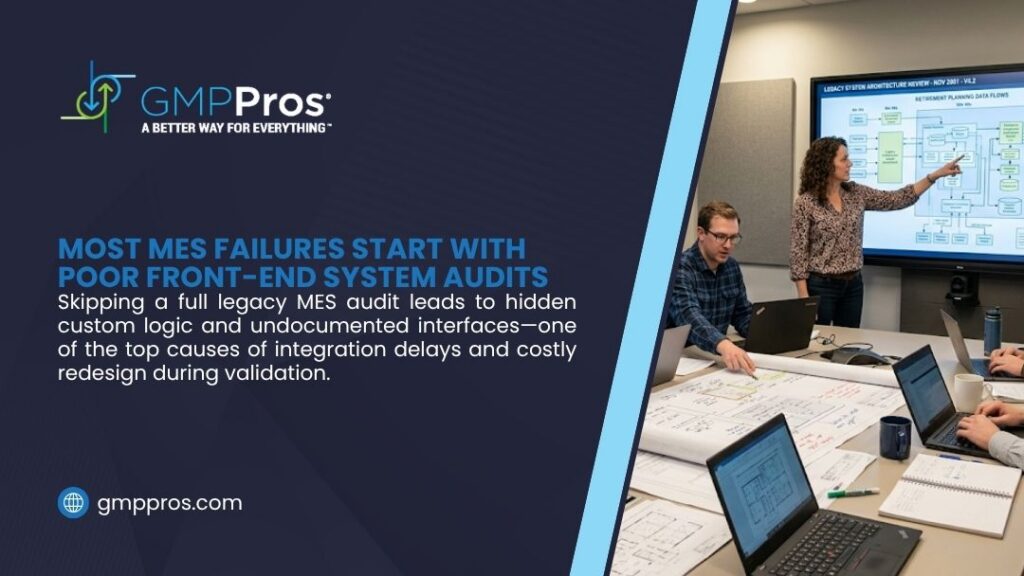
| Legacy MES complexity underestimated | No system audit before design | Design rework and timeline overrun |
| Poor data mapping strategy | Fields defined during build, not before | Record gaps and integration failures at go-live |
| Validation delays | Inadequate resource allocation | System live in production without full qualification |
| IT, QA, and operations misalignment | Separate workstreams, no shared ownership | Conflicting requirements discovered late in the project |
| Production downtime during cutover | No parallel run or fallback procedure | Batch failures and revenue impact |
| Missing post-go-live observation | Assumed integration is stable after launch | Silent data errors found only during audit |
The root cause behind most of these failures is consistent. Organizations underestimate legacy complexity, overestimate data readiness, or skip the cross-functional coordination work that determines whether a new system takes hold in production.
Pharmaceutical MES platforms reduce production deviation response times by 51.3% and decrease unscheduled downtime by 32.4% when fully integrated — but only when the integration itself is properly executed and monitored post-launch.
Decision Framework: Integrate, Replace, or Hybrid Approach?
The right path forward depends on four variables: system age, customization depth, compliance risk, and the organization’s capacity to absorb operational disruption.
| Scenario | Recommended Approach | Key Reason |
| Stable MES, moderate customization, active validation | Integration | Preserve validated state; add EBR layer efficiently |
| Highly customized MES, outdated vendor support | Replacement | Integration cost approaches replacement cost |
| Multi-site with different MES per facility | Hybrid first, then consolidation | Phased risk reduction across a complex environment |
| Active FDA remediation or consent decree | Hybrid with caution | Stability takes priority over modernization speed |
| New facility or greenfield expansion | EBR-native MES from the start | No legacy constraint; build clean architecture |
When Integration Is the Right Choice
Integration makes sense when the existing MES is in a stable validated state, the customization is documented, and the vendor still provides active support. In these conditions, a middleware layer can connect to the EBR without triggering a full system requalification.
The US pharmaceutical MES market has seen a 33% acceleration in the adoption of advanced MES platforms, driven in part by a 29% increase in regulatory compliance requirements.
For organizations in this adoption wave, integration preserves the investment in a functional system while adding the record layer that modern compliance demands.
When Replacement Is the Better Option
Replacement becomes the economically rational choice when legacy MES customization has grown to the point where integration cost approaches the cost of a new platform.
Systems with outdated communication protocols, no active vendor support, and years of undocumented site-specific logic are candidates for replacement, not retrofit.
When Hybrid Systems Are the Safest Strategy
Multi-site organizations with different MES platforms at each facility rarely achieve clean integration across all sites at once.
A hybrid approach deploys EBR at one or two sites first, captures the validation and operational lessons, and applies them to subsequent sites with significantly reduced risk.
A phased pilot approach spanning 4 to 6 months before full-scale deployment has proven particularly effective in pharmaceutical environments, according to 2025 industry research.
That timeline is not conservatism — it is the minimum required to surface the integration issues that no amount of upfront planning can fully predict.
Best Practices for Successful MES and EBR Integration
What separates successful legacy MES integration with electronic batch records from projects that stall or fail is almost always preparation quality, not technology selection.
| Pre-Integration Action | Purpose | Priority Level |
| Full legacy MES system audit | Identify undocumented custom logic and interfaces | Critical |
| Data standard definition | Align field formats, timestamps, and lot schemas | Critical |
| Interface inventory | Document all existing system connections | High |
| QA team involvement from day one | Avoid late compliance discoveries | High |
| Phased deployment plan | Reduce go-live risk across facilities | High |
| Parallel test environment | Validate integration logic before production data flows | Critical |
| Post-go-live observation protocol | Catch silent data errors before an inspection does | Medium-High |
In practice, the projects that finish on time and within budget start with data, not software.
As Taylor Chartier, CEO of Modicus Prime and contributor to ISPE’s GAMP AI Guide, noted in 2025:
“The primary aim is to ensure that technologies are implemented in a way that maintains patient safety, product quality, and data integrity — which are the chief concerns in the healthcare life sciences industry.”
That principle governs MES modernization decisions as much as any other GxP technology investment.
Teams that define their data exchange requirements, timestamp standards, and field-level field mapping before any vendor is selected avoid the majority of go-live failures.
EBR rollout at a single production line costs between $200,000 and $500,000. Full-site deployments range from $1.5 million to $3 million.
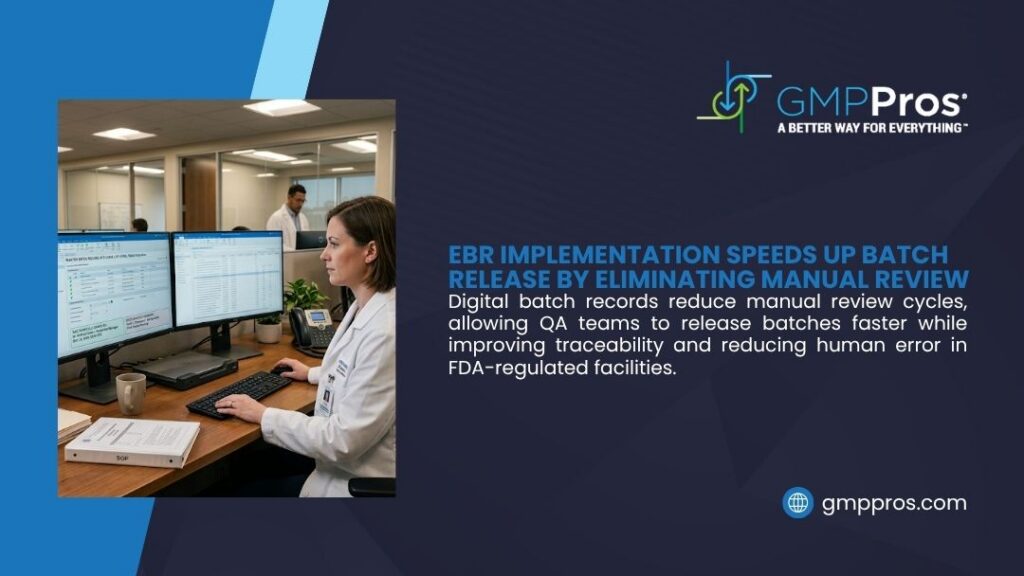
Organizations that achieve full MES and LIMS integration report a 46.2% acceleration in batch release times and a 42% drop in deviation management time, according to 2025 pharmaceutical research.
Those outcomes make the investment defensible at every level of the organization.
Detailed project roadmap guidance for teams in active deployment, including validation templates and go-live frameworks built for FDA-regulated facilities, is available through our EBR implementation pharma resource.
Real-World Considerations in FDA-Regulated Manufacturing Environments
Regulated manufacturers face integration failure risk that general production environments do not. The audit trail is not just a system feature. It is the primary evidence the FDA reviews during an inspection.
| Risk Factor | General Manufacturing | FDA-Regulated Manufacturing |
| Data gap tolerance | Low | Zero |
| Validation requirement | Recommended | Mandatory |
| Change control for integration | Best practice | Required regulatory procedure |
| Production continuity standard | Preferred | Contractual and regulatory obligation |
| Multi-site standardization pressure | Operational efficiency | Compliance-driven requirement |
Three realities consistently shape integration project outcomes in regulated environments:
- Audit readiness cannot wait for go-live.
The system must be audit-ready from the first batch recorded. An integration that produces complete records 95% of the time is a 5% compliance failure during an FDA inspection.
- Production continuity requirements are strict.
Downtime in a pharmaceutical facility carries regulatory, contractual, and patient safety consequences. Integration projects that cannot demonstrate a tested fallback procedure before cutover carry unacceptable risk.
- Multi-site standardization is complex but necessary.
An MES-EBR architecture that functions at one facility requires careful assessment before replication. Different products, equipment, and regulatory histories mean the integration logic often cannot be transferred without revalidation.
For a complete technical view of the documentation and operational challenges associated with these transitions, our resource on challenges transitioning from paper to electronic batch records covers both the compliance and production-level complexity in detail.
Frequently Asked Questions
How do you integrate a legacy MES with an electronic batch record system?
The integration path depends on the legacy MES architecture, customization level, and vendor support. API-based direct integration is the fastest option when interfaces are documented.
Middleware orchestration is the most common choice in enterprise pharmaceutical environments because it decouples the two systems and reduces revalidation scope when either platform changes.
A phased pilot of 4 to 6 months before full deployment has the strongest track record in FDA-regulated facilities.
Can MES and EBR systems run in parallel during a transition?
Yes, and in most regulated environments they must. A hybrid coexistence period allows production to continue on the validated legacy system while the integration is built, tested, and qualified.
The risk is that hybrid periods without a defined exit plan tend to persist indefinitely. A cutover date should be set before the parallel run begins, not during it.
What are the biggest risks when integrating MES with EBR in FDA-regulated environments?
The highest risks are audit trail discontinuity between systems, validation gaps in the integration layer, and data mapping errors that produce incomplete or inaccurate records.
FDA issued 327 warning letters in the second half of 2025 alone, a 73% increase over the same period in 2024, with data integrity failures among the most cited violations.
Do you need to replace a legacy MES to implement electronic batch records?
No, legacy MES integration with electronic batch records is viable when the system is stable, documented, and supported.
Replacement becomes rational when integration cost approaches the cost of a new platform — typically when the legacy system carries high customization depth, outdated communication protocols, and no active vendor support.
How does MES to EBR integration affect GMP compliance and validation requirements?
Every integration point becomes part of the validated system. A change to a validated legacy MES requires a documented impact assessment and, in most cases, partial requalification under GAMP 5.
The integration layer itself must have its own validation package that includes interface specifications, traceability matrices, and performance qualification with production-representative data volumes.
A Better Way to Approach MES and EBR Integration
GMP Pros was founded on a direct conviction: there is a better way to do this work.
After years inside Fortune 500 pharmaceutical and food manufacturers, the GMP Pros team built a different kind of technical consulting firm.
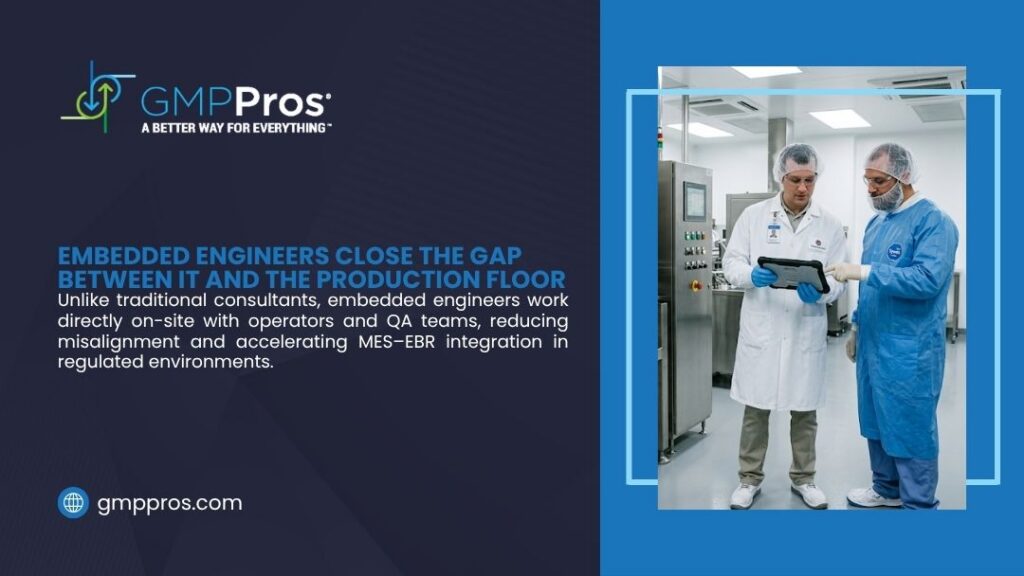
The difference is the model. GMP Pros engineers do not advise from a distance.
From capital projects and technology transfers to electronic batch record deployment and data science, GMP Pros has helped some of the world’s most respected pharmaceutical and food manufacturers move faster, make smarter decisions, and deliver compliant, high-quality products.
If your organization is at the early stages of legacy MES integration with electronic batch records, or in the middle of a project that has stalled, connect with the GMP Pros today to discuss where the highest-risk gaps exist and how an embedded engineering approach can move your program forward.