
- The challenges transitioning from paper to electronic batch records go beyond a software swap, touching every layer of operations, compliance, and quality culture.
- Between 2020 and 2023, FDA warning letters referenced batch record deficiencies in 42% of pharmaceutical facility inspections, costing manufacturers millions through delayed product releases and regulatory remediation.
- Manual data entry causes 30 to 40% of all batch record deviations in facilities still reliant on paper, making errors predictable rather than exceptional.
Until the switch is complete, our guide to closing documentation gaps that hold lots in quarantine can help paper-based sites keep shipments moving.
- CDER warning letters jumped 50% in fiscal year 2025, with more than a third citing GMP violations tied directly to documentation failures including incomplete batch records and missing contemporaneous entries.
The challenges transitioning from paper to electronic batch records are well-documented, yet manufacturers continue to underestimate the scope of what a successful implementation requires.
This guide breaks down the operational, regulatory, and technical barriers FDA-regulated manufacturers face during EBR adoption, and provides actionable strategies to reduce risk and accelerate a successful transition.
Why Transitioning from Paper to Electronic Batch Records Matters
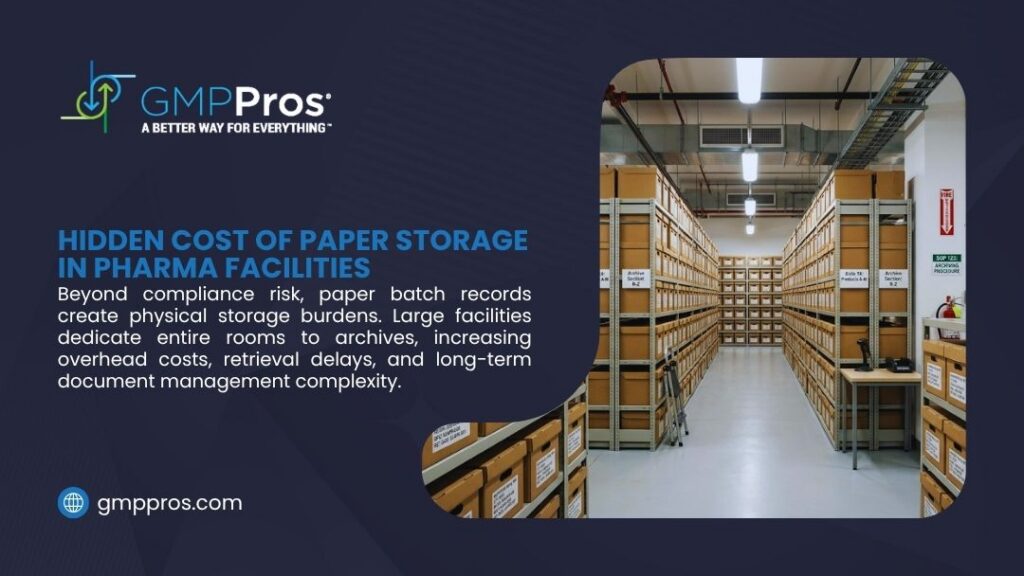
Paper records may feel familiar, but they slow down production and increase compliance risk in ways that are difficult to see from the inside.
Manual data entry causes 30 to 40% of all batch record deviations in facilities still reliant on paper. Operators copy readings by hand, calculate values under production pressure, and complete forms after the fact.
These conditions make errors predictable, not exceptional.
The global EBR market reflects how rapidly the industry is moving away from that model.
According to YahooFinance, the global EBR market was valued at USD 1.28 billion in 2025, it is projected to reach USD 9.62 billion by 2040 at a CAGR of 14.4%
That growth is driven by regulatory pressure, demand for real-time visibility, and the measurable efficiency gains electronic systems deliver.
For a foundational understanding of what these systems involve, see our full guide on Electronic Batch Records before evaluating your transition options.
| Metric | Paper Batch Records | Electronic Batch Records |
| Batch review time | Days to weeks | Hours (review-by-exception) |
| Error rate from manual entry | 30-40% of deviations | Near-zero with automated capture |
| Audit readiness | Requires extensive preparation | Continuous, real-time |
| Data integrity enforcement | Procedural only | System-enforced via ALCOA+ controls |
| Multi-site accessibility | Physical retrieval required | Instant remote access |
The transition is not simply a technology decision. It is a quality system decision with direct implications for FDA audit outcomes, batch release speed, and product integrity.
Common Operational Challenges in EBR Transition
The challenges transitioning from paper to electronic batch records are felt most immediately at the operational level. Workflows change, roles shift, and teams that have relied on familiar paper processes must adapt to new digital systems without halting production.
| Operational Challenge | Root Cause | Impact on Production |
| Workflow disruption at go-live | Inadequate process mapping pre-implementation | Batch delays, operator confusion |
| Hybrid paper-digital co-existence | Phased rollout without clear cutover plan | Data duplication, compliance risk |
| Operator resistance | Cultural attachment to paper workflows | Low adoption, workarounds, errors |
| Inadequate training before go-live | Compressed implementation timelines | Increased exceptions, slow throughput |
| Unclear roles between IT, QA, and Ops | Siloed departments | Delays in decision-making |
Workflow Disruption
When a facility maps its current paper process directly into an EBR system without redesign, the result is a digital version of a broken workflow. The transition exposes gaps that paper masked for years.
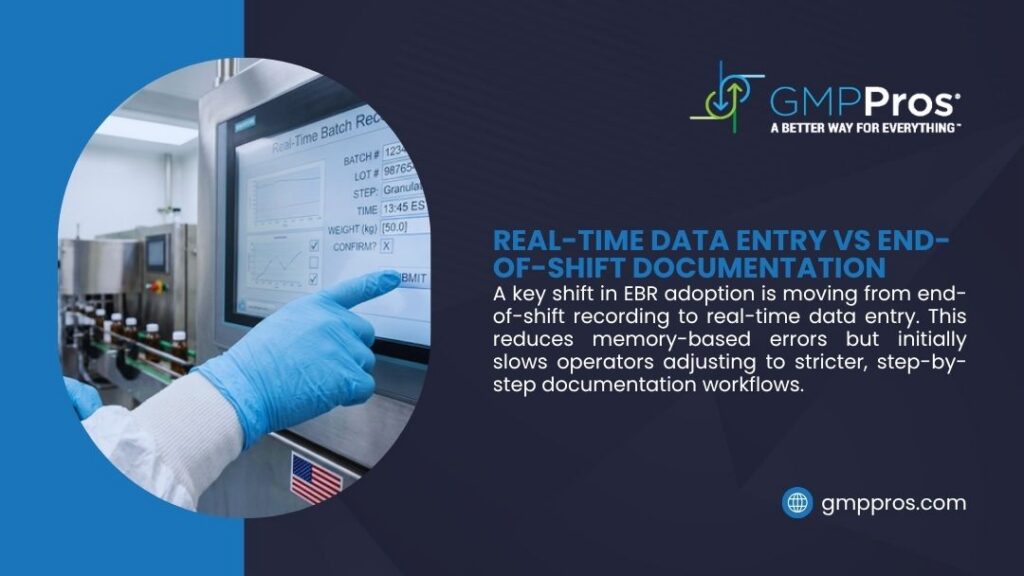
A common scenario in mid-size pharma facilities: operators who previously completed batch records from memory at shift-end now face a system that requires real-time, step-by-step entry. That shift alone can add 15 to 20 minutes per batch until the team builds fluency.
Early involvement of production supervisors in system design prevents the worst of these disruptions. When the people who execute the process help build the digital version, the result reflects reality rather than an idealized workflow.
Hybrid Paper-Digital Systems
One of the most underestimated challenges transitioning from paper to electronic batch records is the period when both systems run simultaneously. Hybrid environments create parallel documentation streams that are difficult to reconcile and easy to audit negatively.
A comparison of both states makes the risk visible:
| Factor | Hybrid State | Full EBR Adoption |
| Data duplication risk | High | Eliminated |
| Regulatory exposure | Elevated (two systems to validate) | Controlled under one validated system |
| Operator burden | Maximum (two workflows) | Reduced over time |
| Audit trail clarity | Fragmented | Unified and continuous |
A clear cutover plan with a defined end date for paper processes reduces the time spent in this vulnerable state.
For a detailed look at the direct differences between documentation approaches, our comparison of paper batch records vs electronic covers the compliance and operational distinctions side by side.
Operator Resistance and Training Needs
Resistance to EBR adoption is rarely about the technology. It is about the disruption to routines that operators have spent years perfecting.
A mid-size biologics company reduced resistance through phased training that started six weeks before go-live. The program included:
- Role-specific instruction for operators, supervisors, and QA reviewers
- Hands-on practice in a test environment with actual batch record templates
- Scenario-based exercises covering deviations, equipment failures, and out-of-spec results
- Competency assessments before any access to the live system
The result was a 40% reduction in go-live exceptions compared to a prior system rollout that used classroom-only instruction.
Regulatory and Compliance Challenges
Regulatory compliance adds a layer of complexity to EBR transitions that operational planning alone cannot address. The challenges transitioning from paper to electronic batch records in a regulated environment require parallel attention to validation, data integrity, and audit readiness.
| Regulation | Core Requirement | Transition Risk |
| 21 CFR Part 11 | Electronic records and signatures | Unvalidated system creates legally questionable records |
| 21 CFR 211.188 | Complete batch documentation | Missing fields during cutover trigger 483 citations |
| 21 CFR 211.192 | QC review before release | Reviewer workflows must be redesigned for EBR |
| ALCOA+ principles | Attributable, contemporaneous, accurate data | Paper habits carry over into electronic misuse |
Validation Requirements
System validation is the most document-heavy phase of any EBR transition. Installation qualification, operational qualification, and performance qualification must all be completed and documented before the system touches production data.
Validation documentation for a complete EBR project often exceeds 1,000 pages. For multi-site rollouts, that volume multiplies with each facility.
A realistic validation timeline looks like this:
- System requirements specification (4 to 8 weeks)
- Vendor assessment and selection (4 to 12 weeks)
- Installation qualification (2 to 4 weeks)
- Operational qualification (4 to 8 weeks)
- Performance qualification (4 to 8 weeks)
- User acceptance testing (2 to 4 weeks)
Compressed timelines in any phase create validation gaps that FDA investigators find during inspections. Adequate resource allocation at the planning stage is not optional.
Data Integrity and Security
Data integrity remains the single most cited FDA compliance issue in pharmaceutical manufacturing.
In fiscal year 2025, more than a third of warning letters cited GMP violations tied to documentation failures, including missing signatures, incomplete batch records, and inconsistent procedures.
EBR systems enforce ALCOA+ principles that paper systems can only encourage. Electronic signatures create permanent, attributable records. System-generated timestamps eliminate backdating. Audit trails capture every modification with before-and-after values.
However, a poorly implemented EBR introduces its own data integrity risks. Shared login credentials, inadequate access controls, and missing audit trail configuration are common findings during inspections at facilities that transitioned without proper validation.
The risk profile during transition is highest precisely when it is most often overlooked.
Understanding how these vulnerabilities appear in practice is covered in depth in our guide on batch record errors in pharma and the specific causes behind them.
Technical and Integration Challenges
From an engineering standpoint, process validation begins well before the EBR system is live. The technical groundwork, particularly system integration, is where most projects fall behind schedule.
Integration with existing MES, ERP, and LIMS platforms requires careful interface design, validated data transfer protocols, and extensive testing before any production data flows through the new system.
| System Type | Integration Complexity | Best Practice |
| Manufacturing Execution System (MES) | High | Define data exchange requirements early; validate interfaces independently |
| Enterprise Resource Planning (ERP) | Medium to High | Map material and lot number flows before configuration |
| Laboratory Information Management (LIMS) | Medium | Confirm bidirectional data transfer with QA and lab teams |
| Process Control Systems (PCS) | High | Use validated OPC protocols for instrument data capture |
| Legacy standalone equipment | Very High | Assess retrofit feasibility; plan manual fallback procedures |
One recurring issue across EBR projects is the discovery of undocumented legacy integrations. Systems that have connected informally over years suddenly require formal validation, which adds time and cost to implementation timelines.
For facilities with complex legacy infrastructure, our resource on legacy MES integration with electronic batch records outlines the most common technical obstacles and how to resolve them without delaying go-live.
System Compatibility
Most pharmaceutical facilities operate equipment from multiple vendors with different communication protocols, data formats, and network requirements. Each interface needs individual validation to prove it captures accurate data.
A practical approach:
- Audit all existing systems and document their current data outputs
- Identify which integrations are critical for day-one operation vs. phase two
- Prioritize validated instrument connections for high-risk process steps
- Plan manual data entry fallback procedures for systems that cannot integrate at launch
Scalability and Future-Proofing
Multi-site operations add another layer of challenge. A system configured for one facility may require substantial rework before it can support a second site with different products, equipment, or regulatory requirements.
Planning for scalability from the start prevents costly rearchitecting later. Cloud-based EBR platforms offer more flexibility for multi-site deployments, though they introduce their own validation and data security considerations under 21 CFR Part 11.
Phased Implementation Strategy
A phased approach reduces the risk of the challenges transitioning from paper to electronic batch records disrupting active production. Full-site rollouts attempted in a single cutover carry a high failure rate due to the volume of change they introduce simultaneously.
| Implementation Phase | Key Actions | Metrics to Track |
| Assessment | Document current workflows, gap analysis, system selection | Number of process gaps identified, validation scope defined |
| Pilot | Single product or line; test environment alongside production | Exception rate, operator error frequency, QA review time |
| Full Rollout | Site-wide deployment with trained staff and validated system | Batch review time, deviation rate, audit finding frequency |
| Continuous Improvement | Post-go-live data review, KPI tracking, system optimization | Batch release cycle time, first-pass review rate |
Pilot Phase and Staff Feedback
The pilot phase is where the gap between planned and actual implementation becomes visible.
In my experience working with FDA-regulated facilities, the teams that run thorough pilots with real products, not just test scenarios, uncover configuration issues that no amount of planning reveals in advance.
Pilot feedback should be structured, not informal. A formal feedback process includes:
- Operator-reported exceptions during pilot batches
- QA reviewer observations on audit trail completeness
- IT logs of system performance under production load
- Supervisor assessment of workflow adherence vs. paper baseline
This feedback loop informs configuration adjustments before full rollout, reducing go-live exceptions substantially.
Full Rollout and Continuous Improvement
KPIs should be defined before rollout begins, not after. Target reductions in batch review time, error rates, and audit findings give teams a measurable benchmark for success.
Facilities that track these metrics see a clear pattern: initial performance dips in the first four to eight weeks as operators build fluency, followed by steady improvement as the system becomes routine.
Batch review time reductions of 50 to 70% are common within six months of full deployment, with ROI typically achieved within 12 to 18 months.

Measuring Success and ROI
The business case for EBR adoption rests on quantifiable outcomes. Before-and-after metrics provide the evidence that justifies the investment and builds internal support for continuous improvement.
| Metric | Typical Before EBR | Typical After EBR | Improvement Range |
| Batch review time | 5 to 10 days | 1 to 3 days | 50-70% reduction |
| Manual entry errors per batch | 3 to 8 errors | Near zero | 90-95% reduction |
| Audit preparation time | Weeks | Hours | 80%+ reduction |
| Deviation rate from documentation | 30-40% of batches | Under 5% | Significant reduction |
| Time to FDA audit readiness | Scheduled preparation required | Continuous | Structural improvement |
Full EBR implementation for a single production line costs between $200,000 and $500,000, with full-site deployments ranging from $1.5 million to $3 million or more.
Most facilities achieve ROI within 12 to 18 months through reduced deviations, faster batch release cycles, and lower audit preparation costs.
The ROI case also includes risk reduction. With CDER warning letters up 50% in FY2025 and documentation failures appearing in a significant share of citations, the cost of staying on paper extends well beyond printing and storage.
Understanding how specific batch errors connect to financial and regulatory exposure is covered in our guide on manual transcription errors in batch records and the downstream costs they generate.
For facilities already at the implementation stage, our EBR implementation pharma guide provides a detailed project roadmap with validation templates and go-live checklists built for FDA-regulated environments.
Frequently Asked Questions
What are the biggest challenges when transitioning to electronic batch records?
The most significant challenges include workflow disruption at go-live, operator resistance to new processes, system integration with legacy MES and ERP platforms, validation documentation requirements, and the compliance risk created by hybrid paper-digital periods.
How do electronic batch records impact FDA compliance and validation?
EBR systems must comply with 21 CFR Part 11, which governs electronic records and electronic signatures.
Properly implemented EBR platforms enforce ALCOA+ data integrity principles automatically, reducing the risk of documentation failures that trigger FDA citations.
What are the risks of switching from paper to EBR?
The primary risks include validation gaps if the system goes live without complete qualification, data integrity failures from misconfigured audit trails or shared login credentials, integration failures between the EBR and existing manufacturing systems, and operator errors during the learning curve period.
How long does it typically take to implement an EBR system?
Most facilities complete a single production line implementation in 12 to 18 months. Smaller, single-product setups may finish in 9 to 12 months. Full-site rollouts typically require 18 to 24 months.
Timeline overruns most commonly occur during system integration and validation documentation phases.
How can we ensure data integrity during the transition?
Define clear cutover procedures that eliminate hybrid paper-digital periods as quickly as possible. Validate audit trail functionality before go-live. Enforce role-based access controls and individual user accounts from day one.
Train staff on ALCOA+ principles and what contemporaneous documentation means in an electronic environment. Conduct post-go-live internal audits in the first 30 to 60 days to catch configuration gaps before an FDA inspection does.
Ready to Move Past Paper Batch Records?
The challenges transitioning from paper to electronic batch records are real, but they are also solvable with the right expertise and a structured approach.
GMP Pros embed experienced engineers directly within your production and quality teams to plan, validate, and deploy EBR systems that meet FDA requirements without disrupting active operations.
If you are looking for a technically credible partner who works from the inside rather than advising from a distance, contact GMP Pros to discuss your transition timeline and where the highest-risk gaps exist in your current documentation system.