
Article Summary
Control platform selection in a GMP plant rarely comes down to scan time. This guide compares DCS vs PLC for pharmaceutical manufacturing across architecture, recipe handling, validation load, data integrity, MES and electronic batch record integration, and lifecycle cost.
It is written for automation engineers, validation leads, and operations directors who need a decision they can defend twice: once to a capital committee, once to an FDA investigator. Batch complexity, data context, and validation burden settle more of these projects than raw controller speed.
Fast Answer: DCS vs PLC for Pharmaceutical Manufacturing at a Glance
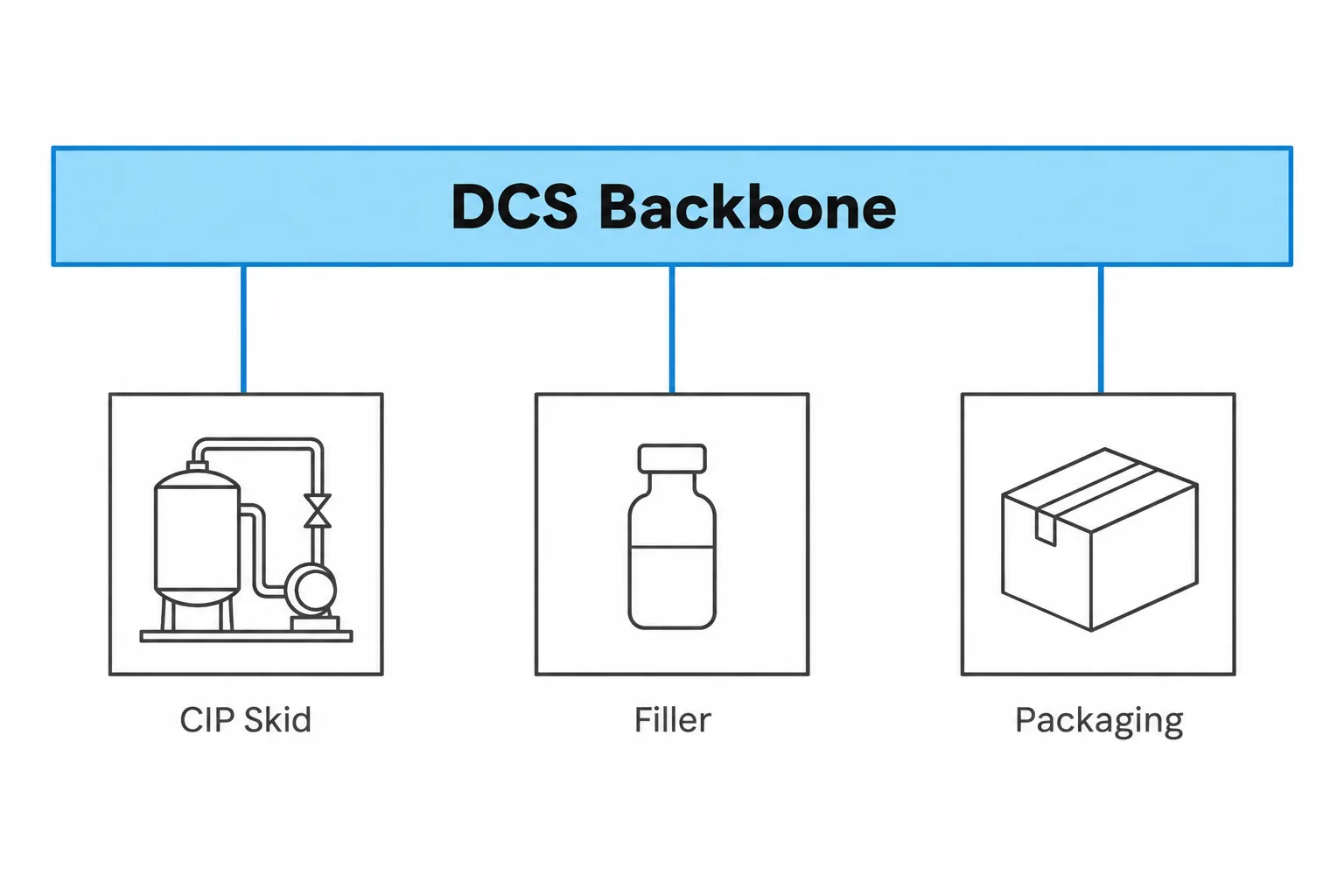
A DCS fits large continuous and hybrid process units that need plant-wide integration, redundancy, and native batch recipe control. A PLC fits high-speed discrete equipment, OEM skids, and packaging lines. Most pharmaceutical sites run both, so the real question is which platform owns the plant backbone and how skid controllers feed it.
Cost follows that split. A PLC plus SCADA architecture usually costs less at purchase and more in integration and validation labor as tag counts climb. A DCS costs more upfront and less per unit added at scale.
What Is a PLC?
A programmable logic controller is a ruggedized industrial computer that scans inputs, solves logic, and writes outputs on a fixed cycle, often in single-digit milliseconds. IEC 61131-3 defines the standard PLC programming languages used across vendors: ladder diagram, function block diagram, structured text, instruction list, and sequential function chart.
Hardware is modular: CPU, power supply, discrete and analog IO modules, and communication modules on a rack or DIN rail. The program lives in the controller, so equipment holds control when the supervisory network drops.
Typical pharmaceutical duty includes CIP and SIP skids, autoclaves, lyophilizers, tablet presses, capsule fillers, vial and syringe lines, cartoners, and purified water or WFI generation. Interlocks, servo motion, and high-speed reject logic favor the PLC.
What Are the Four Types of PLC?
Most references group PLCs by form factor rather than function: compact or unitary controllers with fixed IO; modular rack-based systems; distributed architectures built around remote IO drops; and PC-based or software controllers that run control tasks on industrial computer hardware.
Terminology varies by vendor, so state IO count, redundancy, scan requirements, and protocols in the URS instead of a category label.
What Is a DCS?
A distributed control system delivers controllers, distributed IO, operator stations, engineering tools, alarm management, batch execution, and historian functions as one engineered, version-controlled platform. Configuration is database-driven: a tag defined once propagates to graphics, history, and alarms.
In pharma, DCS platforms typically run API reactor trains, fermentation and bioreactor suites, media and buffer preparation, chromatography and filtration trains, and clean utilities. Hundreds of analog loops, long thermal time constants, and tight parameter control are its home ground.
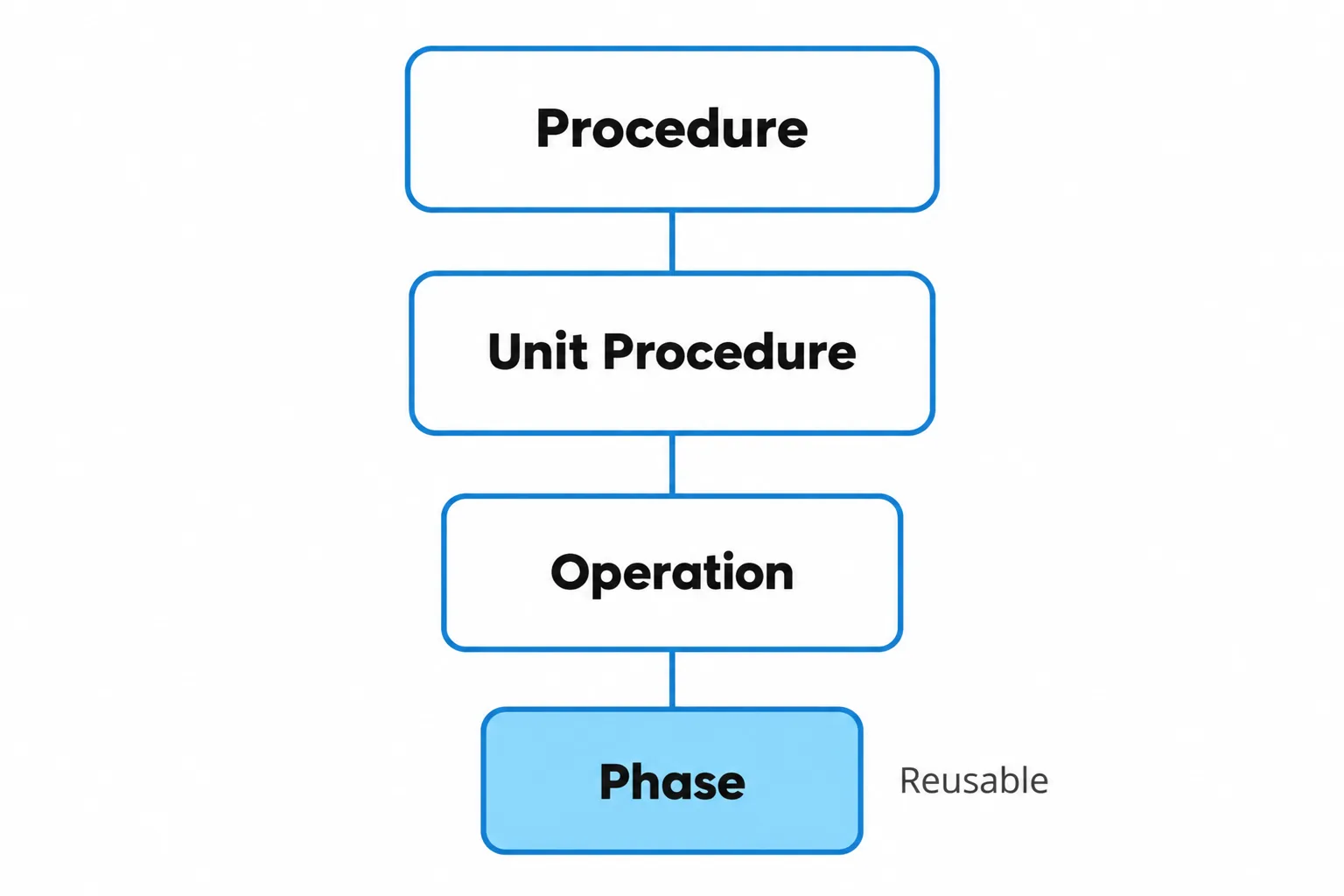
Recipe structure follows ISA-88 (IEC 61512), which defines a procedural hierarchy of procedure, unit procedure, operation, and phase, with general and site recipes at the business level and master and control recipes at the execution level. Phases are the reusable atoms of batch logic, and that hierarchy is what gives batch data its meaning downstream.
PLC vs DCS vs SCADA: Terminology That Trips Projects Up

SCADA is supervisory software, not a controller. It handles visualization, data acquisition, alarming, trending, and historization above a control layer. A PLC executes control. A DCS performs both roles natively inside one platform.
So “which is better, PLC or DCS or SCADA?” is the wrong frame. Compare layered roles: a controller that solves logic, a supervisory layer that presents and records it, and a platform choice that sets how many seams sit between the two.
Modern architectures marketed as PLC-based DCS or process automation systems blur the boundary further. Judge the criteria, not the label: one engineering database or two, a native batch engine or a bolt-on, audit trail coverage at every layer or only at the top.
Key Differences That Matter in a GMP Plant
| Dimension | PLC + SCADA | DCS | GMP consequence |
|---|---|---|---|
| Architecture | Controller-centric, separate supervisory layer | Controllers, IO, HMI, alarms, history engineered as one system | Interface count drives validation scope |
| Engineering model | Two configuration databases to keep in sync | Single global database, tag defined once | Tag mismatches surface as configuration deviations |
| Response time | Millisecond scans, deterministic discrete control | Tuned for analog loops with longer time constants | Platform must match process dynamics |
| IO scale | Tens to a few thousand points per controller | Thousands to tens of thousands across process areas | Scale drives integration labor |
| Operator interface | Graphics built separately from controller logic | Graphics generated from the same database | Less drawing and tag review burden |
| Redundancy | Available, engineered component by component | Native controller, network, and server redundancy | Availability affects batch loss risk |
| Batch and recipe | Custom recipe code or recipe logic in MES | Native ISA-88 batch engine | Phase context feeds the batch record |
| Alarm management | Configured per project | Built-in alarm hierarchy and rationalization tools | Supports operator response and deviation review |
| Audit trail and Part 11 controls | Assembled across controller, SCADA, and historian | Native versioned configuration, electronic signatures, audit trail | Evidence burden during inspection |
| Change control | Parallel changes in two databases | One traceable change | Periodic review effort |
| Lifecycle | Wide vendor and integrator pool, shorter product cycles | Longer support windows, vendor-defined migration paths | Pharma assets run 15 to 25 years |
| Cost profile | Lower capital, higher integration and validation labor at scale | Higher capital, lower marginal cost per added unit | Total cost of ownership, not purchase price |
Architecture and Engineering Model
A PLC plus SCADA design keeps two sources of truth: controller logic and the supervisory tag database. Every change touches both, and both need change control records.
A DCS holds one engineering database. Fewer synchronization points mean fewer configuration-mismatch deviations and a shorter traceability matrix.
On retrofit projects, a mismatch between controller logic and SCADA tag configuration is a familiar source of qualification rework. The fix is a data contract and tag naming standard agreed on before detailed design, not after FAT.
Scan Time, Scale, and Process Type in DCS vs PLC for Pharmaceutical Manufacturing
PLCs earn their place where milliseconds decide outcomes: safety-adjacent interlocks, servo motion, high-speed packaging, vision reject on inspection lines.
DCS platforms earn theirs where hundreds of PID loops, cascade control, and slow thermal or pressure dynamics run across multiple process areas at once.
Map the process first. Discrete and skid-level duty points to a PLC. Large batch and continuous process units point to a DCS. Continuous manufacturing for oral solid dose and flow chemistry strengthens the DCS case, because control, batch definition, and real-time release data all sit in one layer.
| Pharmaceutical Application | Better-Fit Platform | Main Reason |
|---|---|---|
| High-speed tablet packaging line | PLC | Fast discrete control, motion, and reject logic |
| CIP/SIP skid | PLC | Defined equipment sequences and interlocks |
| Multi-reactor API production | DCS | Coordinated process control across multiple units |
| Bioreactor and fermentation suite | DCS | Continuous monitoring and precise control of analog process variables |
| OEM filling machine | PLC | Machine-level control and fast response |
| Multi-unit batch production | DCS | Centralized recipe management and batch phase coordination |
| Purified water generation skid | PLC or DCS | Depends on system complexity, integration, and site standards |
| Hybrid plant with multiple OEM skids | DCS or SCADA backbone with PLCs | Integrates skid controls with plant-level monitoring and data systems |
Validation, Data Integrity, and 21 CFR Part 11 Impact
The two architectures separate most sharply here, and this is where budget estimates get missed.
21 CFR Part 11 requires secure, computer-generated, time-stamped audit trails that independently record the date and time of operator entries and actions that create, modify, or delete electronic records. Role-based access, unique user accounts, and electronic signature controls sit on top of that baseline.
A DCS generally ships those controls as platform features, already tested by the supplier. A PLC plus SCADA architecture often needs them assembled across three layers, then justified and tested as an integrated whole.
Scope the effort with a risk-based method. ISPE’s GAMP 5 Second Edition keeps the framework of the first edition and updates its application to modern systems, with critical thinking and software categories that hold test effort proportional to risk.
The deliverable set stays the same either way: URS, functional and design specifications, IQ, OQ, PQ, traceability, periodic review, and change control. What changes is how many systems each document must cover.
Validation planning should also account for cGMP manufacturing requirements, including documented procedures, qualified systems, controlled changes, and reliable production records.
ALCOA+ risks concentrate at the seams. Watch for unbuffered local historians, unsynchronized clocks across controllers and servers, orphaned tags after equipment changes, and shared operator logins on skid HMIs.
Addressing data integrity issues in pharmaceutical batch records requires checking timestamp consistency, audit trail completeness, attributable user actions, and data recovery across connected systems.
From an engineering standpoint, validation effort scales with the number of interfaces and configuration databases, not with the vendor logo on the cabinet.
Integration With MES, EBR, and the Data Layer
ISA-95 supplies the shared vocabulary. Its functional hierarchy puts sensing and control at levels 1 and 2, manufacturing operations management such as MES at level 3, and enterprise systems such as ERP at level 4. Every control platform decision sets how much work it takes to move data between those levels.
Successful MES implementation depends on defining these interfaces early, including data ownership, system responsibilities, and how manufacturing events move between control and enterprise layers.
An electronic batch record replaces the paper batch manufacturing record with an executed, time-stamped electronic record of materials, parameters, steps, and signatures. Review by exception only works when the control layer supplies clean, contextualized data.
Effective EBR implementation pharma projects also require a clear data model that connects process values, recipe steps, material records, and electronic signatures to each executed batch.
That context is specific. A usable batch record ties each parameter to phase, step, equipment, material lot, operator identity, setpoint, actual value, and limit. Deviation and OOS investigations depend on the same fields, plus the alarm and interlock history around the event.
The batch release workflow needs status fields for review, approval, rejection, and quarantine, each with an attributable signature.
| Integration Requirement | What the Control Layer Should Provide | Why It Matters for MES/EBR |
|---|---|---|
| Batch phase and step context | Identifiable phase, step, and equipment state | Places each process value in the correct batch sequence |
| Parameter data | Setpoint, actual value, units, and timestamp | Supports review against process limits |
| Material traceability | Relevant material or lot identifiers, where applicable | Connects process execution to materials used |
| Operator identity | Attributable user actions and authenticated identities | Supports record review and accountability |
| Alarm and interlock history | Time-stamped events with relevant context | Helps investigate deviations and unexpected process behavior |
| Data buffering and recovery | Defined behavior during network or system interruptions | Reduces the risk of missing data |
| Audit trail coverage | Traceable changes and actions across applicable system layers | Supports data integrity review and inspection readiness |
| Interface and tag mapping | Documented data contracts and consistent tag naming | Reduces mapping errors and integration rework |
DCS batch engines expose recipe and phase context natively, so MES consumes it directly. PLC and SCADA architectures usually rebuild that context through an OPC UA interface plus a mapping layer in MES, which is workable and routinely done, though it adds interfaces to specify, test, and maintain.
Settle three things before integration design: a tag naming standard, a data contract per skid, and historian retention and backup qualification. Later analytics and manufacturing intelligence work depends entirely on those decisions.
Cost, Lifecycle, and Obsolescence Reality
Purchase price misleads. A PLC plus SCADA package typically wins on hardware and license cost, then spends the difference on engineering hours, interface testing, and validation documentation once the plant scales past a few process areas.
Hidden costs deserve a line in the business case: spare parts strategy, vendor support windows, operator training, and migration planning. Pharmaceutical equipment often runs 15 to 25 years, so the supplier roadmap is a selection criterion, not a footnote.
Obsolescence fear pushes some teams toward a DCS by default. Market data does not support that reasoning. PLC market growth data positions programmable logic controllers as the backbone of global industrial automation, with continued growth rather than contraction.
A Decision Framework for Pharmaceutical Manufacturing
Run this eight-question screen before any vendor conversation:
- Process type: continuous, batch, discrete, or hybrid?
- Analog loop count per process area?
- Total IO count across the scope, plus expected growth?
- How many process areas share operator staffing?
- Recipe complexity: fixed sequence, parameterized, or full ISA-88 flexible recipe?
- What is the existing site automation standard?
- What in-house support skills exist for each platform?
- What does the MES and EBR roadmap require in the next five years?
High analog loop counts, multiple coordinated process areas, flexible recipes, and a near-term EBR program push toward a DCS. High-speed discrete duty, single skids, small IO counts, and strong in-house PLC support push toward PLC plus SCADA.
Real sites usually land on a hybrid: a DCS or SCADA backbone for process areas, with OEM PLC skids integrated through OPC UA under defined data contracts. One architecture standard across the site cuts validation, spare parts, and training cost more than a per-unit optimal controller choice ever will.
Common Mistakes on Control System Selection
- Teams select on controller price and leave integration and validation labor unbudgeted.
- Procurement accepts OEM skid PLCs with closed data access, no audit trail, and no OPC UA server.
- No tag naming convention or data contract exists before MES integration design starts.
- A SCADA historian gets treated as a GMP record without buffering, backup, and retention qualification.
- URS traceability gets skipped, then qualification documents are rewritten after FAT.
- Alarm rationalization waits until after operator training, which forces graphics rework.
Frequently asked questions
Is PLC becoming obsolete?
What is DCS in pharma?
Which is better, PLC or DCS or SCADA?
Does a DCS make 21 CFR Part 11 compliance automatic?
Can a PLC and SCADA system support electronic batch records?
Closing Takeaway
Decide in this order: process dynamics, then data and compliance requirements, then scale and lifecycle support. Controller speed matters last in most pharmaceutical scopes, because the expensive risks live in validation evidence and batch data context.
Most sites end up hybrid, and that is a sound outcome. The difference between a clean project and a costly one is disciplined data architecture, a single site standard, and a validation strategy written before procurement.
GMP Pros works inside that decision with clients across pharmaceuticals, biologics, food, and animal health: control system specification and design review, electronic batch record and MES implementation, production and capital project engineering, and data science support.
Our engineers embed with client teams on site, which is where control platform decisions actually get tested.