Article Summary
- EBR system validation timelines range from a few weeks for simple workflows to several months for complex, integrated rollouts
- Timeline depends on scope, batch record complexity, integrations, documentation maturity, and internal approval cycles
- Validation and implementation are separate efforts
- Cross-functional delays, late requirement changes, and QA bottlenecks drive most overruns
- Risk-based planning, early stakeholder alignment, and locked requirements reduce validation time without increasing compliance exposure
Regulated facilities ask this question constantly: how long does EBR system validation take?
The honest answer is that timeline depends far less on which software you choose and far more on scope, integrations, batch record complexity, approvals, and testing depth.
A simple, single-workflow EBR can validate in weeks. A heavily integrated, multi-site rollout may take six months or longer.
This article gives you realistic timeline ranges, a phase-by-phase breakdown, a clear view of what separates implementation from validation, and practical steps to reduce delays without cutting corners on GMP or 21 CFR Part 11 compliance.
How Long Does EBR System Validation Take?
The most direct answer: plan for 6 to 16 weeks for straightforward projects, 3 to 6 months for mid-complexity rollouts, and 6 to 12+ months for enterprise or multi-site deployments.
These are elapsed timelines, not just active work hours. Review cycles, approval queues, and resource conflicts extend the calendar far beyond the effort itself.
| Project Type | Typical Scope | Validation Duration | Main Delay Risks |
| Simple workflow | 1 product line, minimal integrations, few user roles | 6–10 weeks | Slow QA approvals, incomplete requirements |
| Mid-complexity | Multiple workflows, moderate integration needs | 3–6 months | Requirement changes, interface testing gaps |
| Complex / multi-site | ERP/MES/LIMS connections, high customization, multiple sites | 6–12+ months | Coordination overhead, late-stage deviations, change control |
These ranges reflect real project conditions. Facilities that begin with clear, locked requirements and dedicated validation resources consistently hit the lower end. Those that treat validation as a post-configuration afterthought almost always exceed the upper end.
Simple EBR Workflows
A “simple” EBR project typically covers one product or product family, a limited number of user roles, minimal system integrations, and standard workflow logic without heavy exception handling.
For a project structured this way, validation can realistically close in 6 to 10 weeks, provided requirements are stable and review cycles are defined upfront.
Mid-Complexity EBR Projects
Mid-complexity projects introduce more moving parts: multiple workflows, broader stakeholder involvement, moderate integration with equipment or lab systems, and more varied batch record logic.
Expect 3 to 6 months. The additional review touchpoints and coordination between QA, IT, and operations are what stretch the clock, not necessarily the testing itself.
Complex or Highly Integrated Rollouts
Enterprise-scale deployments with ERP, MES, or LIMS connections, multi-site rollouts, and heavily customized workflows require the most validation depth. Interface validation alone adds significant time. Combined with multi-layer approval chains and change control requirements, these projects regularly run 6 to 12 months or longer.
What Is Included in EBR System Validation?
Many teams underestimate how long EBR system validation takes because they conflate configuration with validation readiness. These are two distinct activities, as a configured system is not a validated system.
Validation requires documented evidence that the system performs as intended in your specific GMP environment.
That means intended use documentation, user requirements, risk assessment, traceability matrix, test planning, test execution, deviation handling, and formal approval by QA.
| Activity | Part of Implementation | Part of Validation | Why It Affects Timeline |
| Workflow configuration | Yes | No | Sets the scope for what gets tested |
| User requirements specification | Partial | Yes | Drives traceability and test coverage |
| Risk assessment | No | Yes | Shapes testing depth and priorities |
| IQ / OQ / PQ execution | No | Yes | Core evidence generation effort |
| Deviation documentation | No | Yes | Unresolved deviations block closure |
| QA approval and sign-off | No | Yes | Often the longest elapsed step |
Documentation and Intended Use
Validation starts with clarity on intended use. A system cannot be validated well if requirements are vague. Intended use, user requirements, and risk assessment form the foundation that every downstream test, traceability entry, and approval decision depends on.
Testing and Evidence Generation
IQ, OQ, and PQ (or equivalent structured testing) generate the evidence that the system functions as designed under real operating conditions. This is not just functional testing, but it covers edge cases, boundary conditions, error handling, and data integrity scenarios.
The more complex the workflow logic, the higher the test script volume.
Review, Approval, and Release Readiness
Approval cycles are consistently underestimated. QA review of test execution records, deviation closure, and formal sign-off all take calendar time regardless of how clean the execution was. A short delay in one sign-off can hold the entire package from closure.
EBR Validation Timeline by Phase
Understanding where the time actually goes helps teams plan accurately and set realistic expectations with leadership.
| Validation Phase | What Happens Here | Typical Time Range | Common Blockers |
| Requirements and risk assessment | Intended use, URS, risk-based test scope | 2–4 weeks | Incomplete input, stakeholder availability |
| Test script development | IQ/OQ/PQ scripts, traceability matrix | 2–4 weeks | Requirement changes, resource constraints |
| Test execution | Formal protocol execution, data capture | 2–6 weeks | System defects, out-of-scope findings |
| Deviation and rework | Investigation, correction, retesting | 1–4 weeks | Volume and severity of findings |
| Review and approval | QA package review, sign-off, closure | 2–5 weeks | Review queue, reviewer availability |
Requirements and Risk Assessment
Early planning quality shapes everything that follows. Late requirement changes during test execution force rework across scripts, traceability entries, and sometimes risk classifications.
Teams that invest in thorough requirements upfront compress the total timeline even when individual phases take slightly longer.
For teams earlier in the process, reviewing the broader EBR implementation picture before scoping validation effort helps avoid common planning gaps.
Test Script Development and Execution
Script volume scales with workflow complexity. More branching logic, more exception paths, and more integration touchpoints mean more test cases. This phase is where the difference between a well-scoped project and a poorly scoped one becomes most visible on the schedule.
Deviations, Approvals, and Go-Live Readiness
Elapsed time grows when issues surface late or approval queues back up. A deviation found during PQ that traces back to a requirements gap can reset weeks of work.
Clear deviation procedures and a defined approval path before execution begins are not optional for teams under schedule pressure.
What Makes EBR Validation Take Longer Than Expected?
This is the section most planning conversations skip. Timeline overruns rarely trace back to one cause. They compound.
| Delay Factor | Why It Slows the Project | How to Reduce the Impact |
| Vague or changing requirements | Forces rework across scripts and traceability | Lock requirements before configuration starts |
| Complex batch record logic | Increases test coverage volume significantly | Simplify workflows where GMP risk allows |
| System integrations | Adds coordination, interface testing, data flow validation | Plan interface scope early, test early |
| Unclear ownership | Decisions stall without a clear accountable party | Define roles across QA, IT, operations before kickoff |
| QA review bottlenecks | Approvals queue behind competing priorities | Involve QA in planning, schedule review windows upfront |
| Late-stage changes | Triggers change control, retest, re-approval | Freeze scope before validation begins |
| Insufficient resources | Test execution slows when team is split across projects | Confirm dedicated resource availability before scheduling |
Complex Batch Records and Workflows
Batch records with extensive branching logic, multi-level approvals, calculated fields, and exception workflows require proportionally more test coverage. Each conditional path needs a test case. Each integration point needs verified data flow.
The data integrity issues in pharmaceutical batch records that surface during validation are often traceable to under-specified record design.
Integrations and System Dependencies
Connections to MES, ERP, LIMS, and plant floor equipment introduce hidden coordination work. Interface validation must confirm not just that data transfers, but that it transfers accurately, completely, and with appropriate audit trail coverage.
These dependencies also create scheduling risk because testing cannot proceed until the connected system is available and stable.
Internal Bottlenecks and Late Changes
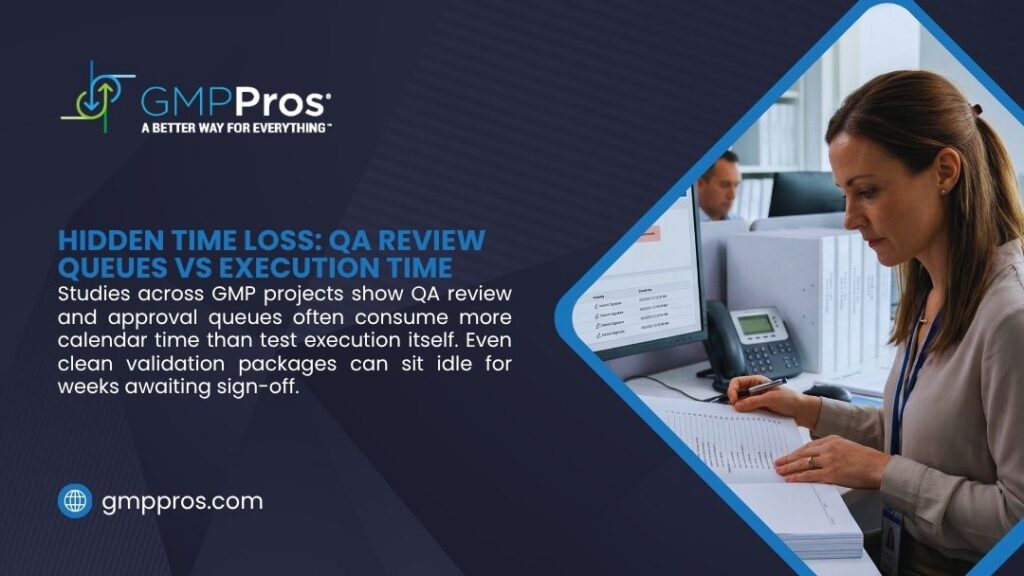
The software being ready does not mean the project is on track. QA review cycles, resource conflicts, ownership confusion between IT and quality, and scope changes introduced after configuration is complete are the most common causes of calendar overrun.
The project slips not because the technology failed, but because the organization around it was not aligned.
Implementation Timeline vs. Validation Timeline
This distinction appears clearly in EBR implementation pharma project planning, yet it is consistently blurred. The result is go-live schedules built on incorrect assumptions.
| Implementation Activity | Validation Activity | Can Overlap? | Impact on Go-Live |
| Workflow configuration | Requirements and risk assessment | Partially | Overlapping requires tight change control |
| User role setup | IQ execution and verification | Yes, with care | Configuration must be stable before IQ |
| Equipment interface build | Interface and data integrity testing | No | Testing must follow stable interface build |
| User training | UAT and PQ execution | Partially | Training informs UAT execution quality |
| Environment readiness | Installation documentation | Yes | Often completed together |
What Implementation Covers
Implementation covers system configuration, workflow design, user role setup, equipment interface build, training environment preparation, and go-live readiness from a technical standpoint.
These activities establish that the system exists and is configured as designed. They do not prove it performs correctly under GMP conditions.
What Validation Covers
Validation covers documented evidence that the configured system functions as intended in your regulated environment. A configured system can still be entirely unvalidated.
Validation requires its own documentation trail, its own approval chain, and its own evidence base, independent of whether the system was configured correctly.
Why Mixing Them Up Creates Bad Schedules
A team that assumes configuration completion equals go-live readiness will discover validation is a separate effort late in the project. At that point, adding 6 to 12 weeks of validation work to an already committed schedule is a difficult conversation.
The better approach is to treat implementation and validation as parallel tracks with clear handoff points, not sequential phases where validation starts after configuration ends.
How to Shorten EBR Validation Time Without Increasing Compliance Risk
The question underneath this one is always the same: how do we avoid a six-month project when we need to go live in three?
The answer is not to cut validation scope. It is to reduce requirements churn, coordination delays, late-stage surprises, and approval bottlenecks that add elapsed time without adding compliance value.
| Action | When to Do It | Why It Saves Time | Team Owner |
| Lock intended use and scope | Before configuration starts | Prevents rework across all downstream documents | QA + Project Lead |
| Define requirements with precision | Pre-configuration | Reduces test script revision cycles | Validation Lead |
| Involve QA from project kick-off | Day one | Eliminates late-stage compliance surprises | QA Manager |
| Use risk-based testing depth | During protocol development | Focuses effort where product quality risk is highest | Validation Lead |
| Reduce unnecessary customization | During design phase | Out-of-the-box workflows validate faster | Engineering + IT |
| Schedule review windows in advance | Before execution begins | Prevents approval queue delays at closure | Project Manager |
| Assign dedicated validation resources | During resource planning | Avoids execution slowdowns from split attention | Operations + PM |
Define Scope and Intended Use Early
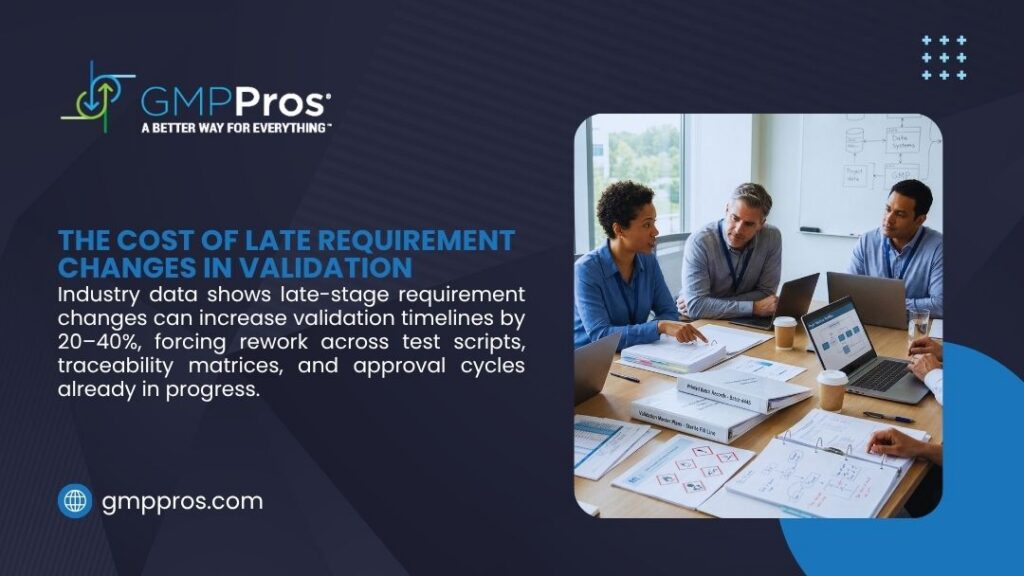
Scope drift is a principal cause of validation delay. Every addition to scope after requirements are approved triggers document changes, traceability updates, and sometimes partial retest.
Narrow, well-defined scope with a clear intended use statement is the single most effective timeline control available.
Teams working through the transition from paper should also review the differences between paper batch records vs electronic systems early in the scoping process, as the gap analysis often surfaces scope items that would otherwise appear mid-validation.
Involve QA, Validation, and Operations from the Start
Cross-functional alignment at kickoff prevents the late-stage surprises that add weeks to approval timelines.
QA concerns raised during test execution (about data integrity coverage, audit trail completeness, or deviation classification) are far more expensive to address than the same concerns raised during protocol development.
Use a Risk-Based, Right-Sized Validation Approach
Right-sized does not mean minimal. It means focused. Depth of testing should scale with the severity of potential impact on product quality, patient safety, and data integrity. Low-risk, low-complexity functions require lighter documentation.
High-risk functions with direct GMP impact require thorough test coverage. The FDA’s process validation guidance and ISPE’s GAMP 5 framework both support this approach.
Reduce Unnecessary Customization
Custom workflows almost always mean more validation effort. Custom logic must be fully tested and custom interfaces must be validated independently.
Where standard, out-of-the-box configurations meet your GMP requirements, they will validate faster. Every customization decision made during design has a measurable cost in validation effort.
A Realistic Planning Framework for EBR Projects
| If Your Project Looks Like This | Plan for This Level of Validation Effort | Key Timeline Caution |
| Single product line, minimal integrations, standard workflows | 6–10 weeks validation; 3–4 months total with implementation | QA approval cycle often adds 2–3 weeks beyond test closure |
| Multiple workflows, moderate integrations, broader stakeholder involvement | 3–5 months validation; 6–9 months total | Requirement stability is the critical path variable |
| Multi-site, ERP/MES/LIMS integrations, complex record logic, high customization | 6–12 months validation; 12–18 months total | Governance, change control, and coordination become primary schedule drivers |
If Your EBR Project Is Simple
Expect one workflow family, a small user group, no complex integrations, and standard batch record logic.
Validation can close in 6 to 10 weeks if requirements are stable at kickoff and QA is resourced to review on a predictable schedule.
The risk here is underestimating approval cycles, because a clean test execution does not guarantee same-week closure.
If Your EBR Project Is Moderate
Multiple workflows introduce more test coverage, more review touchpoints, and more stakeholder coordination. This is where requirement changes have the most impact.
A single scope addition mid-project can shift the timeline by several weeks when traceability, scripts, and approval sequences all require updating.
If Your EBR Project Is Complex
Enterprise rollouts require governance structures that simple projects do not. Steering committees, formal change control, site-specific validation annexes, and multi-level approval chains all extend elapsed time independent of technical execution quality. Buffer planning should account for coordination overhead as a first-order project risk, not a contingency.
Pre-Kickoff Checklist for Timeline Planning
Before scheduling validation, confirm these are in place:
- Intended use statement drafted and reviewed by QA
- User requirements specification complete and baselined
- Validation master plan or strategy document approved
- Test environments identified and access confirmed
- Key stakeholders named across QA, IT, operations, and validation
- Approval path defined with named approvers and expected review windows
- Dedicated validation resources confirmed and protected from competing projects
- Change control procedure established for scope or requirement modifications
Working With GMP Pros on EBR Validation
EBR validation projects stall most often not because the technology is hard, but because scope is poorly defined, resources are stretched thin, and cross-functional alignment breaks down at critical decision points.
GMP Pros embeds experienced validation engineers directly within your facility. The team works on-site alongside your QA, operations, and IT stakeholders — from requirements development through protocol execution, deviation resolution, and final approval package.
For facilities working through EBR projects across pharmaceutical, biologics, or animal health manufacturing (including efforts tied to how to reduce batch record cycle time) GMP Pros brings the technical depth and on-site presence to keep projects on schedule and inspection-ready at closure.
Contact GMP Pros to discuss your EBR validation scope and get a realistic timeline assessment from engineers who have executed these projects across regulated manufacturing environments.
FAQs About How Long Does EBR System Validation Take
How long does EBR system validation take?
Simple workflows can validate in 6 to 10 weeks. Mid-complexity projects typically run 3 to 6 months. Complex or multi-site rollouts often take 6 to 12 months or longer. Elapsed time is shaped by approval cycles and coordination as much as by active testing.
What is the difference between EBR implementation and validation?
Implementation covers configuration, workflow design, and technical setup. Validation covers documented evidence that the configured system performs as intended in a GMP environment.
Which phase of EBR validation usually takes the longest?
Review and approval cycles are the most consistent source of elapsed time overrun, not test execution itself. A clean test package can still sit in queue for two to four weeks depending on QA workload and reviewer availability.
Can a pre-validated EBR platform reduce validation time?
Vendor-supplied validation packages and pre-configured templates can reduce script development effort and provide useful traceability foundations, but they do not transfer site validation responsibility.
Your facility still needs documented intended use, risk assessment, site-specific testing, and QA approval.
Do simple EBR workflows validate faster than customized ones?
Consistently, yes. Standard, out-of-the-box workflows have lower test coverage volume, fewer custom logic paths to verify, and less interface complexity.