
FDA guidance and recent warning letters show that documentation problems are read as process control failures.
In an analysis of 470 warning letters from 2025, 469 out of 470 contained citations tied to documentation or records. It is a pattern that regulated manufacturers cannot afford to overlook.
What FDA Means by Batch Record Deficiencies and Why They Matter
A batch record deficiency is any failure to create, complete, correct, or control production documentation in line with 21 CFR Part 211. It can be a blank data field, a missing signature, a form pulled from an uncontrolled copy, or a correction made without explanation.
FDA does not read these as clerical errors. It reads them as evidence of how well a facility controls its production process.
What Counts as a Batch Record Deficiency?
The most common record problems cited in FDA inspections fall into clear categories:
| Issue | Typical Inspection Concern |
| Blank data fields | Evidence that a critical step was not performed or observed |
| Missing signatures or dates | Broken accountability chain; no proof of review or approval |
| Overwritten or obscured entries | Possible data falsification; ALCOA+ violation |
| Unexplained corrections | Suggests retroactive alteration without a documented reason |
| Wrong form version in use | Master batch record control failure; document control system gap |
| Incomplete deviation notes | Investigation quality too weak to support a batch release decision |
| Late entries without explanation | Contemporaneous documentation requirement not met |
Each of these items is a Form 483 observation candidate. Several of them together in one batch record become the pattern FDA needs to escalate to a warning letter.
Why FDA Treats These Errors Seriously
Under 21 CFR 211.192, all drug product production and control records must be reviewed by the quality unit before a batch is released or distributed.
Any unexplained discrepancy must be fully investigated. That standard transforms a missing signature from a paperwork gap into a release control failure.
| Scenario | FDA Interpretation |
| One missing date, corrected with explanation | Procedural lapse; addressable with CAPA |
| Multiple unsigned steps across several batches | Quality unit oversight failure under 21 CFR 211.22 |
| Corrections with no reason code, across multiple products | Potential data integrity issue |
| Wrong form version found across batch records | Document control system failure |
In FY 2024, failure to follow quality unit procedures under 21 CFR 211.22(d) was the most cited 483 violation, cited 184 times. It held the top spot for four consecutive years.
The second most cited was 21 CFR 211.192, failure to probe discrepancies, at 116 citations.
These are not obscure regulations. They are the foundation of batch record control, and they are failing at the same facilities, year after year.
How to Avoid FDA Warning Letters for Batch Record Deficiencies
Prevention splits across three areas: how the record is built before production starts, how QA reviews it before release, and how the team handles corrections or deviations when something goes wrong.
Each area has distinct owners, and all three must work together.
| Control | Owner | Risk Reduced |
| Approved master batch record with version control | Document Control / QA | Wrong form versions in production |
| Pre-use form verification against current MBR | Production Supervisor | Outdated templates during execution |
| Defined sign-off points in the batch record | QA / Process Engineer | Steps executed without documented authorization |
| QA review checklist before batch release | Quality Unit | Gaps missed prior to distribution |
| Deviation procedure with formal documentation path | QA / Operations | Incomplete or undocumented deviations |
| Correction procedure with single-line strike-through | All personnel | Unclear alterations that raise data integrity flags |
| Version-controlled blank form repository | Document Control | Uncontrolled copies in circulation |
Build the Record Right Before Production Starts
The most preventable batch record deficiencies originate before a single entry is made. A controlled master batch record, with defined sign-off points and a clear version history, removes the conditions that create documentation gaps at the execution stage. The same upstream controls do double duty, since preventing batch record-related product recalls depends on the same master record discipline that keeps warning letters away.
Key pre-production controls:
- Confirm the batch record in use matches the current approved version
- Verify that all attachments referenced in the MBR are current and controlled
- Confirm each operator has documented, current training for the tasks in this batch record
- Complete line clearance documentation before the batch begins
- Review pre-use checklists with production staff before the first entry
Teams that define comprehensive data standards before the record design phase experience 40% fewer documentation issues during system deployment.
For teams already exploring digital recordkeeping, a review of what an electronic batch record system covers provides useful context before any format redesign is evaluated.
| Good Record Design | High-Risk Record Design |
| Every field has a defined entry owner | Fields left open to whoever is available |
| Checkpoints require a dated signature before proceeding | Steps completed without intermediate sign-off |
| Deviations route to a formal investigation form | Corrections made in the margin with no reference |
| Form version appears on every page | No version number on the document |
| Blank spaces have an N/A protocol defined | Blank spaces left without explanation |
Tighten QA Review Before Batch Release
Effective QA review is not a signature at the end of a packet. It is a structured check for completeness, consistency, timing, and whether the record actually reflects what happened in production.
QA reviewers should look for patterns across recent batches, not just individual missing signatures. That same pattern-level view matters when reviewing how OOS results trigger formal investigations, since repeated out-of-specification findings often trace back to the same record deficiencies inspectors cite.
| Review Area | What to Check |
| Completeness | Every required field filled; no unexplained blanks |
| Date and time consistency | Entries within logical production timeframes |
| Signature accountability | Each sign-off tied to a specific, trained individual |
| Correction quality | Single-line strike-throughs with reason codes and initials |
| Deviation linkage | Every deviation referenced in the batch record tied to an open investigation |
| Form version | Matches the current approved MBR and all referenced attachments |
| Yield reconciliation | Theoretical vs. actual yield within approved limits |
In 2025, 23 of 148 lab-directed warning letters cited facilities that released batches without completing required testing. Post-release, that gap becomes a safety issue, not just a documentation one.
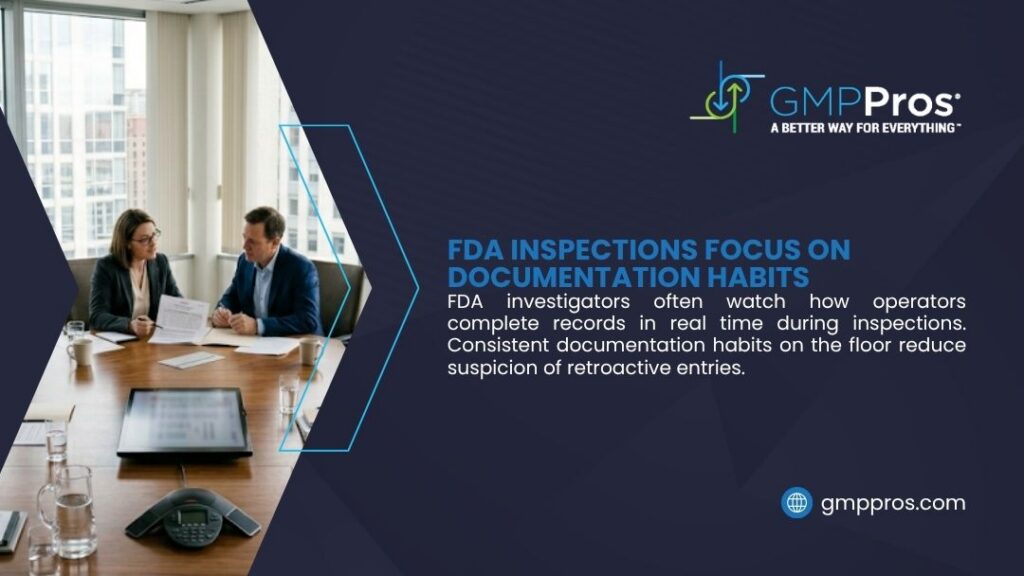
Handle Corrections, Deviations, and Missing Entries the Right Way
How to Avoid FDA Warning Letters for Batch Record Deficiencies — this question gets answered, in part, by how your team handles the moment when something goes wrong.
The correction process becomes part of the record. How a team handles it tells FDA as much as the original entry.
The FDA-accepted correction method:
- Draw a single line through the incorrect entry so the original remains legible
- Write the corrected value nearby
- Initial and date the correction
- Add a brief reason code if the context is not immediately clear
| Situation | Classification | Required Action |
| One missed initial found before release | Minor documentation error | Correct per SOP; note in QA review |
| Missing critical process parameter | Deviation | Formal investigation; batch impact assessment |
| Same blank field found across multiple batches | Systemic failure | CAPA; root cause investigation; QA escalation |
| Altered entry without explanation | Potential data integrity issue | Quality unit escalation; investigation; possible batch hold |
What creates risk in this stage:
- Obliterating original entries with correction fluid or heavy strokes
- Adding entries after the fact without a documented explanation
- Using a different pen color or handwriting style without acknowledgment
The Batch Record Mistakes FDA Flags Most Often
Across 2025 FDA warning letters, the recurring documentation failures follow a short, predictable list.
These are the gaps that appear in inspection reports year after year, and they are preventable with consistent controls already available to most regulated facilities.
| Mistake | Why FDA Cares | How to Prevent It |
| Missing signatures | No evidence of review or control at that step | Defined sign-off protocol; QA checklist |
| Blank process parameters | Step may not have been performed | Required-field design; pre-release completeness check |
| Late or retroactive entries | Violates ALCOA+ contemporaneous documentation | Real-time entry culture; supervisor spot checks |
| Unexplained corrections | Raises a data integrity flag | Correction SOP; personnel training |
| Wrong form version | Document control system failure | Version verification before each batch |
| No deviation linkage | Incomplete investigation chain | Deviation procedures with mandatory linkage |
| Illegible entries | Cannot reconstruct what happened | Legibility standard in training; QA review protocol |
Missing Signatures, Dates, and Approvals
A missing signature is not a cosmetic gap. It breaks the accountability chain for that step in production. If the step is a critical process parameter, a line clearance, or a QA review point, an absent signature is evidence the control was not actually exercised.
| Missing Element | Potential Regulatory Impact |
| Operator signature at process step | No documented evidence the step was performed |
| Date on entry | Cannot confirm contemporaneous documentation |
| QA approval signature | Batch released without confirmed quality review |
| Second-person verification | Critical step unconfirmed; safety and quality gap |
Traceability breakdowns from missing dates and approvals are among the release delays most commonly cited in pre-inspection observations. They are also among the easiest to prevent with a structured pre-release checklist.
Late, Altered, or Unclear Entries
Contemporaneous documentation is not a preference under FDA regulations. It is a requirement. An entry made hours or days after the event, without a documented explanation, raises the question of whether the record reflects what actually occurred.
| Do | Don’t |
| Use a single-line strike-through | Use correction fluid |
| Initial, date, and add a reason code | Overwrite the original so it is illegible |
| Make entries at the time the step is performed | Fill in fields retroactively without documentation |
| Use controlled ink pens in production areas | Leave corrections without any explanation |
From an engineering standpoint, documentation integrity starts at the production floor, not at the QA review table. The record is only as reliable as the moment it was created.
Data integrity concerns appeared in 15% of all FY 2025 warning letters reviewed. Late, altered, or unclear entries are among the most common triggers for those citations.
For Indian sites, the figure reached 60% of letters received, a disparity that points directly to record-creation culture, not just technology gaps.
Uncontrolled Forms and Version Mismatches
A batch record executed on a superseded form is a document control failure. It means either the document control system failed to remove old versions from circulation, or the production team did not verify the form before use.
Either interpretation creates regulatory exposure.
| Controlled Document Workflow | Uncontrolled Document Workflow |
| Current version available in a controlled repository | Multiple form versions circulating on the floor |
| Superseded versions removed or marked obsolete | Old versions mixed with current ones without distinction |
| Version number and effective date on every page | No version identifier on the document |
| Pre-use verification required before each batch | No verification step in the production process |
For facilities still on paper-based systems, version mismatch is one of the highest-frequency failure modes in FDA inspections.
A detailed view of the operational and compliance risks involved is covered in our resource on challenges transitioning from paper to electronic batch records.
A Practical Prevention Checklist for QA and Manufacturing
The gap between what FDA expects and what a facility delivers consistently is almost always an execution problem. The checklists below are built for production teams, not audit response committees.
They reflect what inspection-ready facilities actually do at each stage of the batch lifecycle.
Before the Batch Starts
| Task | Owner | Frequency |
| Confirm batch record version matches current MBR | Production Supervisor | Every batch |
| Verify all attachments are current and controlled | Document Control / QA | Every batch |
| Confirm operator training records are current | QA / Training | Per campaign or change |
| Complete and document line clearance | Production Supervisor | Every batch |
| Review deviation history for this product | QA | Every batch |
| Confirm equipment status and calibration | Production Technician | Every batch |
Pre-batch readiness is where batch record deficiencies are prevented, not corrected. A form verification step that takes three minutes before production starts eliminates the version mismatch that costs hours in deviation investigation later.
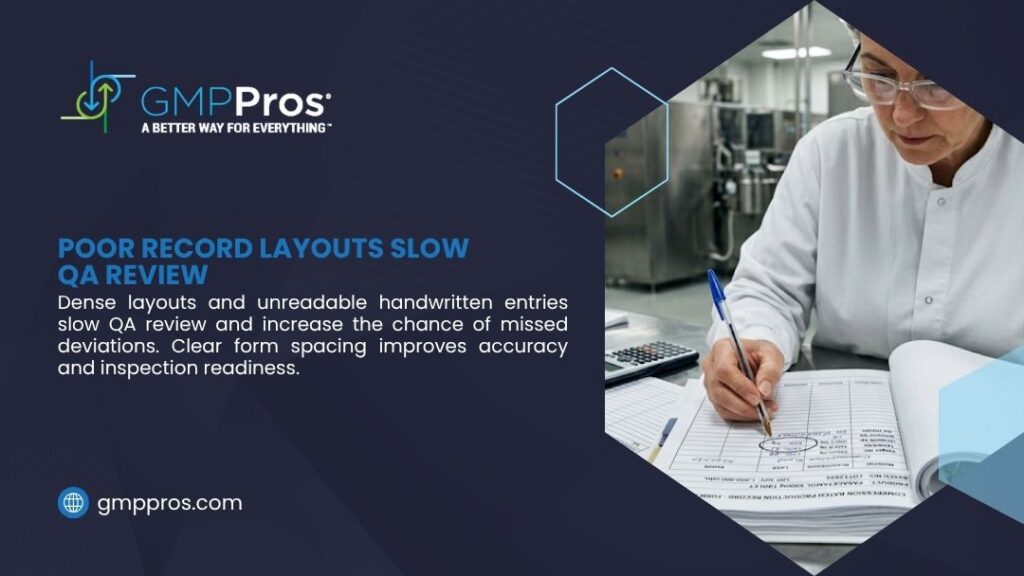
During the Batch
Contemporaneous entries are the foundation of a defensible batch record. Every step documented at the time it is performed reduces the retroactive correction risk that creates data integrity exposure.
| Activity | Who Records It | When |
| Process parameter readings | Operator | At the time of the step |
| Equipment readings and checks | Operator / Technician | At execution |
| In-process deviations | Operator, countersigned by supervisor | Immediately on observation |
| Yield calculations | Operator, reviewed by QA | At defined checkpoints |
| Corrections | Originating operator | At the time of correction |
| QA in-process review | QA | At defined review points in the batch record |
Real-time side-by-side verification at critical steps is one of the most effective controls in high-risk production environments. It removes the single-point-of-failure risk that a solo operator entry creates.
Additional mid-batch discipline that reduces how to avoid FDA warning letters for batch record deficiencies escalation risk:
- Designate a supervisor-level observer for critical process steps
- Escalate any deviation to QA immediately, not at end-of-batch review
- Never leave a field blank with the intent to fill it in later
After the Batch
| Review Step | Owner | Purpose |
| Full completeness review | QA Reviewer | Confirm no blank fields or missing entries |
| Deviation linkage audit | QA | Confirm every deviation is tied to an open investigation |
| Yield reconciliation | QA / Production | Confirm theoretical vs. actual yield within specification |
| Correction review | QA | Confirm all corrections are compliant with SOP |
| Version verification | QA | Confirm form used matches current approved MBR |
| Batch disposition recommendation | QA Manager | Release, hold, or investigate |
| Trend review | Quality Unit | Flag patterns across recent batches for CAPA consideration |
Post-batch review is the last control point before distribution. It is not the place to abbreviate the process.
Resources on pharma regulatory compliance for FDA-regulated manufacturing environments provide additional context for teams rebuilding their post-batch review frameworks.
What to Do If You Already Found Batch Record Deficiencies
Finding a batch record deficiency before FDA does is an advantage, but only if the response is proportionate, documented, and addresses the right root cause. The instinct to fix the paperwork first is understandable. It is also the wrong order of operations.
| Step | Action | Output |
| 1. Discovery | Identify and document the deficiency as found | Deficiency log entry |
| 2. Impact assessment | Determine batch and compliance risk | Impact classification |
| 3. Investigation | Identify root cause, not symptom | Root cause statement |
| 4. CAPA design | Address the system, not just the record | CAPA plan |
| 5. Effectiveness check | Verify the fix is sustained | Effectiveness review record |
Assess Impact Before You Fix the Paperwork
The first question is not how to correct the entry. It is whether the batch was affected and whether the missing or incorrect documentation reflects an actual process failure.
| Deficiency Type | Batch Impact Risk | Compliance Risk | Recommended Path |
| Missing non-critical operator initial | Low | Low | Correct per SOP; note in review |
| Missing critical process step signature | Medium | High | Batch hold; formal investigation |
| Retroactive entry without explanation | Medium | High | Quality unit review; potential CAPA |
| Undocumented deviation found post-release | High | Critical | Formal investigation; CAPA; regulatory assessment |
| Systemic blank fields across multiple batches | High | Critical | Quality unit escalation; full CAPA |
Research from the International Journal of Medical and Pharmaceutical Research found that firms with weak 483 responses have a greater than 50% chance of receiving a warning letter.
The quality of the remediation response matters as much as the corrective action itself.
Build CAPA Around the Root Cause, Not the Symptom
The visible deficiency is rarely the actual problem. A missing signature is a symptom. The root cause might be a batch record layout that places the sign-off field in an easy-to-skip location, a training gap, or a production pace that has outgrown the documentation structure.
| Symptom | Common Root Cause | Corrective Action |
| Missing operator signature | Sign-off point not clearly defined in the record | Redesign record layout; add checkpoint indicator |
| Retroactive entries | No habit of real-time documentation | Training reinforcement; spot audits during production |
| Wrong form version used | No pre-use verification step in the process | Add form verification to the pre-batch checklist |
| Incomplete deviation documentation | Deviation SOP not clear on escalation thresholds | SOP revision; training; worked examples |
| Recurring correction errors | Correction SOP not trained or not visible at point of use | Visual aid at production stations; refresher training |
A CAPA that addresses the symptom rather than the root cause is the most common reason enforcement escalates from a 483 to a warning letter.
In March 2026, FDA posted three CDER warning letters in a single day, each citing weak CAPA responses as the primary reason for escalation.
For teams working through data-related investigations, our resource on data integrity issues in pharmaceutical batch records covers the most common causes and their downstream regulatory consequences.
Frequently Asked Questions
What batch record mistakes most often lead to FDA warning letters?
The most frequently cited documentation failures include missing signatures or dates, retroactive entries without explanation, unclear or obliterated corrections, wrong form versions, and incomplete deviation linkage.
How serious is a missing signature or blank line in a batch record?
A missing signature or blank line in a batch record is very serious in the context of an FDA inspection. A missing signature breaks the accountability chain for that production step and FDA reads it not as a clerical oversight but as evidence the control was not exercised.
What should QA check before batch release?
QA should review for completeness (no blank fields), date and time consistency, correction quality, deviation linkage, form version accuracy, yield reconciliation, and whether the record reflects the production sequence that actually occurred.
What is the difference between a documentation error and a data integrity issue?
A documentation error is an unintentional gap or mistake in a record, such as a missed initial or a transposed number, that can be explained and corrected with proper documentation.
A data integrity issue arises when the accuracy or trustworthiness of the record is in question, such as an entry altered without explanation or a timestamp that does not align with production events.
Inspection Readiness Is an Everyday Practice. GMP Pros Builds It That Way.
Batch record deficiencies rarely start with a single missing entry. They start with the systems, procedures, and habits that produce records every day. And they are fixed the same way, at the process level, not just the paperwork level.
GMP Pros engineers embed directly inside client manufacturing facilities. They do not review from the outside. They work alongside QA, production, and document control teams to identify where the control gaps actually are and what it takes to close them for good.
From electronic batch record implementation to deviation and CAPA system development, GMP Pros brings hands-on technical expertise that FDA-regulated manufacturers need to build and sustain inspection-ready documentation systems.
The team has done this work at some of the world’s most respected pharmaceutical and food manufacturers, and the results are measurable.If your facility has received a 483, is preparing for an upcoming inspection, or has found documentation gaps that need a structured remediation plan, connect with the GMP Pros team today.