
A batch record is the first document an FDA investigator asks to see. Knowing how to prepare batch records for FDA inspection is not an inspection-week task but it’s a daily operational discipline.
In FY 2025, the FDA conducted 694 more inspections than the prior year, and early 2026 data shows no slowdown. The manufacturers that pass consistently are the ones whose records are ready before the inspector walks in.
| What This Guide Covers | Reader Need Addressed |
| What FDA expects from batch records | Understand inspection priorities |
| Preparation workflow before inspection | Build a repeatable pre-inspection process |
| Common documentation mistakes | Identify and prevent recurring gaps |
| Paper, hybrid, and electronic records | Evaluate format risk and compliance posture |
| Inspection-ready checklist | Execute a fast pre-audit review |
What FDA Expects From Batch Records During an Inspection
FDA investigators do not read batch records to understand your process. They read them to verify that your process ran as approved, that the right people confirmed it, and that any deviation was caught and addressed.
Around 60% of GMP inspection findings in 2026 relate to data integrity and documentation control, not physical manufacturing deviations.
That figure tells a direct story: most FDA observations come from records that fail to demonstrate control, not from products that fail to meet specification.
Batch Records as Proof of Control
A compliant batch record shows each significant step, who performed or verified it, and whether the result fell within approved limits.
When any of those elements is absent, the record no longer proves control.
| Record Element | Why FDA Cares |
| Operator signature at each step | Confirms accountability and step completion |
| Date and time of each entry | Verifies contemporaneous documentation under ALCOA+ |
| Process parameters and results | Shows the process ran within approved limits |
| Deviation references | Links production events to investigation outcomes |
| QA review and approval | Confirms the quality unit exercised its release authority |
21 CFR 211.188, batch production and control records, has accumulated 838 inspectional observations in FDA citation analyses, accounting for nearly 6% of all pharmaceutical 483 citations.
It is a consistently targeted section, and the frequency reflects how often basic record completeness fails under inspection.
Master Batch Record vs Executed Batch Record
The master batch record is the approved template. It defines what must happen during production. The executed batch record is the proof that it did.
| Master Batch Record | Executed Batch Record | |
| Purpose | Template for production | Evidence of actual production |
| Content | Instructions, specifications, limits | Completed values, signatures, deviations |
| Changes | Require formal change control | Each entry is a one-time production record |
| FDA focus | Design and completeness of instructions | Accuracy, traceability, and completeness of entries |
In February 2026, FDA issued a warning letter to a U.S. pharmaceutical company for batch records that were missing critical production information on coating and blending.
FDA required the company to provide master batch records that capture all significant steps for each drug product, along with a remediation plan for ongoing management oversight throughout the production lifecycle.
How to Prepare Batch Records for FDA Inspection
Preparation is not a last-minute effort. The most defensible batch records result from a structured pre-inspection review that starts well before FDA arrives.
Teams that know how to prepare batch records for FDA inspection treat record readiness as a continuous process, not a reactive one.
From FY2017 to FY2021, 21 CFR 211.192 production record review appeared 523 times in FDA warning letters. It remains one of the most cited regulations in enforcement, which tells QA and production teams exactly where the highest review risk sits.
For a step-by-step view of how QA teams should structure their batch record review process, our dedicated resource covers the full lifecycle from production completion to batch disposition.
| Step | Owner | What to Verify | Output |
| Scope review | QA Manager | Which products, lots, and time periods are in scope | Prioritized review list |
| Completeness check | QA Reviewer | All fields filled; all signatures present | Gap log |
| Accuracy and traceability | QA Reviewer | Entries match production events; no orphaned data | Traceability confirmation |
| Correction and deviation review | QA / Production | Corrections compliant; deviations linked to investigations | Disposition recommendation |
| Version confirmation | Document Control | Form matches current approved MBR | Version sign-off |
Start With a Record Scope Review
Not every batch record carries the same inspection risk. High-volume products, recent lots, and any batch with a deviation or yield discrepancy should be the first priority in a pre-inspection review. Add batch records involved in OOS investigations to that priority list, because investigators routinely trace out-of-specification results through the supporting documentation. Many of these checks also speed up routine disposition, and our article on completeness fixes before QA release explains how to build them into daily review.
- Records from products under any regulatory commitments or post-inspection agreements
- The most recent 20 to 30 lots for each high-risk or frequently produced product
- Any open deviations or investigations tied to batch records from the past 12 months

Check Completeness, Accuracy, and Traceability
A complete batch record has no unexplained blank fields, no unsigned steps, and no entries that cannot be traced to a specific person, time, and process event.
| Completeness Check | What a Gap Signals to FDA |
| Blank field with no N/A notation | Step may not have been performed |
| Missing initials on in-process steps | Accountability chain broken |
| No date on an entry | Contemporaneous documentation not confirmed |
| Result recorded without reviewer sign-off | QA release control not exercised |
Common batch record errors in pharma often trace back to the completeness stage: blank fields, absent timestamps, and missed second-person verifications that no one caught before release.
Verify Corrections, Deviations, and Attachments
Every correction in a batch record becomes part of the record itself. A compliant correction uses a single-line strike-through, preserves the original entry, and includes initials, a date, and a brief reason.
| Compliant Correction | Non-Compliant Correction |
| Single-line strike-through; original legible | Entry obliterated with correction fluid |
| Initialed, dated, reason noted | No reason, no initials, no date |
| Recorded at time of error | Added days after the fact with no explanation |
Deviations must link directly to a formal investigation record. A deviation noted in the batch record but with no corresponding investigation reference is an incomplete record under 21 CFR 211.192 and a direct path to a Form 483 observation.
Common Batch Record Mistakes That Trigger Inspection Problems
Most inspection findings do not start with one large failure. They start with small, repeated documentation gaps that accumulate into a pattern FDA can cite as a systemic quality unit issue.
In 2024 alone, over 70 Form 483s specifically cited failures in batch documentation, from absent signatures to incomplete data capture during production.
Batch record deficiencies appeared in 42% of pharmaceutical facility inspections between 2020 and 2023, costing manufacturers millions through delayed product releases and regulatory remediation.
Missing or Incomplete Entries
Human errors account for approximately 50% of all batch record discrepancies in pharmaceutical production. 80% of process deviations can be traced to human error.
The gaps FDA finds are rarely intentional; they reflect the distance between a procedure that exists on paper and a habit that has not fully formed on the floor.
| Common Missing Entry | Regulatory Impact |
| Operator signature at process step | No proof the step was performed or verified |
| Yield calculation sign-off | QA release authority not documented |
| Deviation reference in the batch record | Investigation chain broken; release basis unclear |
Poor Correction Practices
Correction fluid, heavy overwriting, and retroactive additions without documentation are among the most direct triggers for data integrity questions during an FDA inspection.
More than 60% of warning letters in FDA’s 2024 enforcement summary cited failures linked to human factors in documentation and quality processes.
For a deeper view of how data integrity issues in pharmaceutical batch records develop and compound, the patterns typically start at the correction stage before escalation to a wider investigation.
Version Control and Outdated Forms
A batch record executed on a superseded form is a document control failure. Production teams that pull forms from a shared drive without a version check create the exact scenario FDA cites as a systemic gap.
| Controlled Workflow | High-Risk Workflow |
| Current version in a controlled, access-restricted repository | Forms on shared drives without version control |
| Superseded versions removed or marked obsolete | Multiple versions available without clear distinction |
| Pre-use form verification required before each batch | No verification step built into the production process |

Paper, Hybrid, and Electronic Batch Records
An electronic batch record system does not automatically make a facility inspection-ready. But the data on paper-based risk is direct: manual data entry causes 30 to 40% of all batch record deviations in facilities still on paper.
Electronic batch records reduce transcription errors by 90 to 100% through automated data capture and equipment-integrated data flow.
Facilities with full electronic batch record adoption report batch release times reduced by 40% and audit findings reduced by 60 to 75% compared to paper-based operations.
| Format | Key Compliance Risks | Inspection Posture |
| Paper | Version gaps, illegibility, retroactive entries | High scrutiny; fully manual audit trail |
| Hybrid | Fragmented records; partial audit trail | Moderate risk; inconsistent controls across the system |
| Electronic | Access control, system validation, audit trail integrity | Lower risk when fully validated and governed |
What Changes in an Electronic Environment
Electronic systems create automatic audit trails, enforce electronic signatures under 21 CFR Part 11, and eliminate manual transcription for equipment-connected parameters. Those controls address the most common paper failure modes directly.
The risk shifts to access control, system validation, and audit trail completeness. A poorly validated electronic system introduces its own data integrity exposure, and FDA treats that risk the same way it treats a blank field in a paper record.
What Stays the Same for FDA
The format of the record does not change what FDA expects to see. Records must still be complete, accurate, attributable, and reviewable.
As pharmaceutical manufacturing digitalization investment grows from $3.4 billion in 2025 toward $5.5 billion by 2030, the expectation that records demonstrate real-time control grows with it.
A detailed breakdown of risk profiles and compliance considerations is available in our resource on paper batch records vs electronic.
Inspection-Ready Batch Record Checklist
In 2025, the FDA expanded unannounced inspections at foreign facilities and conducted 694 more total inspections than in 2024.
For regulated manufacturers, this is the practical implication: knowing how to prepare batch records for FDA inspection at any time is no longer optional. It is baseline operational readiness.
Before the Audit Team Arrives
| Item | Owner | Status Check |
| Confirm all recent lot records are complete and signed | QA Manager | Verify within 5 business days |
| Cross-check form versions against current approved MBRs | Document Control | Verify before inspection week |
| Review all open deviations and confirm investigation linkage | QA | Resolve or document current status |
| Pull training records for all production personnel | Training / QA | Confirm current and documented |
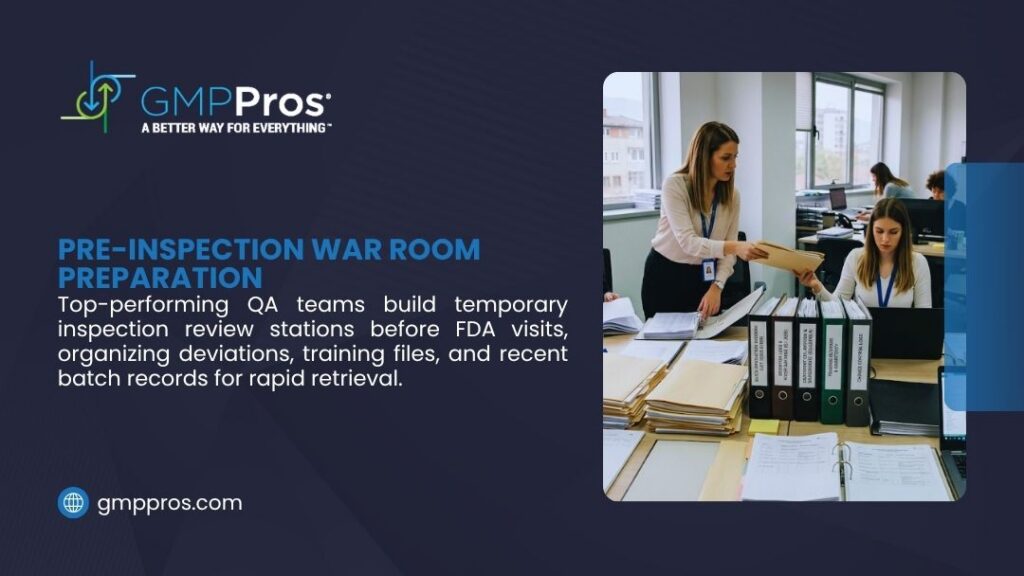
| Rapid review of the five most recent batches for highest-risk products | QA Reviewer | Prioritize by volume and regulatory history |
What to Have Ready at the Desk
FDA investigators often request supporting documents alongside the batch record itself. Have the following well-organized and accessible:
- Current approved master batch records for all products in scope
- Deviation and investigation records linked to any batch under review
- Training records for all operators who signed the batch records in scope
- SOP references for correction procedures, deviation classification, and QA release
- Form version log confirming what version was current at the time of each batch
For teams that have already found documentation gaps and need a structured path forward, our resource on how to avoid FDA warning letters for batch record deficiencies covers the full remediation framework.
What Does FDA Look for First When Preparing Batch Records for FDA Inspection?
FDA investigators typically start with completeness: every required field filled, every step signed, every deviation referenced.
From there, they look at traceability (can every entry be attributed to a specific person and time?) and correction integrity (are any entries altered without explanation?).
A record that is complete, traceable, and clean from a correction standpoint gives the inspection a strong start.
Frequently Asked Questions
What does FDA look for first in batch records?
FDA looks first in batch records for completeness, traceability, signatures, timestamps, and evidence that the process followed the approved master record.
What are the most common batch record mistakes?
Most common batch record mistakes are absent entries, poor corrections, outdated form versions, unsigned steps, and weak deviation documentation.
How should batch record corrections be made?
Batch record corrections should be made as a single-line strike-through that leaves the original legible, with initials, a date, and a reason noted nearby.
What is the difference between a master batch record and an executed batch record?
The master batch record is the approved production template. The executed batch record documents what actually happened during a specific production run.
Are electronic batch records easier to inspect?
They can reduce error rates and accelerate review, but only when access controls, audit trails, and system validation are fully governed.
Build a System That Holds Up Under Any Inspection
A batch record that passes FDA review is the result of a system that works every day, not a cleanup effort when an inspection is scheduled. The preparation, the review discipline, and the correction habits are built over time at the process level.
GMP Pros engineers embed inside FDA-regulated manufacturing facilities to help QA and production teams build those habits directly within operations. From batch record design to QA review frameworks, the work is hands-on and production-floor based.If your facility has upcoming inspections, recent 483 observations, or a documentation system that has not kept pace with production volume, connect with the GMP Pros team today.